Light Mode

The gap is the easy part to find. What matters is what it does next: hold, fill, or fill partway and keep going. Trade Ideas tracks both.
Free account, just an email. No card. Live access for a limited time.

Named to the Inc. 5000 list of America’s fastest-growing private companies six years in a row (2017–2022).

Investopedia: Best Short Term Stock Screener, 2024
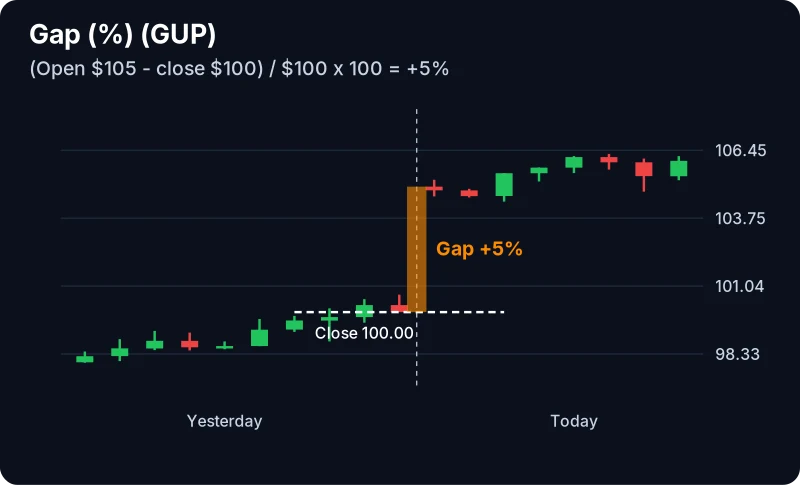

Find it. Gap (%) ranks gaps by percent, Gap ($) by dollars, and Gap (Bars) by how big the gap is next to the stock’s normal bars. Add Relative Volume so you only see gaps with volume behind them.
Watch it. Gap Up Reversal and Gap Down Reversal fire the first time a gap crosses back through yesterday’s close, filling the gap. False Gap Up Retracement and False Gap Down Retracement fire when a gap fills partway, then turns and keeps going.
The gap Top List (Screener) works in the Web Dashboard. The fill and reversal alerts are Streaming Alerts (Scanner). Streaming Alerts run in TI Pro, our desktop app for Windows (on a Mac, through Parallels). Gap and Go as a momentum setup lives on the momentum scanner page. Earlier in the day, use the premarket scanner.
It finds stocks that open well above or below yesterday’s close. Then it keeps watching: does the gap hold, fill, or fill partway and turn?
Finding gaps is easy. Knowing which ones are holding is what the alerts are for.
Gap (%) is the one most traders sort by, since it treats a $10 stock and a $100 stock the same way.
Gap ($) is handy when you trade one price range. Gap (Bars) compares the gap to the stock’s normal bar size, so a quiet stock with a modest gap still stands out.
False Gap Up Retracement and False Gap Down Retracement watch what a gapping stock does after the open. A stock gaps up, sells off from the open, then works back to the opening price. That round shape on the intraday chart is an intraday cup pattern on a gap, which some traders call a horseshoe. It is not a classic cup and handle, which takes weeks to form.
FGUR fires when a gap up fills part of the way and then turns back up. FGDR is the mirror image on a gap down. Traders use them to see gaps that held after the first shakeout.
Gap and go. A gap with volume that holds above the open.
Gap fill. Some traders trade back toward yesterday’s close when a gap weakens.
False gap retracement. The gap fills partway, then turns and keeps going the original way.
The first minutes after the open are fast and spreads are wide. Many traders wait for the first bars to form.
A gap on light volume tells you little. Without Relative Volume, the list fills up with thin names.
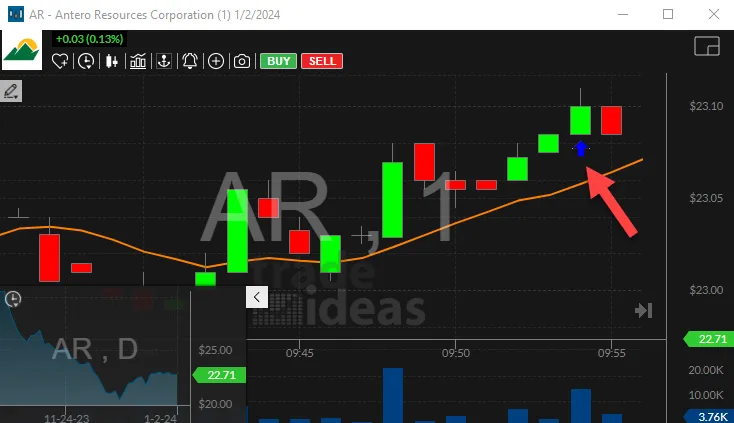
Right after the open, price sets a range, then breaks above it and the alert fires. Traders who play gaps watch the same thing: does the stock hold above its early range, or slip back into it?
Free account, just an email. No card. Live access for a limited time.
It finds stocks that opened well above or below yesterday’s close, then follows what the gap does. You see gaps that hold, gaps that fill, and gaps that fill partway and keep going.
A stock gaps up when it opens higher than the last price of the day before. The space on the chart between yesterday’s close and today’s open is the gap.
A gap down is the same thing the other way: the stock opens below yesterday’s close. Gaps often come from news, earnings or a move in the whole market overnight.
Sort a Top List (Screener) by Gap (%) with a minimum like 5 for gaps of 5% or more. Add Relative Volume so you only see gaps with real volume.
Gap (%) measures the gap as a percent of price, so a $2 gap on a $10 stock ranks above the same $2 gap on a $100 stock. That keeps cheap and expensive stocks on the same scale.
You can try it with a free account, just an email, no card. Live access is for a limited time. After that it is part of a paid plan.
The fill alerts, like Gap Up Reversal, fire the first time since the open that a gap crosses back through yesterday’s close. False Gap Up Retracement usually fires no more than once per stock per day.
Sort the Gap (%) Top List the other way, or set a maximum like -4. Gap Down Reversal fires when a gap down fills.
Many day traders start at 3% to 5%. Small caps gap more, so some use 10% there.
Not before they happen. After the close, sort by Change Post Market (%) to see what is moving after hours. Those are often the next morning’s gaps.
Past results, including backtests, don't guarantee future results.
Free account, just an email. No card. Live access for a limited time. Ready to buy? See plans & pricing