Light Mode

Some traders fade gaps on purpose. They want to know the moment a gap closes back to yesterday’s price.
Free account, just an email. No card. Live access for a limited time.

Named to the Inc. 5000 list of America’s fastest-growing private companies six years in a row (2017–2022).

Investopedia: Best Short Term Stock Screener, 2024
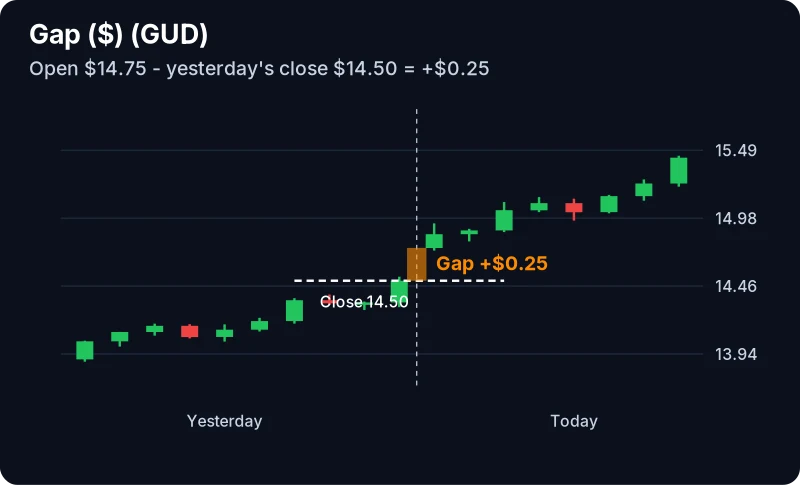
Both alerts show the size of the gap, so you can skip tiny fills. Use Gap ($) with a minimum of 0.50 and a maximum of -0.50. That keeps gaps of at least $0.50 up or down, the ones worth fading.
Example numbers, not a real trade
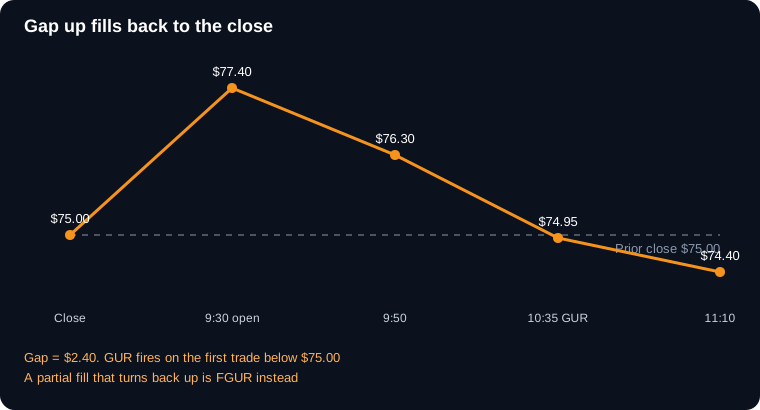
A partial fill that turns and keeps going is a different setup. That one lives on the gap and go scanner.
Gap fill traders bet the opening move was too much. That can work, but fading a gap that still has buyers behind it gets expensive fast. The point of the scan is to wait until the market shows its hand.
Some rules of thumb fade traders use. Bigger gaps on no news fill more often than gaps on real earnings. Gaps into an old resistance level tend to stall there. And a gap that has already given back half of itself by 10:00 has shown you who is in charge.
A starting recipe: a gap of at least $0.50 either way (Gap ($) minimum 0.50, maximum -0.50), price over $10, relative volume over 1.5 so you aren’t fading a sleepy name. Then let the gap up reversal and gap down reversal alerts mark the moment the gap is gone. Each one fires the first time price crosses yesterday’s close after the open.
Example, made-up numbers. A $90 stock gaps up to $93.50 on an analyst note, no new numbers from the company. It tops out at $94 in the first ten minutes and starts leaking lower. By 10:20 it is at $91.80, half the gap gone. At 11:05 it trades $89.98 and the gap up reversal alert fires. A trader who sold short at the half-fill had the alert as the target. A trader who waited for the alert knows the gap is officially closed and can look for a short under the close.
Gap downs fill the other way. A $25 stock gaps down to $23.80 on a market wobble, holds $23.50, and grinds higher all morning. When it trades back over $25, the gap down reversal alert goes off. Some traders buy that cross, with a stop back under the close.
One honest warning. A gap can fill weeks later, or never. The alert tells you when it happens today; it doesn’t predict that it will.
Size matters on fades more than most setups. A gap that refuses to fill can run against you all morning, so many fade traders start with a smaller position and add only after the half-fill shows sellers are in control. And if a stock with real earnings news is holding its gap into 10:30, most experienced faders just leave it alone and look for an easier one.
Free account, just an email. No card. Live access for a limited time.
About gaps that close.
Price trades back to the prior day’s close, erasing the opening gap.
No. Some fill the same day, some weeks later, some never. Treat any rule of thumb about it with care.
It fires on the first cross through the close since the open, so you don’t get a stream of repeats.
It shows sellers (or buyers, on a gap down) have taken back half the opening move. Many fade traders watch that level before the full fill.
Past results, including backtests, don't guarantee future results.
Free account, just an email. No card. Live access for a limited time. Ready to buy? See plans & pricing