Light Mode

Every ORB break, any timeframe, every stock, the second it happens.
ORB breakouts and breakdowns on 1, 5, 15, 30 and 60-minute opening ranges.
Free account, just an email. No card. Live access for a limited time.

Named to the Inc. 5000 list of America’s fastest-growing private companies six years in a row (2017–2022).

Investopedia: Best Short Term Stock Screener, 2024
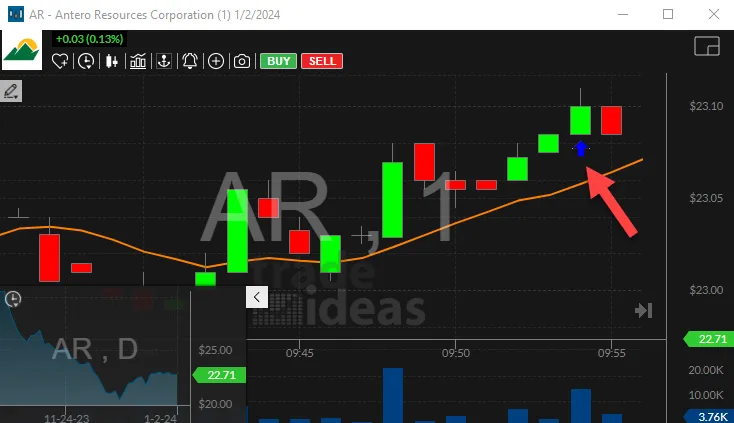
The opening range is the high and low of the first bar of the day. Trade Ideas fires the first time price breaks it.
Streaming Alerts (Scanner) run in TI Pro, our desktop app for Windows (on a Mac, through Parallels).
Stocks breaking the high or low of the first bar of the day. The first bar sets a range; a break of it is the first real direction many traders trade.
| Alert | What it does |
|---|---|
| 1 Minute Opening Range Breakout (ORU1) | 1 minute ORB up. |
| 5 Minute Opening Range Breakout (ORU5) | 5 minute ORB up. |
| 15 Minute Opening Range Breakout (ORU15) | 15 minute ORB up. |
| 30 Minute Opening Range Breakout (ORU30) | 30 minute ORB up. |
| 60 Minute Opening Range Breakout (ORU60) | 60 minute ORB up. |
| 1 Minute Opening Range Breakdown (ORD1) | 1 minute ORB down. |
| 5 Minute Opening Range Breakdown (ORD5) | 5 minute ORB down. |
| 15 Minute Opening Range Breakdown (ORD15) | 15 minute ORB down. |
| 30 Minute Opening Range Breakdown (ORD30) | 30 minute ORB down. |
| 60 Minute Opening Range Breakdown (ORD60) | 60 minute ORB down. |
| Bullish Opening Power Bar (OVO5U) | Bullish opening power bar: one tick over a strong first 5 minute bar. |
| Bearish Opening Power Bar (OVO5D) | Bearish opening power bar. |
Short ranges break early and often. Longer ranges break later and less often, with a bigger range behind them. Many traders run 5 and 15 together.
Bullish Opening Power Bar (OVO5U) needs a big first 5 minute bar that opens near one end and closes near the other, with the market doing the same. It fires one tick past the bar.
The opening range is the high and low of the first bar after 9:30 a.m. ET. On a 5 minute chart, it is the first five minutes; on a 30 minute chart, the first half hour.
Opening range breaks on stocks that gapped are a common day-trade setup. Add Gap (%) (GUP) at a min of 3 to the window so you only see ORBs on gappers.
5 Minute Opening Range Breakdown (ORD5) and the other down alerts fire when price breaks the opening low. Many traders short those, or use them as a reason to avoid a long.
Many traders put the stop on the other side of the opening range. A wide first bar means a wide stop, so some skip stocks whose first bar is too big.
The chart at the top shows AR on a 1 minute chart. Price builds a range in the first minutes, then breaks over it, and the alert marks the bar.
Longer ranges suit traders who would rather let the open settle. The 30 and 60 minute alerts fire later in the morning on bigger ranges, and some traders use them as their only morning entries.
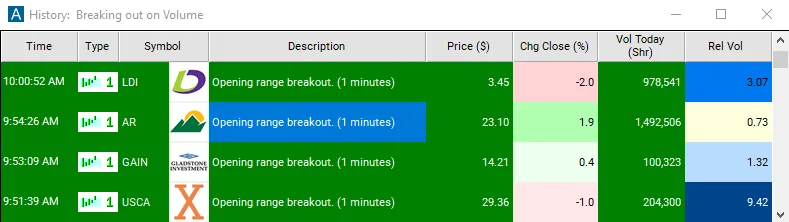
This real window ran the 1 Minute Opening Range Breakout (ORU1) alert. At 9:51:39 a.m. ET, USCA broke its 1 minute opening range at $29.36 on Relative Volume of 9.42, while down 1.0% on the day. At 10:00:52, LDI broke out at $3.45 on Relative Volume of 3.07. AR fired at $23.10 with Relative Volume of 0.73.
All three are opening range breakouts. The relative volume column is what separates them: USCA was trading more than nine times its normal volume for that time of day, AR less than normal. Most ORB traders would look at USCA and LDI first.
Shorter ranges fire earlier and more. The 1 and 2 minute versions fire within the first few minutes, often several times on the same stock as price chops. The 5 and 15 minute versions are the most common. The 30 and 60 minute ranges suit traders who want the open to settle, and they give wider stops.
Gap (%) (GUP) with a min of 3 limits the window to stocks that gapped up. An opening range break in the direction of the gap is the classic gap-and-go. A break the other way, with Gap Up Reversal (GUR) firing, is a gap that is failing.
Some traders want the opening range break and a break of the premarket high together. Add Position in Pre-Market Range (RPM) at a min of 100: the alert then only shows stocks that are also above their premarket high.
Bullish Opening Power Bar (OVO5U) fires one tick above the high of a bullish 5 minute opening bar that the market confirmed. It is a narrower setup than a plain ORB: the first bar has to be strong and the market has to agree. Bearish Opening Power Bar (OVO5D) is the bearish version.
The usual stop is the other side of the opening range. If the range is wide, some traders use the middle of the range instead. Targets are often set at one or two times the range height.
Example numbers, not a real trade
An ORB on a stock while the index breaks its own opening range the same way has the wind at its back. Watch S&P Change (5 min) (Spy5), the S&P change over 5 minutes, in the same window.
Low float stocks can break their opening range by 10% in a minute. Add Float (Float) with a max of 20 million and Relative Volume (RV) with a min of 3 for a low float ORB window. Keep Halt (HALT) on next to it: these are the stocks most likely to halt right after the break.
If you miss the first break, many traders wait for price to come back and hold the top of the range. That retest gives a closer stop. If it falls back into the range instead, the break failed.
Early breaks fail often. Wide first bars mean wide stops.
Test your rules in a simulated account first.
Free account, just an email. No card. Live access for a limited time.
Plain answers to what traders search for.
A scanner that alerts when a stock breaks the high or low of its first bar of the day.
Opening ranges of 1, 2, 5, 10, 15, 30 and 60 minutes, each with a breakout and a breakdown alert. That is 14 ORB alerts in all.
Yes, 5 Minute Opening Range Breakout (ORU5) and 5 Minute Opening Range Breakdown (ORD5).
You can try it with a free account, just an email, no card. Live access is for a limited time, then it is part of a paid plan.
Streaming Alerts run in TI Pro, our desktop app for Windows. On a Mac, traders run it through Parallels. Top Lists (Screeners) also run in the Web Dashboard, in a browser.
Yes, 15 Minute Opening Range Breakout (ORU15) and 15 Minute Opening Range Breakdown (ORD15).
The usual stop is the other side of the opening range. If the range is wide, many traders use the middle of the range instead to keep the risk smaller.
There is no single best one. The 5 and 15 minute ranges are the most common. The 1 and 2 minute versions fire very early and more often fail; the 30 and 60 minute versions fire later with wider stops.
Past results, including backtests, don't guarantee future results.
Free account, just an email. No card. Live access for a limited time. Ready to buy? See plans & pricing