Light Mode

A stock that opens well above yesterday’s close has news, buyers, or both. Trade Ideas ranks those gap ups before the bell and keeps watching them after it.
Free account, just an email. No card. Live access for a limited time.

Named to the Inc. 5000 list of America’s fastest-growing private companies six years in a row (2017–2022).

Investopedia: Best Short Term Stock Screener, 2024

A gap up scan is mostly about leaving things out. Start wide, then narrow it:
Example numbers, not a real trade
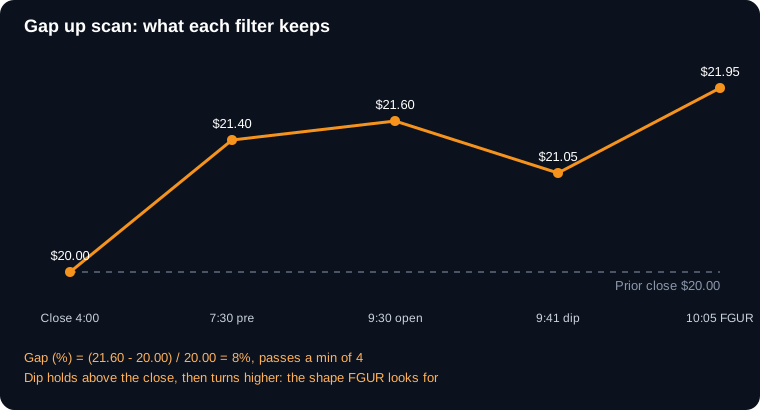
Want it ready-made? The Premarket channel on the Channel Bar opens a full layout of premarket alerts and Top Lists (Screeners) in one click. Streaming Alerts (Scanner) run in TI Pro, our desktop app for Windows (on a Mac, through Parallels).
Most gap up traders we talk to run the same few steps every day, and they do them in the same order so nothing gets skipped when the bell is close.
Here is how that played out on a made-up but typical morning. A $14 stock reports earnings after the close and prints $15.40 at 8:00, a 10% gap. Premarket volume is 600,000 shares, about four times normal. At the open it pushes to $15.70, dips to $15.10 by 9:41, stays above the $14 close, and turns higher. The retracement alert fires at $15.45. Your stop goes under the $15.10 dip, so you know your risk before you click anything.
The part that trips up new traders is size. A 10% gap in a $3 stock and a 10% gap in a $300 stock are different animals. If you trade higher priced names, switch the main filter to dollars and set the minimum where a gap actually means something for those stocks, like $3 or $5.
One more habit worth stealing: save the scan as its own window and give it a plain name like “Morning gaps 4%.” Next morning it is already there with the same settings, and you can tweak one number at a time and see what changed. That beats rebuilding it from memory at 8:55 with your coffee going cold.
Mistakes we see a lot with gap ups: buying the first green candle at 9:30 before the open settles, holding a gapper that already lost yesterday’s close because it “should” come back, and running a list so wide that nothing gets real attention. Tight list, clear line, stop decided ahead of time. That covers most of it. The scanner does the looking so you can spend your energy on those three things.
Free account, just an email. No card. Live access for a limited time.
Short answers to what traders ask most about gap ups.
A gap up is when a stock opens, or trades premarket, above the prior day’s close, leaving an empty space on the chart. A $20 stock that opens at $21.60 has an 8% gap up.
Many traders build the list between about 8:00 and 9:30 a.m. ET, once premarket volume shows up, then trim it in the first 15 minutes after the open. Gaps found at 4:30 a.m. often look different by 9:30.
A gap up is the opening move. Gap and go is a setup on top of it: the gap holds and the stock keeps going instead of filling. See the gap and go scanner for that part.
Most traders do better with three to five. The scanner can show fifty, but you can only plan a handful of trades well in the first half hour.
Past results, including backtests, don't guarantee future results.
Free account, just an email. No card. Live access for a limited time. Ready to buy? See plans & pricing