Light Mode

Bad earnings, a downgrade, a sector selloff. Gap downs come with a reason, and the first hour often tells you whether sellers are done.
Free account, just an email. No card. Live access for a limited time.

Named to the Inc. 5000 list of America’s fastest-growing private companies six years in a row (2017–2022).

Investopedia: Best Short Term Stock Screener, 2024
Set Gap (%) to a maximum of -3 and the list shows stocks down 3% or more from yesterday’s close. From there, two alerts split the list:
Example numbers, not a real trade
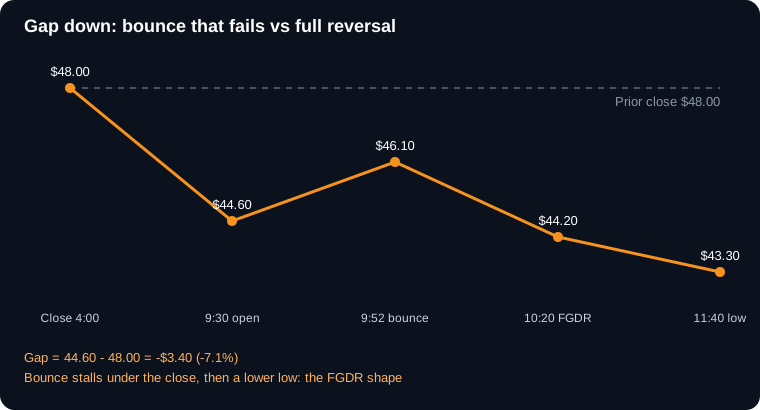
Add Relative Volume so a quiet drift lower doesn’t crowd out real selling. Short sellers and dip buyers read the same list from opposite sides.
A stock that opens down 8% is not automatically a short, and it is not automatically a bargain either. The first thing to sort out is why it dropped, because the reason tends to shape the rest of the day.
A working recipe a lot of traders start from: gap of -4% or worse, at least 200,000 shares premarket, relative volume of 2 or more, price over $5 so the spreads aren’t brutal. Then sort by the size of the gap and read the headlines from the top down.
Example, numbers made up. A $60 stock guides lower after the close and opens at $54, down 10%. It bounces to $56.20 by 9:50, which is still well under the $60 close, then stalls. At 10:25 it breaks back under $54 and the false gap down retracement alert fires. A short seller might use the $56.20 bounce high as the line in the sand. A dip buyer looking at the same chart waits, because nothing has turned yet.
Now flip it. Same $60 stock, but it is down with the whole sector on a rate scare. It opens at $55.50, holds $55 for twenty minutes, then climbs. At 11:15 it trades back through $60 and the gap down reversal alert tells you the gap is gone. Same filter, opposite story.
Gap downs move fast and the spreads widen at the open. Give the first five minutes a chance to settle unless you have done this a lot. And keep your size smaller than you would on a gap up, since sharp short squeezes happen on these too.
A few things to skip on the gap down list. Stocks under a dollar with wide spreads, because a ten cent spread on a fifty cent stock eats your edge alive. Names with no volume, since the price can jump around without anybody really trading. And anything halted or about to report again. Filter those out once, save the scan, and your morning list gets a lot cleaner without any extra work on your part.
Free account, just an email. No card. Live access for a limited time.
What traders ask about stocks that open lower.
A stock that opens below the prior day’s close. A $48 stock opening at $44.60 gapped down $3.40, about 7%.
Some do, many don’t, and it varies by stock and day. That is why the scanner splits them: one alert for gaps that keep falling, another for gaps that reverse through the close.
Yes. The gap filters read the latest premarket print before the open, so the list builds before 9:30.
No. Plenty of gap downs reverse, especially when the drop came from the market and not the company. The scanner shows which way it is going; the decision is yours.
Past results, including backtests, don't guarantee future results.
Free account, just an email. No card. Live access for a limited time. Ready to buy? See plans & pricing