







 HRV
Streaming Alert (Scanner)
High Relative Volume Alert (HRV)
By Daniel Mirkin, CEO, Trade Ideas. Updated October 2026.
Find stocks trading unusual volume right now, versus their normal for this time of day with Trade Ideas Streaming Alerts (Scanner). High relative volume means a stock is trading at least 50% more volume than its recent average for the same time of day. At 3x or more, the alert says "very high relative volume."
See the crowd arriving before the crowd does.
Free account, just an email. No card. Live access for a limited time.
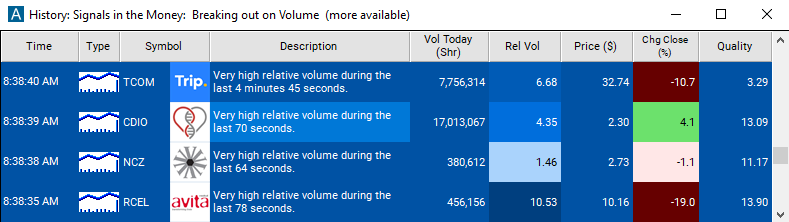
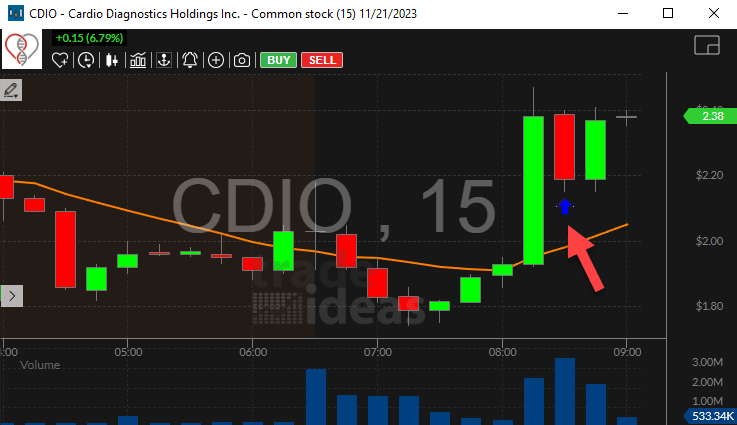
Streaming Alerts show high relative volume the moment a stock starts trading well above its normal pace for that time of day.
How Trade Ideas finds it: The alerts server continuously monitors various properties for each stock and compares these values to historical background information. See Trade Ideas plans and pricing to run it live.
What is high relative volume?
Relative volume compares how much a stock is trading right now with how much it usually trades at this same time of day. A stock that normally trades 50,000 shares by 10:15 and has traded 150,000 is running at three times normal.
High relative volume tells you people are paying attention to a stock today. It does not tell you which direction it will go.
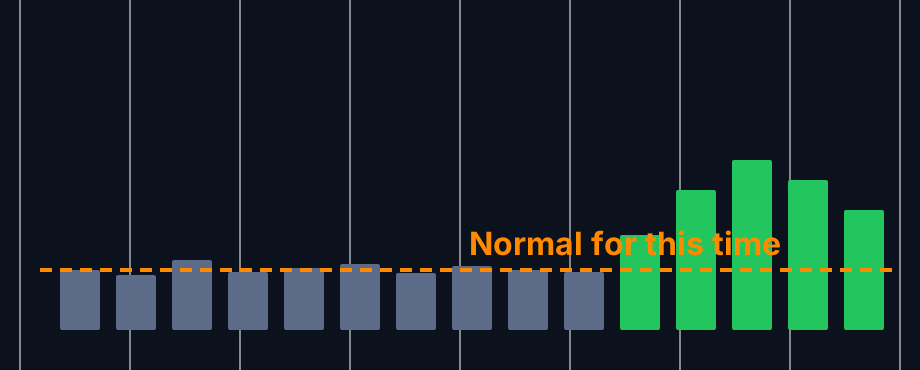
How the High Relative Volume alert measures it
The baseline
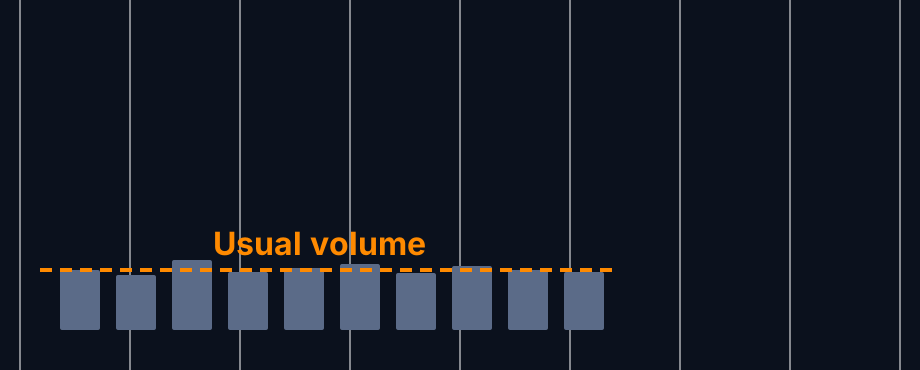
Trade Ideas looks at several recent days, broken into 15 minute pieces, to learn what normal looks like for each stock at each time of day.
The jump
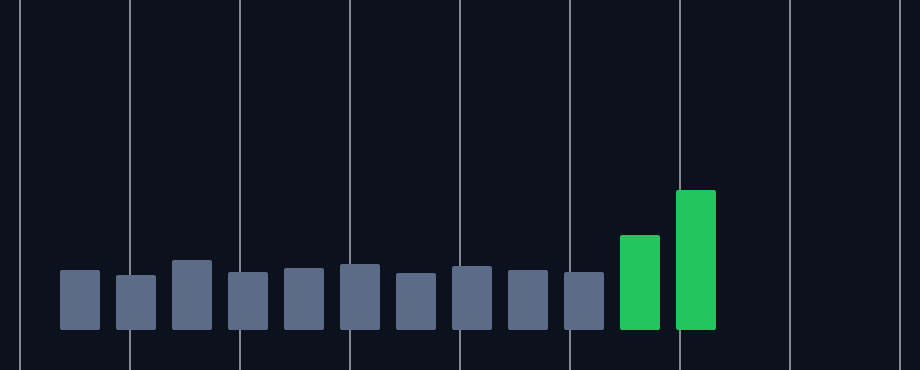
Current volume has to run at least 50% above that baseline before the alert fires.
Very high
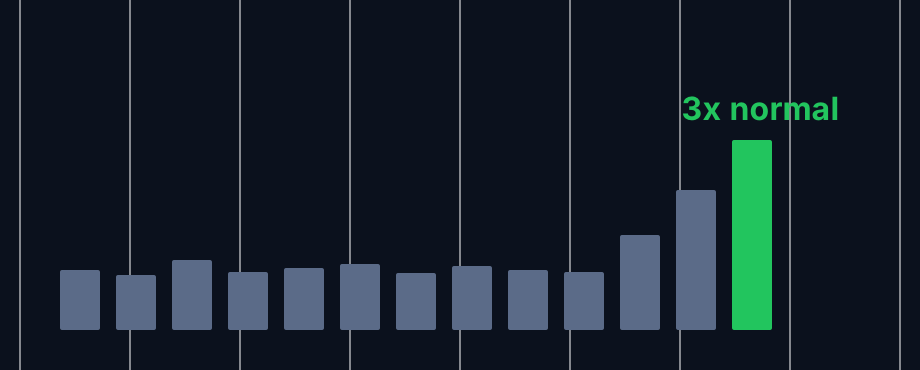
At three times normal or more, the alert description says very high relative volume.
How traders use it
Step 1: Let the Trade Ideas alert find it
Turn on the High Relative Volume alert (HRV). Every stock is compared with its own history for this time of day, so a quiet stock and a busy one are judged fairly. See it live in the Web Dashboard.
Step 2: Wait for the trigger
Trader tip
Most traders do not buy or sell on volume alone. They look at what price is doing while the volume comes in: breaking out, breaking down, or reversing.
Step 3: Entry
Some traders pair HRV with a price alert like a new high or an opening range break and act on that.
Step 4: Exit
Stops are usually set from the price setup, not from volume. Volume just tells you the move has attention. That is common practice, not a recommendation.
Tips
- Use a minimum price and average volume filter so thin stocks do not crowd the list.
- Morning volume is naturally high. Relative volume adjusts for that, raw volume does not.
- News often explains the surge. Check it.
- For longer stretches, try the Strong Volume alert (SV).
Past results, including backtests, are not indicative of future results.
How the High Relative Volume alert works
Settings
This alert appears when a stock is trading on higher volume than normal. Normal volume is based on the average volume of the stock on several recent days, at the same time of day. Historical volume data is broken into 15 minute intervals. Current volume must be up a minimum of 50% over the historical average before this alert is reported.
If the current volume is at least 3 times the historical average, the alert description includes "very high relative volume". Current volume may be smoothed out; if volume in one time period is below average, it will take more volume to cause this alert in adjacent time periods. Distant time periods also affect each other, but to a lesser degree.
This alert is related to the current volume filters.
Default settings
Settings
The alerts server continuously monitors various properties for each stock and compares these values to historical background information. When the current value of one of these properties is unusually high, an alert is reported. By default, the high relative volume alert occurs when a stock is trading at a current volume 50% over the historical average.
Custom settings
Settings
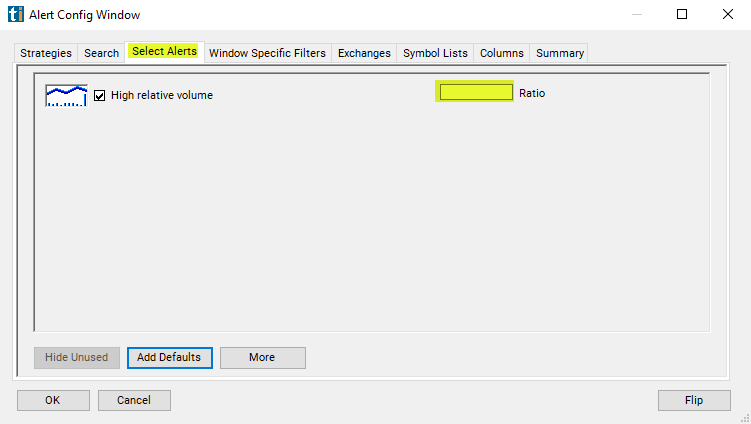
For 'High Relative Volume' alerts, you have the option to use an alert specific filter. This filter is located immediately to the right of the corresponding alert and is always optional. You can decide to leave it blank if you want to receive more alerts, or you can fill it in to restrict the number of alerts you receive. This filter allows you to specify the quality of the alert. When you set a higher number for this filter, you are telling the alerts server to display only alerts that meet a higher quality standard, resulting in fewer alerts being shown.
When setting an alert for 'High Relative Volume', the user can set minimum standards, above those built into the alerts server. Each time the server reports an alert, it divides the current value of the property by the historical value for the property. The user can specify a minimum value for this ratio.
Settings
See the help for each individual alert type to know what parameter the ratio represents. Individual alerts types also have different minimum values, specified in that part of the help.
What the alert shows you
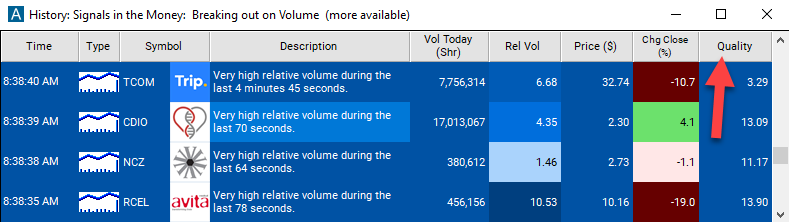
The description of the alert will report the amount of time the stock has recorded high relative volume.
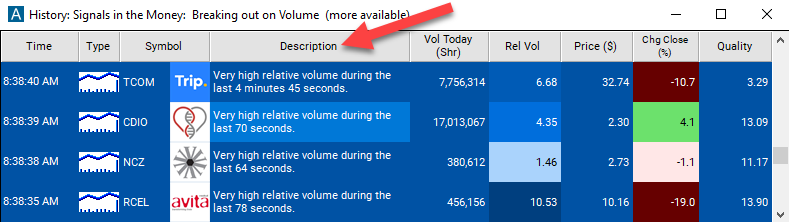
Add the quality column to a scan using the 'High Relative Volume' alert to see the number of times more than its average volume level of the last 15 minute interval.
Filters to pair with the High Relative Volume alert
Categories
FAQ
Which stocks have unusual volume right now?
Turn on the High Relative Volume alert (HRV) in Trade Ideas Streaming Alerts. The alerts server continuously monitors various properties for each stock and compares these values to historical background information.
What is the High Relative Volume alert?
High relative volume means a stock is trading at least 50% more volume than its recent average for the same time of day. At 3x or more, the alert says "very high relative volume."
How do I see fewer, higher-quality High Relative Volume alerts?
Use the optional alert-specific filter immediately to the right of the alert. A higher number tells the alerts server to show only higher-quality alerts, so fewer appear. Leave it blank to see more.
What is relative volume in stocks?
Today's volume compared with the stock's usual volume for the same time of day.
What counts as high relative volume in Trade Ideas?
At least 50% above the historical average for that time of day. Three times or more is labeled very high.
Is high relative volume bullish?
It can go either way. It shows interest, and the price action shows direction.
What is the difference between HRV and Strong Volume?
HRV compares recent volume with normal for this time of day. Strong Volume looks at total volume for the day against the daily average.