Light Mode

VWAP reclaims and breaks on every stock, the second price crosses.
Crosses above and below VWAP, stretched moves away from it, and distance to anchored VWAP levels.
Free account, just an email. No card. Live access for a limited time.

Named to the Inc. 5000 list of America’s fastest-growing private companies six years in a row (2017–2022).

Investopedia: Best Short Term Stock Screener, 2024
VWAP is the average price weighted by volume since the open. Many day traders read above VWAP as buyers in control and below as sellers.
Streaming Alerts (Scanner) run in TI Pro, our desktop app for Windows (on a Mac, through Parallels).
Stocks crossing VWAP, stocks stretched far from it, and stocks sitting right on it. Each is a different setup, and the scanner can show all three.
| Alert or filter | What it does |
|---|---|
| Crossed Above VWAP (CAVC) | Price crosses above VWAP, with statistical confirmation to cut noise. |
| Crossed Below VWAP (CBVC) | Price crosses below VWAP. |
| Positive VWAP Divergence (VDU) | Price stretches 1%, 2%, 3% and more above VWAP, one alert per level. |
| Negative VWAP Divergence (VDD) | The same below VWAP. |
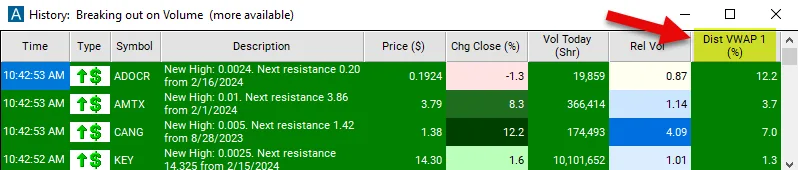
| Distance From VWAP 1 (VWAP) | Distance from VWAP, in percent. A min of 0.001 = above it. |
| Distance From VWAP 2 (DVWAP2) | Distance from a second VWAP level, in percent. |
| Distance From VWAP 3 (DVWAP3) | Distance from a third VWAP level. |
| Distance From VWAP 5 (DVWAP5) | Distance from a fifth VWAP level. |
| VWAP Stop (VWAPStop) | A VWAP-based stop level in dollars, placed outside near-term anchored VWAP. |
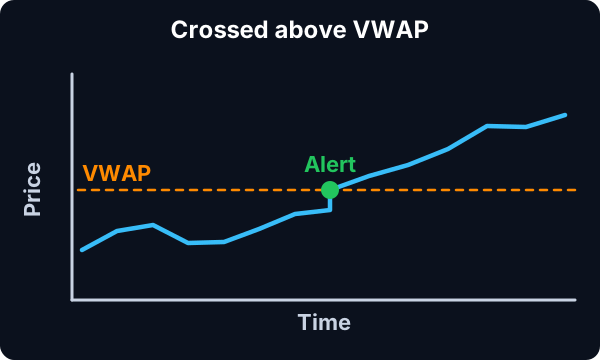
A reclaim is price climbing back above VWAP after trading under it. Crossed Above VWAP (CAVC) fires on that cross. Add Relative Volume (RV) so you only hear about reclaims with volume behind them.
A VWAP bounce, in Trade Ideas terms, is a reclaim after a dip. There is no "touch and hold" alert, so treat a bounce as a cross back above after trading below.
Crossed Below VWAP (CBVC) marks the loss of VWAP. Positive VWAP Divergence (VDU) and Negative VWAP Divergence (VDD) show how far the move has run, one alert at each whole percent.
Stretched moves, 3% or more from VWAP, are where some traders look to fade and others look to press. The alert just tells you it happened.
The DVWAP filters show distance to additional VWAP levels, and VWAP Stop (VWAPStop) places a stop outside near-term anchored VWAP. For how anchored VWAP works, see the anchored VWAP guide.
VWAP is the volume-weighted average price since the open. Every trade counts, and bigger trades count more. By the end of the day it is the average price everyone paid.
Big buyers often use VWAP as a benchmark for their own fills, which is part of why so many traders watch it.
Crossed Above VWAP (CAVC) and Crossed Below VWAP (CBVC) use statistical confirmation, so a stock flickering across VWAP on a few trades does not fire again and again. That makes them cleaner than a raw cross.
Set Distance From VWAP 1 (VWAP) to a min of -0.3 and a max of 0.3 for stocks within 0.3% of VWAP. That is a list of stocks sitting right on the line, before they pick a side.
Positive VWAP Divergence (VDU) fires at each whole percent above VWAP: 1%, 2%, 3% and beyond. A stock 4% above VWAP on a quiet market day is stretched. Some traders fade it; others ride it. The alert just shows where it is.
VWAP has only a few trades behind it right after the open, so it moves a lot in the first minutes. Many traders give it 15 to 30 minutes before reading crosses.
Daily VWAP resets each day. For longer views, traders use anchored VWAP from a key date, like an earnings day. The DVWAP filters and VWAP Stop help with that.
The filter capture at the top shows the Distance From VWAP filter. On a chart, a reclaim looks like price climbing back over the VWAP line after trading below it, and CAVC marks the bar where it happens.
VWAP reclaim (long)
| Alert or filter | Setting |
|---|---|
| Crossed Above VWAP (CAVC) | On. Price crosses back above VWAP. |
| Change From The Close (%) (FCP) | Min 0, so the stock is green on the day. |
| Relative Volume (RV) | Min 1.5. |
VWAP loss (short)
| Alert or filter | Setting |
|---|---|
| Crossed Below VWAP (CBVC) | On. Price crosses below VWAP. |
| Change From The Close (%) (FCP) | Max 0. |
| Spread (Spread) | Max 10 cents. |
Stretching above VWAP
| Alert or filter | Setting |
|---|---|
| Positive VWAP Divergence (VDU) | On. Fires at each whole-percent step above VWAP: 1%, 2%, 3% and more. |
| Relative Volume (RV) | Min 2. |
Distance From VWAP 1 (VWAP) gives the distance from VWAP in percent. Near zero means price is sitting on it. Plus 3% or more on a slow large cap is stretched. On a small cap, 3% is a normal swing. Many traders set the range by the stock’s own volatility: Volatility (%) (VWVP) shows how far a stock normally moves in 15 minutes, in percent. A stock sitting several of those moves away from VWAP is stretched for that name.
Example numbers, not a real trade
VWAP resets every morning, so in the first minutes it moves with every print. Many traders ignore VWAP signals before 9:45 a.m. ET. On thin stocks, a few big trades can drag it around. A Dollar Volume floor helps.
Regular VWAP starts at today’s open. Trade Ideas also tracks VWAP from earlier starting points: VWAP 2 (VWAP2) starts at the previous day’s open, and VWAP 3 through 5 start further back. Distance From VWAP 2 (DVWAP2) shows how far price is from VWAP 2 in percent: a min of 0.001 means above it, a max of -0.001 means below it.
Two-day VWAP hold (long)
| Alert or filter | Setting |
|---|---|
| Distance From VWAP 2 (DVWAP2) | Min 0.001. Price is above the VWAP that started yesterday at the open. |
| Distance From VWAP 1 (VWAP) | Between 0 and 1. Price is also just above today’s VWAP. |
| Crossed Above VWAP (CAVC) | On. The trigger when price reclaims today’s VWAP. |
| Relative Volume (RV) | Min 1.5. |
Read it this way: buyers from yesterday and today are both in profit, and price just came back to where today’s buyers broke even. Many traders treat that as the cleaner VWAP long.
VWAP Stop (VWAPStop) gives a stop level placed outside near-term anchored VWAP, built from the stock’s high and low. Use it as the stop instead of guessing a round number.
VWAP 1 (VWAP1) is the dollar value of today’s VWAP itself. Paired with Price (Price), it lets you see the gap in dollars as well as percent, which is easier to use when setting a stop.
VWAP crosses happen often on choppy stocks. Volume and spread filters matter.
VWAP resets each day. Early in the session it moves a lot.
Test your rules in a simulated account first.
Free account, just an email. No card. Live access for a limited time.
Plain answers to what traders search for.
A scanner that shows stocks crossing, near or stretched from VWAP. Trade Ideas streams VWAP crosses and divergence alerts on every US stock.
Turn on Crossed Above VWAP (CAVC) and add Relative Volume.
Trade Ideas reads a bounce as a cross back above VWAP after a dip. There is no touch-and-hold alert.
The DVWAP filters show distance to other VWAP levels, and VWAP Stop gives a level outside near-term anchored VWAP.
Trade Ideas runs on its own: TI Pro on Windows (Mac via Parallels) and Top Lists (Screeners) in the Web Dashboard.
You can try it with a free account, just an email, no card. Live access is for a limited time, then it is part of a paid plan.
Price is above the average price paid today, weighted by volume. Many traders read it as buyers in control.
VWAP is built from the session's trades. Most traders read it after the open.
Past results, including backtests, don't guarantee future results.
Free account, just an email. No card. Live access for a limited time. Ready to buy? See plans & pricing