
Summer Market Trends 2026: How Inflation, AI, and Policy Shifts Are Redefining Seasonal Stock Patterns
Summer Market Trends 2026: How Inflation, AI, and Policy Shifts Are Redefining Seasonal Stock Patterns
Summer trading has always had its own rhythm. Volume can thin out, sector rotation can get sharper, and price moves can become harder to trust without confirmation.
But Summer 2026 is not just a normal seasonal market.
Inflation is still a major catalyst. Fed policy remains a key driver of risk appetite. AI continues to pull attention toward semiconductors, software, data centers, power demand, and mega-cap tech. Energy prices are also adding pressure across sectors that traders may not always associate with oil.
For active traders, the question is not simply, “What usually works in summer?”
The better question is:
Where are momentum, volume, and relative strength showing up right now?
That is the difference between trading old seasonal assumptions and trading the actual market in front of you.
Markets are moving faster than seasonal patterns alone can explain. Use Trade Ideas AI Signals to find real-time setups based on momentum, volume, and changing market conditions.
Find Real-Time AI Trade Setups
Why Seasonal Patterns Need Real-Time Confirmation
Seasonal stock patterns can be useful, but they should not be treated like fixed rules.
In a typical summer, traders may expect lower volume, slower institutional participation, and more uneven price action. Some sectors may also attract more attention depending on consumer demand, energy prices, or earnings expectations.
The problem is that 2026 has too many active catalysts for traders to rely on seasonality alone.
A single inflation report, Fed comment, AI earnings surprise, or energy price spike can shift market leadership quickly. A sector that looked weak in the morning can become the strongest group by the afternoon. A breakout that looks clean on a chart can fail if volume is not there.
That is why active traders need confirmation.
Before acting on a seasonal idea, traders should ask:
- Is volume expanding?
- Is the move happening across the sector or only in one stock?
- Is the stock showing relative strength?
- Is the setup holding after the opening move?
- Is the move supported by news, earnings, macro data, or unusual activity?
Seasonality can give traders a starting point. Real-time data should decide whether the setup is worth trading.
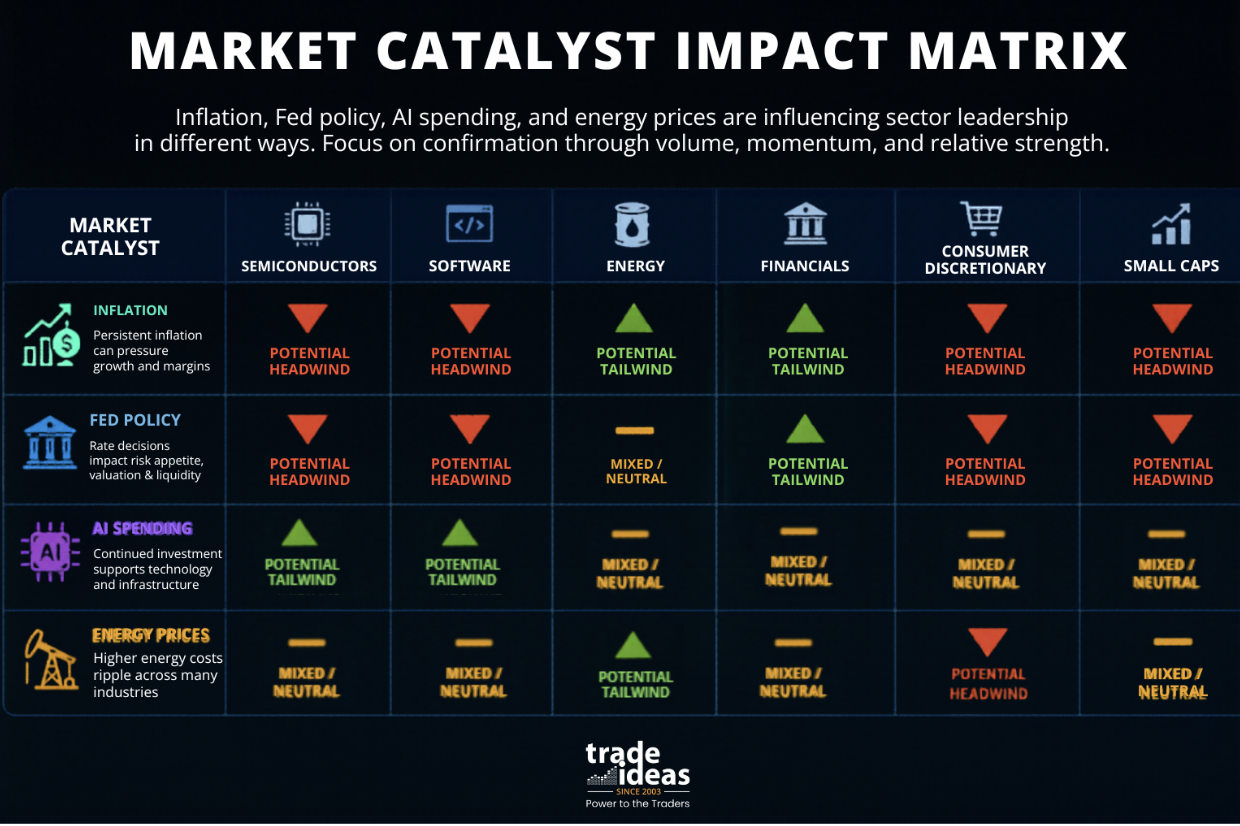
Summer 2026 Market Catalyst Impact Matrix: Inflation, Fed policy, AI spending, and energy prices can influence sectors differently. Traders should focus on confirmation through volume, momentum, and relative strength rather than assumptions.
Inflation: Watch Volume, Gaps, and Sector Rotation
Inflation matters to traders because it can move markets fast.
When inflation comes in hotter than expected, rate-sensitive stocks can weaken. Growth stocks may lose momentum. Consumer discretionary names can come under pressure. Financials, energy, materials, and defensive sectors may react differently depending on how traders interpret the data.
For Trade Ideas users, the practical move is not to predict the CPI number. It is to watch how the market reacts after the number is released.
That means scanning for:
- Pre-market gaps
- Relative volume spikes
- Sector strength and weakness
- Stocks holding above key levels after the open
- Stocks reversing after the first reaction
- Unusual momentum in inflation-sensitive sectors
A CPI report can create a short-term move, but the tradable signal often comes from confirmation after the first wave of volatility.
This is where real-time stock scanners matter. Instead of guessing which stocks should move, traders can track which stocks are actually attracting volume, breaking ranges, or holding strength while the broader market digests the data.
Fed Policy: Rate-Sensitive Setups Need Discipline
Fed policy remains one of the biggest drivers of market behavior in 2026.
For traders, the rate decision itself is only part of the story. The market often reacts just as much to the wording, tone, and expectations around what comes next.
That can affect:
- Small caps
- Regional banks
- Real estate stocks
- High-growth technology
- Consumer discretionary names
- Highly shorted momentum stocks
- Treasury-sensitive sectors
Fed-related trading can be risky because the first move is not always the real move. Stocks may spike, fade, reverse, and then settle into a different trend after traders process the statement and commentary.
The key is to avoid trading the headline alone.
A better workflow is to watch for confirmation:
- Which sectors hold up after the first reaction?
- Which stocks keep making new highs or lows after the initial volatility?
- Are breakouts supported by volume?
- Are rate-sensitive groups moving together?
- Is the broader market confirming the move?
Fed days reward preparation and discipline. Traders should know what they are watching before the announcement, then use real-time alerts to identify what is actually moving after the market reacts.
AI Momentum: Track Strength Beyond the Headlines
AI is still one of the most important market themes, but traders need to look beyond the obvious names.
The AI trade is no longer limited to a few mega-cap stocks. It now touches multiple areas of the market, including:
- Semiconductors
- Cloud infrastructure
- Software
- Data centers
- Cybersecurity
- Power generation
- Utilities
- Cooling and infrastructure providers
That creates more ways for traders to build watchlists and scan for opportunity.
The key is to separate headline hype from tradable strength.
A stock mentioning AI is not enough. Traders should look for evidence that buyers are actually stepping in.
Useful signals include:
- Unusual relative volume
- Sector-wide strength
- Breakouts from tight ranges
- Strong earnings reactions
- Continuation after the first gap
- High relative strength compared with the broader market
- AI-related sympathy moves across connected industries
For Trade Ideas users, AI-related setups can be tracked through custom scans, watchlists, alerts, and AI Signals. The goal is not to chase every AI headline. The goal is to find the names where price, volume, and momentum confirm that traders are paying attention.
Energy Prices: Volatility Can Move More Than Oil Stocks
Energy is another summer catalyst traders should not ignore.
Oil and fuel prices can affect more than energy producers. They can also influence airlines, transports, shipping, consumer discretionary stocks, industrials, and inflation expectations.
That matters because energy-related moves can create second-order trading opportunities.
For example:
- Rising oil prices may support energy stocks
- Higher fuel costs may pressure airlines and transports
- Inflation concerns may hit consumer-sensitive stocks
- Commodity moves may affect materials and industrial names
- Energy volatility may change market expectations around Fed policy
Traders should avoid looking at energy in isolation. A move in crude oil can ripple through multiple sectors.
A simple way to approach this is to build watchlists around both direct and indirect energy exposure. Then use volume and relative strength to see where traders are actually positioning.
Sector Rotation: Do Not Assume Leadership
One of the biggest risks in summer trading is assuming that last year’s leaders will keep leading.
Sector rotation can change quickly when inflation, interest rates, AI spending, and energy prices are all active at the same time.
Instead of assuming which group should lead, traders should monitor:
- Which sectors are gaining relative strength
- Which sectors are holding gains after the open
- Which groups are showing unusual volume
- Which sectors are breaking out together
- Which weak sectors are failing to bounce
- Which stocks are moving with sector support versus moving alone
This matters because isolated moves can fade quickly. Sector-supported moves often have stronger confirmation.
Trade Ideas users can approach this by building scans around relative volume, price movement, sector strength, and watchlist behavior. The point is to let the market show where attention is moving instead of forcing a seasonal bias onto the trade.
Backtesting: Check the Setup Before Trusting It
In a market driven by macro headlines and fast rotation, traders need to be careful with assumptions.
A setup that worked well in a calmer market may not perform the same way when inflation reports, Fed expectations, and AI earnings are driving daily volatility.
That is why backtesting matters.
Before relying on a scanner or alert strategy, traders should ask:
- Has this setup worked recently?
- Does it perform better in high-volume conditions?
- Does it fail during choppy markets?
- What does the risk/reward look like?
- Does the setup need a filter for volume, price, sector, or time of day?
Backtesting does not remove risk, but it helps traders avoid relying only on gut feeling.
Summer Trading Risks to Watch
Summer markets can create attractive setups, but they can also create traps.
The biggest risks include:
- Thin volume
- False breakouts
- Fast reversals
- Overreaction to macro headlines
- Low-quality momentum
- Chasing extended AI names
- Ignoring sector confirmation
- Trading before key data releases
- Holding through Fed-driven volatility without a plan
The solution is not to avoid trading summer markets. The solution is to be more selective.
Traders should focus on setups with confirmation. That means price movement, volume, sector support, and clear risk levels.
If the setup is not clean, it is okay to wait.
What Traders Should Watch This Summer
For Summer 2026, active traders should keep these signals on the screen:
1. CPI and inflation reactions
Do not just watch the report. Watch which stocks and sectors hold up after the report.
2. Fed language and rate expectations
The market can move on changes in tone, not just rate decisions.
3. AI earnings and guidance
Watch for continuation after the first gap. Strong AI names should hold momentum beyond the headline move.
4. Energy price moves
Track direct energy names, but also watch transports, airlines, industrials, and consumer-sensitive stocks.
5. Market breadth
If only a handful of mega-cap stocks are carrying the market, breakouts in weaker names may need more caution.
6. Relative volume
Volume confirms attention. Without volume, summer breakouts can fail quickly.
7. Sector confirmation
A stock moving with its sector often has better support than a stock moving alone.
How Trade Ideas Fits the Workflow
The practical takeaway for Trade Ideas users is simple:
Do not trade the season. Trade the setup.
Summer 2026 has enough macro pressure that traders need real-time confirmation before acting. That means scanning for what is moving now, not relying only on what usually works in summer.
Trade Ideas can support that workflow through:
- AI Signals for real-time trade ideas
- Custom scans for momentum, gaps, volume, and sector movement
- Watchlists for AI, energy, inflation-sensitive, and rate-sensitive names
- Backtesting to review how a setup has performed
- Smart Risk Levels to help define risk before entering
- Brokerage Plus and simulator tools for execution planning and practice
This is not about predicting every market move. It is about building a process that helps traders respond faster and more clearly when the market shifts.
Conclusion: Trade the Market in Front of You
Summer trading in 2026 is being shaped by more than seasonal patterns.
Inflation, Fed policy, AI momentum, energy prices, and sector rotation are all influencing how stocks move. That creates opportunity, but it also makes confirmation more important.
For active traders, the goal is not to guess which summer pattern will repeat.
The goal is to identify where volume, momentum, and relative strength are showing up in real time.
Seasonality can help build the watchlist. Real-time confirmation should drive the trade.
Summer trading requires a workflow built around speed, confirmation, and risk control. Compare Trade Ideas plans and choose the setup that fits how you trade.
Recent Posts
- You don’t need a rocket ship. You need a great trade.
- Don’t Write Off a Stock Just Because It’s Already Up 1,000%
- What Makes This Trade Great: Low-Priced China Stocks Are Back in the Spotlight
- Every Stock Has a Secret Schedule — And Trade Ideas Just Cracked the Code
- When Good Earnings Don’t Matter — How Our AI Caught a Short on a Down Market Day
FAQs About Active Trading in Summaer
1. Is summer usually a bad time for active trading?
Not always. Summer can bring thinner volume and more false breakouts, but it can also create strong short-term moves when news, earnings, inflation data, or Fed commentary hit the market. Traders should focus less on the calendar and more on volume, momentum, and confirmation.
2. Which sectors should traders watch most closely in Summer 2026?
Traders should watch semiconductors, software, energy, financials, consumer discretionary stocks, and small caps. These groups are directly affected by AI spending, inflation, interest rates, and energy prices. The best opportunities usually appear where sector strength, volume, and price action confirm each other.
3. How can traders avoid false breakouts during summer markets?
False breakouts are more common when volume is weak. Traders should look for relative volume, sector confirmation, and follow-through after the opening move. A breakout is more reliable when the stock holds key levels and continues to attract attention beyond the first spike.
4. Should traders change their strategy around Fed or CPI days?
Yes. Fed and CPI days can create sharp reversals and emotional price action. Traders should avoid reacting only to the headline number. It is better to watch how stocks behave after the first move, then focus on confirmed momentum, volume, and defined risk levels.
5. How does AI change summer trading opportunities?
AI creates opportunities beyond mega-cap tech. Traders can watch semiconductors, software, cloud infrastructure, data centers, utilities, and cybersecurity. The key is to avoid chasing AI headlines and instead scan for confirmed strength through unusual volume, breakouts, earnings reactions, and sector-wide momentum.
Start Today