
Don’t Let August Catch You Off Guard: What the Market’s Quietest Month Can Do to Your Portfolio
Don’t Let August Catch You Off Guard: What the Market’s Quietest Month Can Do to Your Portfolio
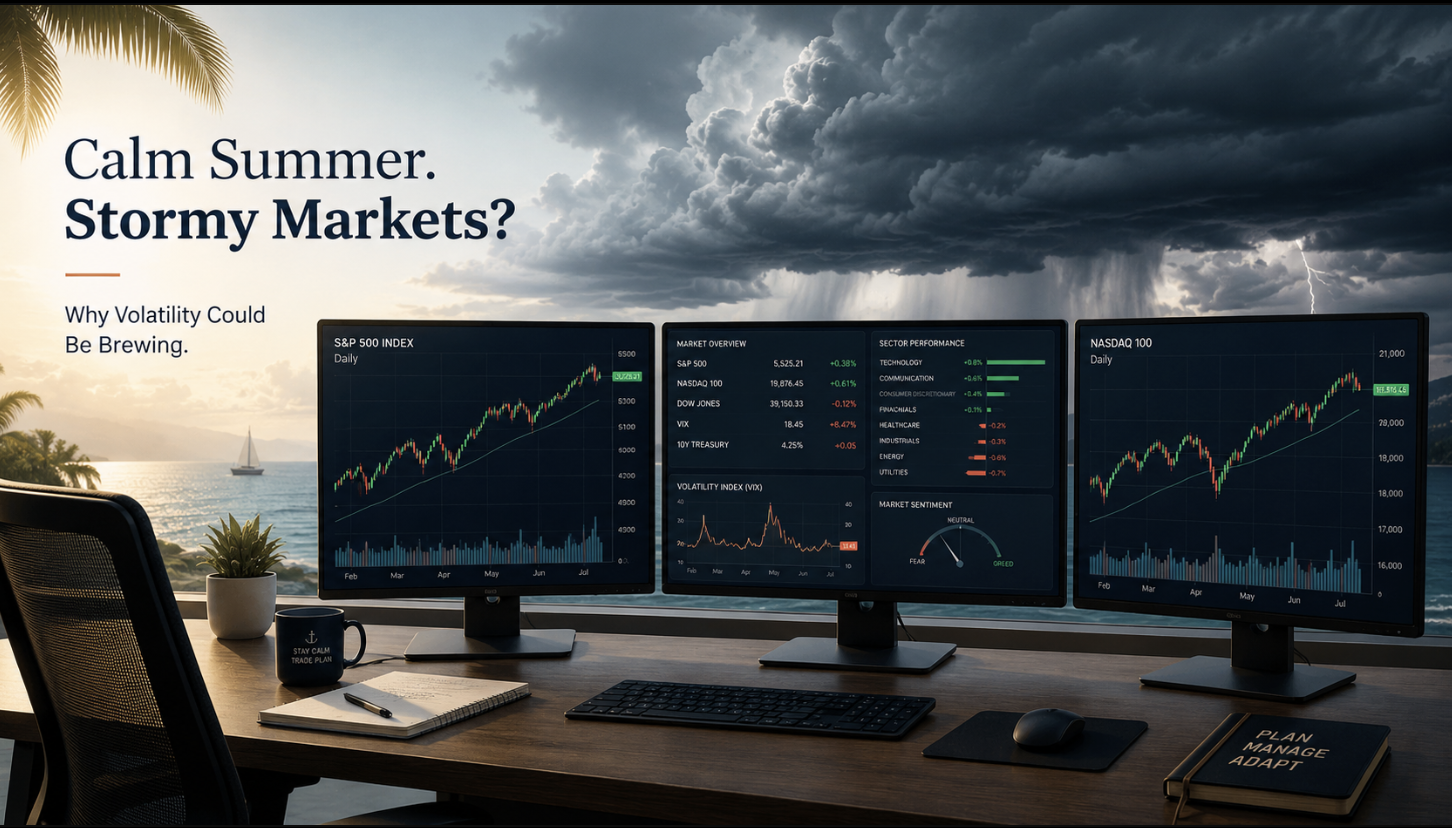
August looks like the easy month. Volume is thin, institutional desks are quiet, earnings have wrapped, and the market feels like it’s on comfortable summer autopilot. Most traders exhale in August — they loosen their stops, run bigger positions than they should, and convince themselves the slow tape is permission to relax; it isn’t. August has one of the most well-documented and consistently underestimated track records in the trading calendar — not for being quiet, but for delivering some of the most violent and unexpected moves of the entire year. The same thin volume that makes August feel slow is the exact environment that turns a normal market move into an outsized one. When buyers aren’t there, price doesn’t drift lower — it falls. August isn’t a month to put on cruise control. It’s a month to prepare more carefully than any other.
What the August Effect Actually Is
The August Effect describes a well-documented seasonal pattern driven by one simple reality: the people who keep markets functioning smoothly are on vacation. Institutional players, portfolio managers, and market makers are operating with reduced staff — and the result is a market that appears calm on the surface but is structurally fragile beneath the surface. Bid-ask spreads widen, price moves happen faster, and a single large order can move a stock in ways that feel completely disproportionate to the news driving it. History has made this point repeatedly and painfully.
- August 2015 — China’s currency devaluation sent the Dow down over 1,000 points in a single session.
- August 2018 — the Turkish lira crisis triggered overnight emerging market contagion.
- August 2024 — the Japanese yen carry trade unwind caused one of the fastest VIX spikes in recent memory.
The pattern is consistent: August volatility doesn’t announce itself. It arrives fast, moves hard, and catches unprepared traders on the wrong side, leaving them with no liquidity to exit cleanly.
Why August Is Different From Every Other Slow Month
Not all slow months are created equal. January can be quiet, and June can drag, but August is uniquely dangerous for specific structural reasons. The institutional vacuum is real — the hedge funds, investment banks, and market makers who normally provide liquidity and dampen volatility are largely absent. The most important risk is that news keeps hitting the tape anyway: geopolitical events, economic data releases, Fed commentary, and earnings stragglers continue on schedule, while the market’s ability to absorb them is dramatically reduced. A headline that causes a 1% move in November can cause a 3% move in August simply because there’s nobody there to cushion it. Layer on top of that the September setup — August is when institutional money quietly begins pre-positioning for September, historically the worst month of the year for equities. That selling pressure can emerge seemingly out of nowhere on an otherwise unremarkable Tuesday afternoon, catching over-leveraged traders completely off guard.
The Specific Risks to Watch in August 2026
Several factors are converging, making this August more loaded than a typical one.
1.) Post-earnings Digestion: Q2 earnings will have just wrapped, and any sector that disappointed will face continued selling pressure into August, with no new catalyst to reverse it. Weak guidance from a major sector in July doesn’t disappear — it creates an overhang that thin liquidity amplifies.
2.) Fed Policy Uncertainty: Any shift in language or a surprise in economic data gets dramatically magnified in low-volume conditions. Which brings us to the single most important date on every trader’s calendar right now — the Federal Reserve’s annual Jackson Hole symposium in late August. Fed chairs have used this stage to signal major policy pivots that moved markets immediately and significantly — and in 2026, with rate policy still the central question for the second half, whatever comes out of Jackson Hole will matter enormously.
3.) The Geopolitical Wildcard: August has historically brought unexpected geopolitical events to light — and with global tensions elevated in 2026, that risk is anything but hypothetical.
4.) Early Pricing: Watch for September fear beginning to price in early — unusual selling in Q2’s leading sectors before most retail traders even realize the rotation has begun.
How Smart Traders Prepare — The Game Plan
The preparation for August isn’t about predicting what will happen. It’s about structuring your portfolio to handle whatever August delivers:
- Right-size your positions—not the month to run at maximum exposure.
- Reduce sizes across the board and give every trade more room to breathe.
- Widen your stops
- Account for increased volatility in your risk parameters before the month begins
- Watch the VIX closely — signal to reduce risk immediately.
- Build your watchlist around stocks with their own specific catalyst
The Opportunity Side of August
August’s danger and opportunity stem from the same source: thin liquidity and amplified moves. For the prepared trader, that amplification works in their favor. Individual stock catalysts are the cleanest opportunity August offers — a stock with a genuine news catalyst gets amplified dramatically because there’s no broad market noise competing for institutional attention. The move is cleaner, faster, and more powerful than the same catalyst would produce in November. In a flat August tape, any sector showing genuine relative strength stands out immediately. Using Trade Ideas’ relative strength scanners helps surface what’s moving independently of the index. When volatility spikes, defensive names, gold, and utilities have historically held up or benefited outright. And the most underrated August setup of all: the September pre-positioning play. As institutional money quietly rotates defensively ahead of September, the early signs appear in August tape weeks before most retail traders notice. Getting ahead of that rotation is one of the cleanest seasonal setups of the entire year.
The One Date Every Trader Must Circle
Every August, the Federal Reserve hosts its annual symposium in Jackson Hole, Wyoming — and it has a long history of moving markets significantly. Ben Bernanke signaled QE2 there in 2010. Janet Yellen set expectations for a rate hike there in 2016. Jerome Powell’s 2022 Jackson Hole speech triggered one of the fastest single-day drops of the year. In 2026, with rate policy still the central market question, whatever the Fed communicates at Jackson Hole will be immediately market-moving. Circle the date. Set your Trade Ideas alerts around key price and volatility levels before the speech begins. Have your response plan ready in advance — because by the time the market reacts, the move is already happening. Jackson Hole is completely predictable in timing and completely unpredictable in impact. Treat it accordingly.
The Bottom Line
August is the month that separates the traders who plan from the traders who react. The quiet is not a green light to relax — it’s a window to prepare. The traders who come out of August in strong shape are never the ones who got lucky. They’re the ones who respected the thin liquidity, identified the real catalysts, and used the right tools to stay ahead of the moves. Come September, the traders who navigated August well will have the capital, the confidence, and the positioning to take full advantage of Q4.
Use Trade Ideas alerts aggressively—in a thin market, being notified the moment a stock hits a key level is more valuable than at any other time. August moves fast. Join Trade Ideas today to set your alerts before the month begins so you can act before the opportunity is already gone.