
The Cheapest Trading Platform Is Often the Most Expensive One You’ll Ever Use: What Makes Trade Ideas Different From the Rest
The Cheapest Trading Platform Is Often the Most Expensive One You’ll Ever Use: What Makes Trade Ideas Different From the Rest
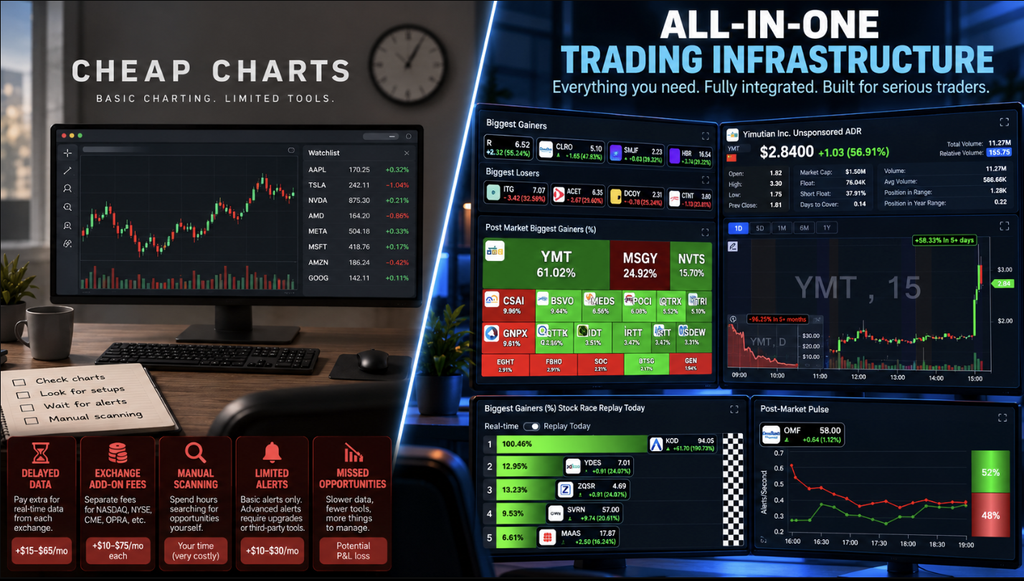
You’re shopping for a trading platform. You pull up a comparison page, see Trade Ideas at $89 per month sitting next to TradingView at $12.95 per month, and the math feels obvious. Same scanner. Same alerts. Same charts. Why pay seven times more? It’s a completely reasonable question — and it’s based on a completely flawed assumption. It’s not our fault, but when people shop, they look at price before the content.
It takes a keen eye to see that not all trading platforms are built for the same purpose, the same trader, or the same market environment. And choosing the wrong one doesn’t just cost you the subscription fee. It costs you the trades you miss because your data was delayed. The setups you never saw because your scanner required a manual refresh. The edge you never developed because the tool you were using was designed for a completely different kind of trading than the one you were trying to do.
The comparison trap is real: when platforms list features side by side with simple checkmarks, everything looks equivalent. But a checkmark doesn’t tell you that one scanner streams alerts the millisecond a setup develops, while the other requires you to click a button to find out what you already missed. The cheapest platform is never the one with the lowest subscription fee. It’s the one that helps you make the most.
The Most Important Question Nobody Asks — What Is This Platform Actually Built For?
Before comparing any two trading platforms feature by feature, there is a more important question that almost nobody asks: what was this platform actually built to do? Three fundamentally different philosophies exist in retail trading.
- The charting canvas: built for visual analysis, drawing tools, and studying price history — excellent for swing traders doing end-of-day work.
- The automated charting layer: built to automate trendlines and patterns on charts you are already looking at — reduces manual work but still focused on chart interpretation rather than market discovery.
- The market-wide search engine: built to continuously scan the entire market in real time and surface opportunities the moment they develop — built specifically for active intraday traders who need the market to find them, not the other way around. Trade Ideas is the third category.
That distinction matters enormously because active day trading requires infrastructure the first two categories were never designed to provide. The mistake most traders make when comparing platforms is evaluating the feature list rather than the infrastructure those features are built on. The feature list tells you what a platform claims to do. The infrastructure tells you how well it actually does it — and that is where every meaningful difference in this comparison lives.
Trade Ideas vs. TradingView — The True Cost of “Cheap” Charts
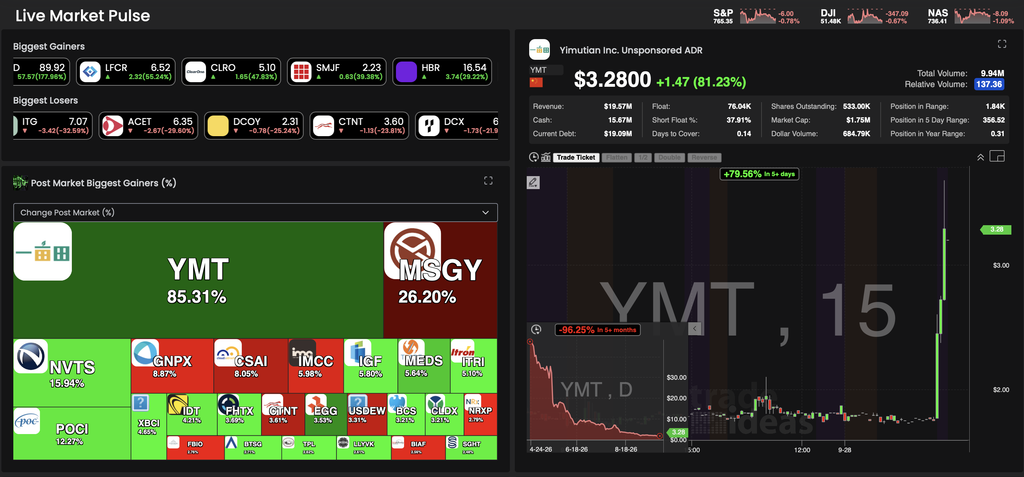
TradingView’s $12.95 monthly price may look like an easy win over Trade Ideas at $89, but that headline price tells only part of the story. Active traders may need to pay extra for real-time exchange data. At the same time, Trade Ideas includes real-time U.S. market data and can scan more than 8,000 equities simultaneously, with unlimited streaming alerts. TradingView excels as a charting canvas, but traders still do much of the opportunity hunting themselves; Trade Ideas goes further with Holly AI, which identifies setups and provides defined entries, targets, and risk levels. Adding live phone, chat, and email support makes Trade Ideas look less like an expensive option and more like a purpose-built platform for traders who need speed, automation, and market-wide scanning.
Trade Ideas vs. TrendSpider — When Similar Prices Hide Very Different Products
At $82 per month for TrendSpider and $89 for Trade Ideas, price is hardly the deciding factor—the real difference is workflow. TrendSpider automates chart analysis on stocks you’re already watching, while Trade Ideas acts as a market-wide discovery engine, scanning thousands of stocks to find opportunities before you ever open a chart. TrendSpider’s scanner also requires manual refreshing, whereas Trade Ideas continuously streams alerts as setups develop in real time.

The AI difference follows the same pattern: TrendSpider helps interpret charts and build conditions, while Holly AI generates actionable trade ideas with defined entries, targets, and stop levels. Add Trade Ideas’ native Brokerage+ integration with IBKR and E*TRADE, and the distinction becomes clear: TrendSpider helps automate analysis, while Trade Ideas is built to automate discovery and execution for active intraday traders.
Trade Ideas vs. StockCharts — Bringing a Knife to a Gunfight
StockCharts is one of Trade Ideas’ most starkly different competitors. At $19.95 per month, StockCharts looks like the budget-friendly alternative to Trade Ideas, but the two platforms are built for fundamentally different jobs. StockCharts excels at swing trading, position investing, and end-of-day technical analysis, relying on static scans and periodically refreshed chart data. Trade Ideas, by contrast, is built for active intraday trading, continuously scanning more than 8,000 equities and delivering real-time alerts as market conditions develop.
The gap widens further with Holly AI, which provides actionable entries, targets, and stop levels, plus native brokerage integration for direct execution. StockCharts remains an excellent tool for studying longer-term trends, but for day traders who need live market discovery and immediate execution, it simply wasn’t designed for the same fight. Traders eventually always realize you get what you pay for.
The Infrastructure Difference
Feature lists tell you what a trading platform can do, but infrastructure determines how well—and how fast—it can actually do it. For active day traders, that difference is critical. Server-side platforms handle heavy computation and push results directly to the user, while client-side systems rely more on browser refreshes and local updates. When a setup can appear and disappear within seconds, delays, refresh cycles, and manual scans can mean missed opportunities. The same applies to pricing: a cheaper subscription can quickly lose its advantage once real-time exchange data and other add-ons are required. And not all “AI” is created equal—there is AI that draws or interprets charts and AI that actively identifies trade setups with defined entries, targets, and risk parameters. Ultimately, infrastructure is what separates a platform built for analysis from one built for real-time trading.
Who Each Platform Is Actually Right For
While it would be easy to say Trade Ideas is the best and only trading platform you will ever need, there is a role each platform plays depending on your goals:
- TradingView is right for: swing traders and investors who want beautiful charting tools, a large community of shared ideas, and a visual analysis environment — and who do not need real-time intraday scanning or AI-generated trade signals.
- TrendSpider is right for: technically sophisticated traders who want to automate their chart pattern identification and trendline drawing — and who are comfortable manually refreshing their scanner and using a third-party tool for brokerage execution.
- StockCharts is right for: longer-term investors and swing traders who want to study historical price patterns, run end-of-day screens, and analyze markets after the close — and who are not trying to capture intraday momentum moves.
- Trade Ideas is right for: active day traders who need the entire market scanned continuously in real time, AI-generated trade ideas with specific entry and exit parameters, sub-second alerts that stream automatically, and native brokerage integration for direct execution — traders for whom missing a setup because of a delayed data feed or a manual refresh is not acceptable.
At the end of the day, the platform decision is not about which tool has the longest feature list or the lowest price point — it is about which tool was built for the kind of trading you are actually trying to do. The cheapest platform is never the one with the lowest subscription fee; it is the one that gives you the best return on the time and capital you invest in trading. So if you are serious about succeeding as a trader in the long term, investing in Trade Ideas will provide the whole package. Log in to Trade Ideas today and experience the difference that server-side architecture, Holly AI, and real-time market scanning actually make — because the best trading platform isn’t the one that costs the least. It’s the one that helps you make the most.