
How to Use the Gap and Go Strategy in Summer’s Low-Volume Markets
How to Use the Gap and Go Strategy in Summer’s Low-Volume Markets

Summer markets can make Gap and Go trading more challenging. Lower trading volume often means weaker momentum, more false breakouts, and fewer high-quality setups. If you’re trading the same way you do during busier months, you may find yourself taking more low-conviction trades than you’d like.
The good news is that the Gap and Go Strategy can still work well in summer; you just need to be more selective. Knowing what to look for before the opening bell can help you filter out weak opportunities and focus on stocks with the best chance of following through.
In this guide, we’ll walk through how to adapt the Gap and Go Strategy for low-volume markets, identify stronger setups, avoid common mistakes, and build a more consistent morning trading routine.
Want to spend less time searching and more time evaluating quality setups?
Explore how an AI-powered stock scanner helps active traders identify high-conviction opportunities before the opening bell.
What Is the Gap and Go Strategy?
The Gap and Go Strategy is a day trading strategy that focuses on stocks opening significantly above their previous closing price and continuing their upward move after the market opens.
These price gaps are usually triggered by a meaningful catalyst, such as:
- Earnings reports
- Product launches
- FDA approvals
- Analyst upgrades
- Industry or company news
However, a price gap alone isn’t enough. Strong gap-and-go trading setups also show healthy buying interest and increasing relative volume, indicating that more traders are participating in the move.
Think of it this way: a stock that gaps 6% on major earnings with heavy premarket volume has a much better chance of continuing higher than one that gaps the same amount without a clear reason or enough market participation.
What Makes a Good Gap and Go Setup?
| Factor | Why It Matters |
| Strong catalyst | Creates genuine buying interest instead of speculation. |
| Gap at the open | Signals increased demand before regular trading begins. |
| High relative volume | Confirms traders are actively participating in the move. |
| Sector strength | Momentum often performs better when the broader sector is also moving. |
| Risk plan | Defines your entry, stop-loss, and profit target before entering the trade. |
A common mistake among newer traders is assuming every gap-up stock is worth trading. In reality, the best opportunities usually share several characteristics that point to sustained momentum, not just an exciting premarket chart.
That’s especially important during the summer, when lower liquidity can make weak setups look stronger than they really are.
Why Summer’s Low-Volume Markets Change the Rules
Seasonality has a noticeable impact on trading activity. During the summer months, many institutional traders are less active, overall market participation tends to decline, and liquidity can become thinner than usual.
For momentum traders, that changes the playing field.
Lower volume doesn’t mean there are no opportunities; it simply means there are fewer stocks capable of sustaining a move after the opening bell. As a result, gap trading strategies that rely on strong follow-through require more patience and better confirmation.
Instead of asking:
“Which stocks are gapping today?”
A better question is:
“Which gaps are backed by enough conviction to keep moving?”
That small shift in mindset can help eliminate many of the low-quality trades that often lead to unnecessary losses.
The U.S. Securities and Exchange Commission (SEC) also encourages investors to understand market risks and avoid making decisions based solely on short-term price movements, especially during periods of increased uncertainty or volatility.
Typical Market vs. Summer Market
| Typical Trading Environment | Summer Trading Environment |
| Higher market participation | Lower overall participation |
| Stronger momentum continuation | More false breakouts |
| Better liquidity | Wider spreads and thinner liquidity |
| More trading opportunities | Fewer but higher-quality setups |
| Faster confirmation | Greater need for patience |
The takeaway isn’t to stop trading during the summer.
Instead, become more selective.
Look for setups that combine:
- A meaningful catalyst
- Strong premarket participation
- Healthy relative volume
- Clean price action
- Sector confirmation
The more boxes a stock checks, the better your chances of finding a move with genuine momentum.
How to Identify a High-Probability Gap and Go Setup
Not every stock that gaps higher is worth trading. In fact, some of the biggest premarket movers end up reversing shortly after the opening bell because they lack the buying interest needed to sustain the move.
Instead of focusing on the size of the gap alone, evaluate the quality of the setup. A few simple checks before the market opens can help you avoid weaker trades and build a watchlist with higher-conviction opportunities.
1. Look for a Clear Market Catalyst
The best gap and go trading setups usually have a reason behind the move. A strong catalyst attracts attention from traders and institutions alike, increasing the likelihood of continued momentum.
Some common catalysts include:
- Better-than-expected earnings
- Positive company guidance
- FDA approvals
- New product announcements
- Major partnerships or acquisitions
- Analyst upgrades
If you can’t identify why a stock is gapping, it’s worth being cautious. Unexplained price moves often lose momentum faster than those backed by meaningful news.
2. Confirm Relative Volume
A stock may gap 5%, but if very few traders are participating, there’s a higher chance the move fades after the open.
That’s where relative volume becomes important.
Relative volume compares current trading activity with the stock’s normal trading volume. Higher relative volume generally indicates stronger market participation, making the move more credible.
As a rule of thumb:
- Above-average relative volume = stronger confirmation
- Low relative volume = increased risk of a failed breakout
Rather than treating volume as a secondary indicator, use it as a filter before considering an entry.
3. Watch Premarket Price Action
Premarket charts often reveal whether buyers are maintaining control before the opening bell.
Healthy setups typically show:
- Holding above premarket support
- Consistent buying pressure
- Stable price action
- Controlled pullbacks instead of sharp reversals
On the other hand, if a stock gives back most of its gap before the market opens, momentum may already be weakening.
4. Trade with the Sector, Not Against It
Momentum tends to be stronger when the broader sector is also performing well.
For example, if multiple semiconductor stocks are moving after positive industry news, individual names within that sector often benefit from the broader buying interest.
A strong stock in a weak sector can still work, but it usually requires more caution than one moving with sector momentum.
Gap Quality Scorecard
Before adding a stock to your watchlist, run through this quick checklist.
| Factor | High-Quality Setup | Lower-Quality Setup |
| Catalyst | Clear news or earnings event | No obvious reason for the gap |
| Relative Volume | Above normal trading activity | Thin participation |
| Premarket Trend | Holding or making higher highs | Losing momentum before the open |
| Sector Performance | Sector showing strength | Sector underperforming |
| Risk-to-Reward | Clearly defined | Difficult to manage |
A stock doesn’t need to score perfectly across every category. The goal is to stack as many favorable factors as possible before risking capital.
Before you move on to execution, it’s worth taking a moment to validate the setup. A quick decision framework can help you avoid impulsive trades and focus only on opportunities that meet your criteria. Think of it as a final quality check before adding a stock to your watchlist.
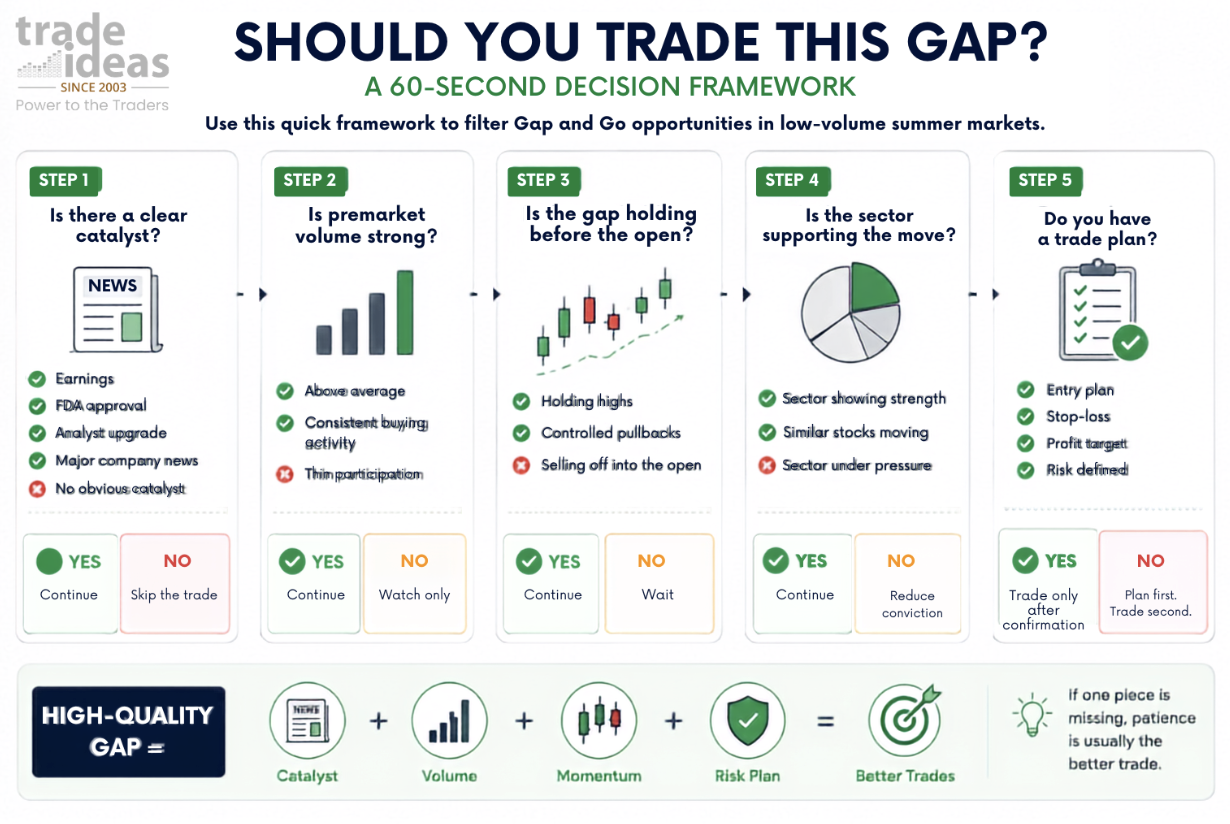
Once a stock passes these initial checks, the next step is turning your analysis into a structured trading plan. Here’s a simple premarket workflow that can help you prepare for the opening bell without feeling rushed or overwhelmed.
A Step-by-Step Summer Gap and Go Strategy Workflow
Finding quality setups becomes much easier when you follow the same process every morning. Instead of reacting to whatever is moving, create a routine that helps you narrow your focus before the market opens.
Here’s a simple workflow you can use.
Step 1: Scan Premarket Movers
Start by identifying stocks with meaningful overnight gaps.
Focus on companies that are moving because of:
- Earnings
- Breaking news
- Analyst upgrades
- Sector-wide catalysts
Avoid building your watchlist around price movement alone.
Step 2: Verify the Story Behind the Move
Before adding a stock to your list, ask one simple question:
“Why is this stock moving today?”
If the answer isn’t immediately clear, it’s often better to move on.
A genuine catalyst provides context, and context helps sustain momentum.
Step 3: Filter Out Weak Setups
Now narrow your list using factors such as:
- Relative volume
- Premarket strength
- Float size
- Sector momentum
- Key technical levels
This step is where many traders save themselves from unnecessary trades.
Instead of manually reviewing dozens of charts every morning, many active traders use AI-powered stock scanners that automatically surface stocks meeting specific criteria. This makes it easier to spend time evaluating opportunities rather than searching for them.
If you’re looking to streamline that process, Trade Ideas‘ AI-powered market scanning tools can automatically filter stocks based on real-time price action, volume, and customizable conditions, helping you build a more focused watchlist before the opening bell.
Step 4: Wait for Confirmation
One of the biggest mistakes in morning gap trading is entering as soon as the market opens.
Instead, let the first few minutes provide additional confirmation.
Watch for:
- Buyers defending key support levels
- Strong opening volume
- Higher highs and higher lows
- Price holding above the opening range
Patience often leads to better entries and clearer risk levels.
Step 5: Define Your Trade Before Entering
Every trade should answer three questions before you click Buy.
- Where will you enter?
- Where will you exit if you’re wrong?
- Where will you take profits?
If you don’t have those answers beforehand, you’re making decisions emotionally instead of strategically.
A trading plan doesn’t eliminate losses, but it makes them easier to manage.
Your Morning Gap Trading Routine
Use this checklist before placing your first trade.
✔ The stock has a clear catalyst.
✔ Relative volume confirms participation.
✔ Premarket momentum remains intact.
✔ The broader sector supports the move.
✔ Risk and reward are clearly defined.
✔ You’re waiting for confirmation, not chasing the first candle.
Following the same routine every day helps remove emotion from the decision-making process. Over time, consistency in preparation often leads to consistency in execution.
Common Summer Trading Mistakes That Can Ruin a Gap and Go Setup
Even experienced traders can struggle during the summer months. The difference is that successful traders recognize when market conditions have changed and adjust their approach accordingly.
Here are some of the most common mistakes to avoid.
Chasing the First Big Move
A stock opening 8% or 10% higher can create a sense of urgency. Jumping into a trade without waiting for confirmation often leads to poor entries and unnecessary losses.
Instead, let the market show whether buyers can maintain control before committing capital.
Ignoring Trading Volume
A large gap may grab your attention, but without enough participation, the move can lose momentum quickly.
Always consider relative volume alongside price action. Strong momentum is typically supported by strong participation.
Trading Every Gap
Not every gap-up stock deserves a place on your watchlist.
Being selective is especially important during low-volume markets. Waiting for one or two quality setups is usually more productive than chasing every stock that’s moving.
Risking Too Much on a Single Trade
Summer markets can produce choppier price action and wider spreads.
Reducing your position size slightly can help manage risk while still allowing you to participate in quality opportunities.
As FINRA points out, using appropriate risk management techniques, including position sizing and stop-loss planning, is an important part of disciplined trading.
How AI Can Help You Find Better Gap Opportunities
Finding a promising Gap and Go Strategy setup isn’t usually the hardest part.
Finding it before everyone else and filtering out the noise is.
Every morning, hundreds of stocks move during premarket trading. Manually checking news, volume, charts, and technical levels for each one can quickly become overwhelming.
That’s where AI-assisted tools can make a meaningful difference.
Rather than replacing your decision-making, AI helps narrow the field by highlighting stocks that already match the criteria you’re looking for.
For traders using the Gap and Go Strategy, that can mean spending less time searching and more time evaluating high-quality opportunities.
Some of the ways AI can support your workflow include:
- Identifying unusual premarket activity in real time
- Filtering stocks based on price, volume, float, or custom criteria
- Monitoring multiple watchlist candidates simultaneously
- Sending alerts when a setup matches your trading plan
- Backtesting strategies before risking real capital
Trade Ideas brings many of these capabilities together through its AI-powered scanners, customizable alerts, and Holly AI, which helps traders identify actionable opportunities using real-time market data rather than manually scanning hundreds of charts.
For traders looking to validate and refine their strategies, Trade Ideas also offers tools that allow you to test ideas against historical market behavior before applying them in live conditions.
Risk Management Tips for Low-Volume Markets
Even the strongest setup can fail. That’s why managing risk should always take priority over chasing returns.
A few simple habits can make a significant difference during quieter market conditions.
Keep Position Sizes Realistic
Lower liquidity can lead to larger price swings. Reducing your position size slightly helps protect your account without forcing you out of the market.
Let the Market Confirm Your Idea
Entering too early increases the likelihood of getting caught in a failed breakout.
Waiting for confirmation may mean giving up a few cents of upside, but it often improves the quality of the trade.
Respect Your Stop-Loss
Don’t move your stop simply because you hope the trade will recover.
A small, planned loss is easier to recover from than a large emotional one.
Accept That Some Days Offer No Trade
One of the most underrated trading skills is knowing when not to trade.
If no setup meets your criteria, staying patient is often the better decision.
Summer Gap and Go Strategy Checklist
Before entering your next trade, run through this quick checklist.
| ✔ Checklist | |
| A clear catalyst is driving the gap | ☐ |
| Relative volume confirms strong participation | ☐ |
| Premarket price action remains strong | ☐ |
| The sector supports the move | ☐ |
| Entry, stop-loss, and target are planned | ☐ |
| Risk-to-reward meets your trading rules | ☐ |
| You’re waiting for confirmation instead of chasing | ☐ |
The more boxes you can check, the stronger your overall setup is likely to be.
Conclusion
The Gap and Go Strategy remains one of the most effective ways to trade momentum, but summer markets require a little more patience and a lot more selectivity.
Instead of focusing on every stock that’s gapping higher, prioritize the ones supported by strong catalysts, healthy trading volume, and clear market participation. Combine that with a consistent morning routine and disciplined risk management, and you’ll be in a much better position to capitalize on quality opportunities while avoiding unnecessary trades.
Looking to simplify your premarket routine?
Explore how Trade Ideas’ AI-powered scanners, real-time alerts, and market intelligence tools can help you identify high-conviction trading opportunities faster and trade with greater confidence.
Frequently Asked Questions
Can the Gap and Go Strategy work with stocks under $10?
Yes, but lower-priced stocks are generally more volatile and can have wider spreads. Many traders apply stricter risk management rules and look for stronger volume confirmation before trading these names.
Is the Gap and Go Strategy only for day traders?
While it’s primarily used for intraday trading, some setups with exceptionally strong catalysts can continue trending beyond the first trading session. Your holding period should always depend on your trading plan and market conditions.
Can ETFs be traded using a Gap and Go approach?
Yes. Sector and index ETFs can occasionally present gap opportunities, especially after major economic news or significant overnight market events. They generally move more steadily than individual stocks but may offer lower volatility.
Does market volatility affect the success of the Gap and Go Strategy?
Absolutely. Higher volatility often creates more trading opportunities but can also increase risk. During quieter markets, traders typically benefit from being more selective and waiting for stronger confirmation before entering a position.
How can I practice the Gap and Go Strategy before trading with real money?
Many traders begin by paper trading or backtesting their setups to understand how the strategy performs under different market conditions. Reviewing past trades and testing your rules can help build confidence before committing real capital.