
AI is Finally Unbundling the $32,000 Bloomberg Terminal
AI is Finally Unbundling the $32,000 Bloomberg Terminal
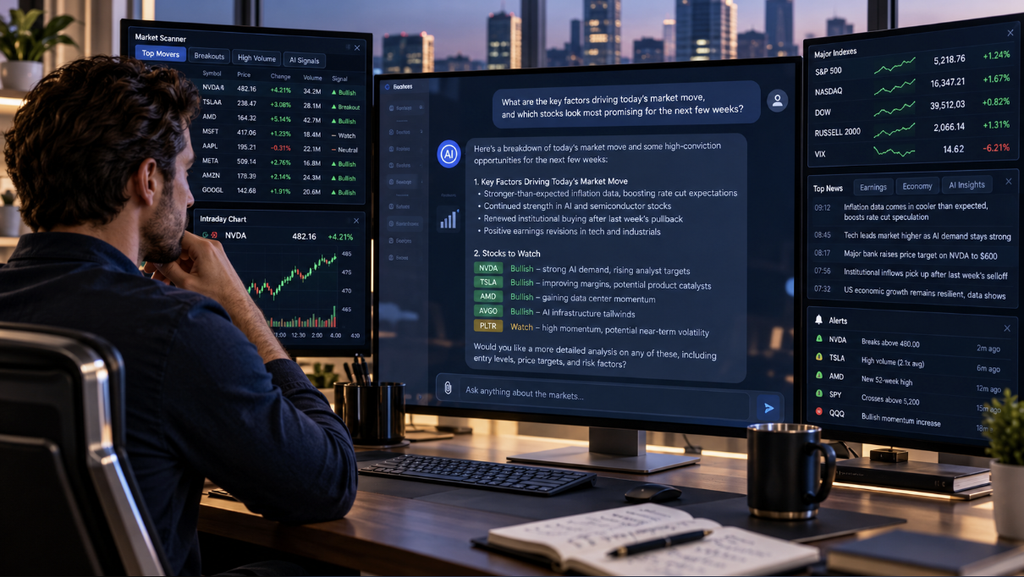
For decades, the Bloomberg Terminal was the undisputed gold standard of institutional finance. Traders, analysts, portfolio managers, and investment bankers weren’t simply paying for software—they were buying access to real-time market data, research, analytics, communication tools, and an entire professional ecosystem in one place. At roughly $30,000 or more per seat each year, that access came at a steep price, but major banks, hedge funds, and investment firms had little reason to question it. Bloomberg didn’t become dominant because it was affordable; it became dominant because, for many professionals, working without it barely felt like an option.
Then AI Changed What a “Financial Terminal” Needs to Be
Traditional financial terminals were built to solve information overload: helping professionals find, organize, and interpret enormous amounts of market data. Generative AI changes that workflow entirely. Instead of manually navigating screens, filings, transcripts, and research reports, users can increasingly ask a natural-language question and get a synthesized answer in seconds. AI can summarize earnings calls, compare companies, analyze filings, surface catalysts, build models, and even write code—turning tasks that once required specialized software knowledge into something far more conversational and accessible.
Bloomberg’s Real Threat Isn’t One Competitor — It’s Unbundling
Bloomberg’s biggest threat isn’t one cheap AI subscription suddenly replacing the entire Terminal. It’s that the platform’s once-unified advantage can now be rebuilt from a growing stack of lower-cost tools. AI can handle research and document analysis, specialized scanners can surface trading opportunities, broker platforms can execute trades, and inexpensive charting software can cover technical analysis. Add public filings, earnings transcripts, APIs, and alternative-data providers, and Bloomberg is no longer competing only with firms like Refinitiv or FactSet—it is competing with an entire ecosystem of specialized software working together.
The $32,000 Question: What Are You Actually Paying Bloomberg For?
At roughly $32,000 a year, the real question is what Bloomberg still provides that cheaper tools cannot. The Terminal’s value comes from more than research: it combines proprietary, real-time financial data, Bloomberg News, analytics, modeling, execution tools, Instant Bloomberg messaging, and deeply integrated institutional workflows. AI is rapidly commoditizing tasks like research synthesis and document analysis, but Bloomberg’s proprietary datasets, trusted sourcing, professional network, and execution infrastructure are much harder to replicate. That distinction matters because the disruption is not as simple as “AI replaces Bloomberg”—it is about which parts of Bloomberg’s value can now be unbundled, automated, or replaced at a fraction of the cost.
AI Is Attacking Bloomberg’s Interface Advantage
Bloomberg’s interface has long rewarded users who learned its specialized commands, shortcuts, and workflows, but AI is pushing finance toward a far more conversational model. Instead of knowing exactly where to look, a user can increasingly ask a question like, “Show me semiconductor companies with improving margins, lower valuation multiples, and rising earnings estimates,” and let the software handle the search. Bloomberg itself is adapting through ASKB, which uses conversational AI to navigate its data, research, news, and analytics. When even Bloomberg is turning the Terminal into a conversation, it signals just how quickly the traditional financial interface is changing.
Where Bloomberg Still Has a Moat AI Can’t Simply Prompt Away
AI is only as powerful as the information it can access, and that is where Bloomberg still holds a significant advantage. Its moat is built on trusted financial data, proprietary content, global market coverage, institutional workflows, and a professional messaging network that connects hundreds of thousands of finance professionals. In regulated environments, reliability, provenance, auditability, and low-latency data matter just as much as having a sophisticated AI model. General-purpose AI can analyze and summarize information, but it does not automatically own the underlying data infrastructure—and that remains one of Bloomberg’s strongest defenses.
The Real Disruption
Before AI, many financial firms asked whether they could operate without Bloomberg at all. Increasingly, the better question is which employees truly need a $32,000-a-year Terminal. As AI-powered tools take over more research, analysis, and information-gathering tasks, some users may replace parts of their Bloomberg workflow with significantly cheaper alternatives. That does not make Bloomberg obsolete, especially for traders and institutional desks that rely on its data and infrastructure. Still, it does put pressure on the traditional per-seat subscription model. The real disruption may be less about replacing Bloomberg outright and more about forcing firms to justify every expensive seat.
The Twist: Bloomberg Might Use AI to Save the Bloomberg Terminal
Bloomberg is not standing still while AI reshapes financial research. Through ASKB and its broader AI strategy, the company is effectively embedding the disruption directly into the Terminal. That gives Bloomberg a powerful combination: proprietary financial data that general-purpose AI companies cannot easily replicate, paired with the conversational experience users increasingly expect. If Bloomberg can successfully merge those strengths, AI may not weaken the Terminal at all—it could make it faster, easier, and more valuable to use. The real question is whether those improvements will continue to justify a roughly $32,000 annual subscription.
AI Isn’t Killing Financial Data, but the Old Way We Access It
The Bloomberg Terminal’s greatest threat isn’t that AI makes professional financial information worthless. It’s the opposite — and that’s what makes this moment so significant. AI makes information dramatically easier to search, analyze, and act on, so the value of simply providing an interface to access it is collapsing. The premium is shifting — away from being the gatekeeper of data and toward owning what cannot be easily replicated: proprietary data, execution speed, institutional trust, and the kind of real-time intelligence that arrives before the market has already moved. Bloomberg spent decades becoming the place where financial professionals went to find answers. In the AI era, investors increasingly expect the answer to find them. The platforms that understand that shift and build for it will define the next generation of financial data infrastructure. The ones that don’t will spend the next decade defending a moat that is already draining. Visit Trade Ideas today to join the new era of AI investing.