
Swing Trading Entry Points: How to Find and Confirm Better Entries
Swing Trading Entry Points: How to Find and Confirm Better Entries

Finding the right swing trade entry is less about catching the exact bottom and more about recognizing when a setup is ready. Swing Trade entry points are potential opportunities identified from price movement, trend conditions, and technical setups that traders can review before entering.
This guide explains the main entry types, the 10-SMA pullback strategy, how to confirm setups on the chart, and how a real-time stock scanner can help surface potential opportunities. It also covers when to skip an entry, swing trading risk management, common mistakes, and how to test an entry strategy before using it with real capital.
| Quick Answer: A good swing trading entry occurs when price reaches a predefined technical area and shows confirmation that supports the setup. Before entering, traders should consider trend direction, support or resistance, price action, stop-loss placement, profit target, and position size.The goal is not to catch the exact bottom. It is to enter where both the reason for taking the trade and the potential risk are clear. |
What Makes a Good Swing Trading Entry?
A strong entry generally gives the trader three things:
- A clear technical reason for taking the trade
- A logical level for defining when the setup has failed
- Sufficient potential upside relative to the planned downside
Traders can evaluate a setup using price action, support and resistance levels, trend direction, moving averages, and other technical analysis methods.
Importantly, confirmation matters. Price reaching a support level or moving average does not automatically make it an entry. Traders may wait to see how price behaves around that area before deciding whether the original setup remains valid.
Common Types of Swing Trading Entry Points
There is no single entry method that applies to every market condition. Some of the most common swing trading entries include the following.
Pullback Entry
A pullback occurs when price temporarily moves against the direction of the broader trend.
For example, a stock trending higher may decline for several sessions before approaching a previous support area. Rather than chasing the stock during the initial advance, a trader can watch the pullback and look for evidence that buyers are returning.
Support or Reversal Entry
A support or reversal entry focuses on areas where previous selling pressure has slowed or buying interest has appeared.
Traders may look for signals such as a rejection wick, higher low, bullish reversal candle, or another sign that price is beginning to stabilize.
Support itself does not guarantee a reversal. The purpose of confirmation is to determine whether price is actually reacting to the level.
Breakout and Retest Entry
A breakout occurs when price moves above an established resistance level or trading range.
Instead of entering immediately during the breakout, some traders wait for price to return toward the former resistance level. If that level begins acting as support, the retest can provide a more clearly defined entry and invalidation point.
Trend-Continuation Entry
A trend-continuation setup occurs when price resumes its broader direction after a temporary pullback or consolidation.
Here, traders are not trying to identify a new trend. They are looking for evidence that an existing trend is beginning to continue.
The 10-SMA Pullback Strategy
One way to apply the pullback concept is through the 10-SMA pullback strategy.
The setup looks for stocks that already have upward momentum but temporarily move back toward their rising 10-period simple moving average.
Rather than buying during the initial run higher, the trader waits for price to pull back and evaluates whether the broader trend still appears intact.
The important distinction is that touching the 10 SMA is not an entry signal by itself. It identifies an area where traders can begin looking for confirmation.
Step 1: Find a Stock With Existing Momentum
Start with a stock that has already demonstrated upward momentum.
The goal is not to predict which stock might begin trending. Instead, the strategy looks for an established move that is temporarily pulling back.
A series of higher highs and higher lows, positive recent performance, or a rising short-term moving average can help provide context.
Step 2: Wait for the Pullback
Avoid entering simply because the stock is moving higher.
Wait for the price to retrace toward the area being monitored. In this strategy, that area is the rising 10 SMA.
The pullback gives traders an opportunity to determine whether the stock is temporarily resting within its trend or whether the original momentum is beginning to break down.
Step 3: Watch the Rising 10 SMA
As the price approaches the 10 SMA, watch how it behaves around the moving average.
A rising 10 SMA matters because the strategy is designed around stocks with an existing upward short-term trend.
Price moving near the SMA identifies the potential setup area. It still does not provide automatic confirmation.
Step 4: Wait for Entry Confirmation
Before considering an entry, look for signs that buyers may be returning.
Potential confirmation can include:
- A rejection wick near the pullback low
- A higher low
- A bullish reversal candle
- Price is moving back above the 10 SMA
- Renewed buying pressure following the pullback
Waiting for confirmation can help traders avoid entering while price is still falling.
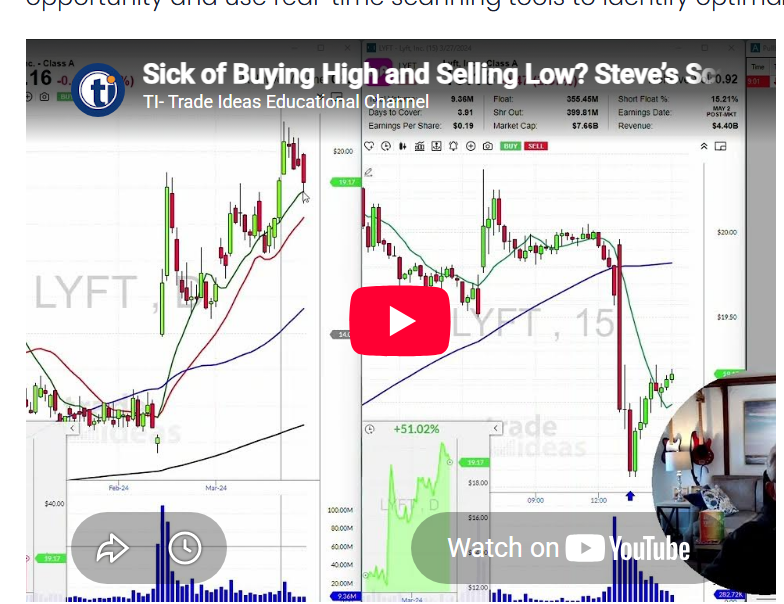
How Trade Ideas Helps Find 10-SMA Pullback Swing Trading Setups
Once the strategy and its conditions are defined, technology can help traders find stocks that match them.
Trade Ideas can scan stocks in real time using customizable conditions. Instead of manually reviewing individual charts, traders can create alerts for factors such as recent momentum, daily price movement, and proximity to the 10 SMA.
The scanner helps surface potential setups for review. It does not replace entry confirmation or risk evaluation.
Recommended 10-SMA Scan Configuration
For this pullback setup, the goal is to find stocks that already showed upward momentum but are now retracing toward a rising 10-period simple moving average.
A practical scan can use the following filters:
| Scan Filter | Purpose |
| Price above $5 | Keeps the scan focused on stocks above the selected minimum price. |
| Down on the day | Identifies stocks currently pulling back rather than continuing straight higher. |
| Within -0.25% to +0.25% of a rising 10 SMA | Finds stocks trading close to the moving average used as the setup area. |
| Up at least 4% over the previous 10 days | Confirms that the stock had recent upward momentum before the pullback began. |
Together, these filters help narrow the market to stocks that were recently trending higher, are now pulling back, and are approaching a rising 10 SMA.
Test With OddsMaker and Simulated Trading
Trade Ideas’ OddsMaker can backtest alert strategies against historical market data and report metrics such as win rate, profit factor, average winners and losers, and an equity curve. Trade Ideas notes that its backtesting uses historical one-minute candle data and does not account for every live-trading factor, such as slippage.
After historical testing, traders can use Trade Ideas Simulated Trading to practice with virtual capital and real-time market data before deciding whether to apply the strategy in live trading. Trade Ideas positions simulation as a way to practice order placement, position sizing, trade management, and strategy execution without risking real money.
How to Confirm the Entry on the Chart
A scanner alert should be treated as the beginning of the evaluation process, not an instruction to enter.
Once the scanner identifies a stock, examine how price behaves around the 10 SMA.
For example, a stock may trigger the scan while continuing to fall straight through the moving average. That would look very different from a stock that reaches the SMA, rejects lower prices, forms a higher low, and begins moving back above it.
Confirmation can therefore help distinguish between a stock that simply meets the scanner conditions and a stock beginning to behave as the strategy expects.
When You Should Skip the Entry
Not every scanner alert or pullback produces a usable swing trading entry. Consider passing on the setup when:
- The broader upward trend has clearly weakened
- Price moves decisively below the planned support area
- The 10 SMA is flat or declining
- No meaningful confirmation develops
- Price has already moved too far away from the intended entry
- The stop would need to be unusually far from the entry
- The available upside does not justify the planned downside
- Knowing when not to enter is just as important as identifying a possible entry.
Plan and Test Your Entry Strategy Before Trading
Entry selection and risk management should be planned together. Before entering a swing trade, define:
- Entry point: The level or condition that triggers the trade.
- Stop loss: The point at which the setup is considered invalid. Traders should also remember that a stop price is not a guaranteed execution price, particularly when markets are moving quickly.
- Profit target: The area where gains may be considered.
- Position size: The amount of capital exposed based on the entry and stop.
Once these rules are defined, test the strategy before relying on it with real capital. For the 10-SMA setup, this may include the required trend, distance from the moving average, recent price performance, confirmation signals, stop placement, and exit conditions.
Historical testing can show how those rules performed in previous market conditions, while paper trading allows traders to practice identifying and executing the setup without immediately risking real money.
Historical or simulated performance does not guarantee similar results in future market conditions.
Common Swing Trading Entry Mistakes
| Mistake | What Can Happen | How to Prevent It |
| Chasing a stock after a large move | You may enter too late, leaving less upside and a wider risk zone. | Wait for a pullback, consolidation, or another predefined setup. |
| Entering before confirmation | The pullback may continue, causing the trade to move against you immediately. | Wait for a rejection wick, higher low, reversal candle, or move back above the level. |
| Treating a moving-average touch as an automatic entry | Price may break through the moving average and continue lower. | Use the SMA as an area to watch, then confirm the setup with price action. |
| Ignoring the broader trend | You may enter against stronger market momentum. | Confirm that the broader trend supports the direction of the trade. |
| Setting the stop loss after entering | Emotion may lead you to widen the stop and accept more risk than planned. | Define the stop-loss level before entering. |
| Entering without a profit target | You may hold too long or exit based on emotion instead of your plan. | Set a target using resistance, price structure, and planned risk. |
| Using the same position size for every trade | Some trades may expose much more capital to loss than others. | Adjust position size based on the entry, stop loss, and acceptable risk. |
| Entering because of FOMO | You may chase price and abandon your original trading rules. | Enter only when the setup meets your predefined criteria. |
Swing Trading Entry Checklist
Before entering a swing trade, ask:
Does the broader trend support the setup?
Has the price reached the planned technical area?
Is there a clear entry confirmation?
Is the stop-loss level defined?
Is the profit target identified?
Does the potential reward justify the planned risk?
Is the position size appropriate for that risk?
Am I following my setup rather than chasing price?
If several of these questions cannot be answered clearly, the setup may need more time before an entry is considered.
Final Thoughts
Better swing trading entries come from following a process, not trying to catch the perfect price. Define the setup you want, wait for the right conditions, confirm the move on the chart, and know your risk before entering.
Whether you trade pullbacks, reversals, breakout retests, or a 10-SMA setup, the same discipline applies: use tools such as Trade Ideas to find potential setups, skip those that fail your criteria, and avoid letting FOMO replace your trading plan.
For your next setup, start with one clearly defined entry strategy. Set your criteria, scan for matches, wait for confirmation, define the entry, stop, target, and position size, then test the approach before committing real capital. The goal is not to find a perfect entry, it is to make each entry deliberate, confirmable, and repeatable.
| Looking for more structured swing trading entry points? Use Trade Ideas’ real-time stock scanner to surface stocks matching your predefined setup criteria and evaluate each opportunity before taking action. Start Trade Ideas Today |
Frequently Asked Questions
How long should I wait for entry confirmation on a swing trade?
There is no fixed amount of time because confirmation depends on the chart timeframe and how price behaves around the planned entry area. Wait until the setup produces the signal your strategy requires rather than entering simply because the price has reached the level. If price moves away before confirmation appears, reassess the setup instead of chasing it.
Should entry confirmation happen on the same timeframe as the swing trading setup?
Ideally, the main setup should remain valid on the timeframe used to plan the swing trade, while a lower timeframe can provide more precise entry confirmation. For example, a trader may identify the broader setup on a daily chart and monitor a shorter timeframe for signs that price is beginning to respond. Avoid letting a small intraday signal override a clearly weakening higher-timeframe setup.
What if a 10-SMA pullback briefly breaks below the moving average and then recovers?
A brief move below the 10 SMA does not automatically invalidate a swing trading setup if price quickly recovers and the broader trend remains intact. The reclaim can become part of the entry confirmation, but traders should still evaluate price structure and their predefined invalidation level. A sustained break with weakening momentum is different from a temporary test of the moving average.
What should I do if confirmation comes after the price has already moved away from my planned entry?
Recalculate the setup before entering because a later entry can change both the stop distance and potential reward. If the new price no longer fits your predefined risk-reward criteria, skipping the trade may be more consistent than chasing the move. The original setup being valid does not mean every later price offers the same quality of swing trading entry.
Why can a well-confirmed swing trading setup still fail?
Entry confirmation improves the evidence supporting a setup, but it cannot guarantee what price will do next. Market conditions, sudden volatility, broader trend changes, or unexpected selling can invalidate an otherwise reasonable entry. That is why confirmation should work together with a stop-loss plan, position sizing, and strategy testing rather than being treated as a guarantee.