
What Every Trader Gets Wrong About Paper Trading & Why It’s Costing Them
What Every Trader Gets Wrong About Paper Trading & Why It’s Costing Them
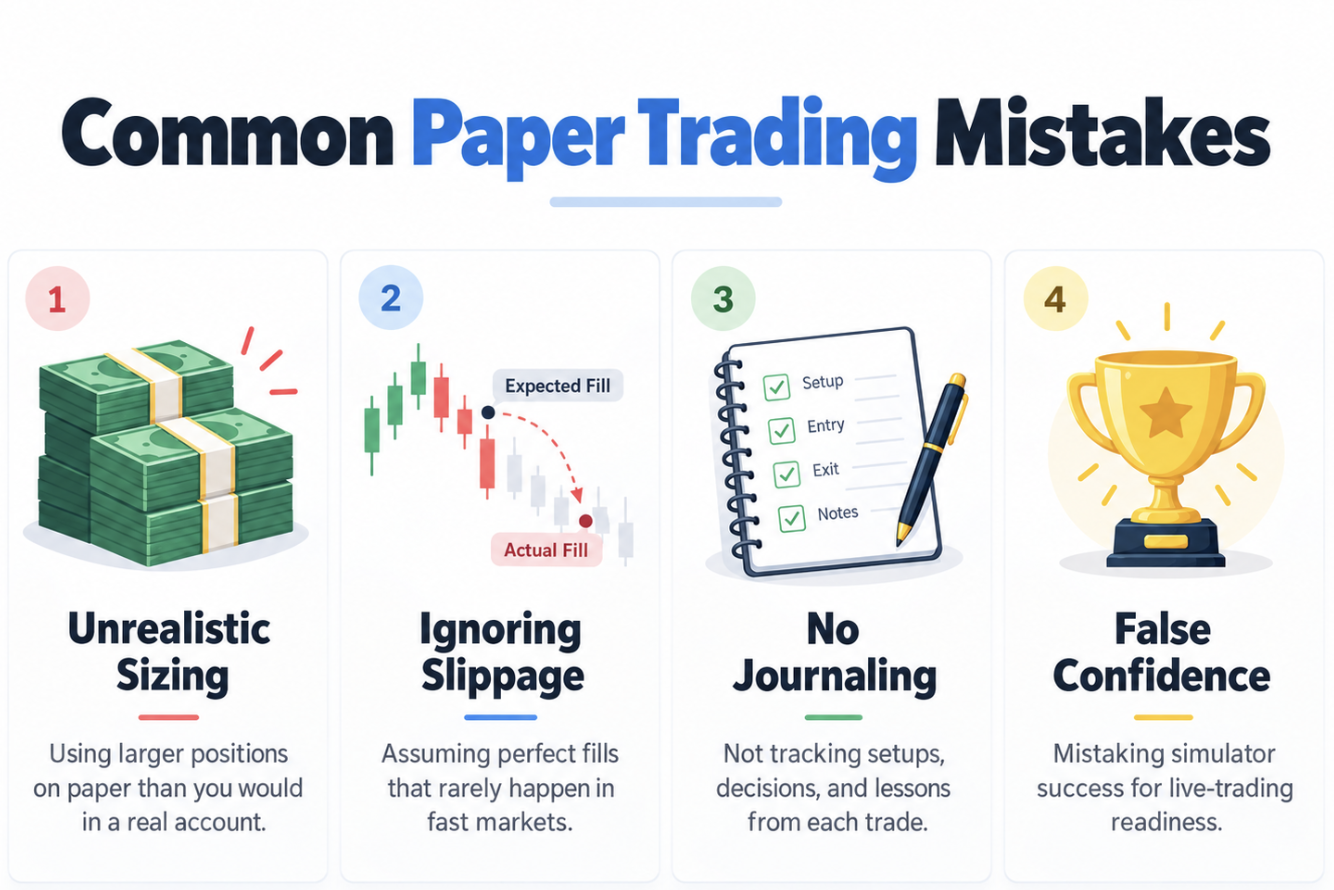
The uncomfortable truth that nobody tells new traders clearly enough: paper trading and real trading are not the same experience. The gap between them is not a small one that shrinks as you get more reps in the simulator. It is a fundamental, structural difference that only reveals itself when real money is on the line — and by then, the lesson is expensive. Paper trading is one of the most valuable tools available to any developing trader when used correctly. It is also one of the most dangerous when used incorrectly — because the false confidence it creates can be more damaging than no preparation at all. This is the honest guide to what most traders get wrong about paper trading and how to use it in a way that actually prepares you for live markets rather than just making you feel like you are.
What Paper Trading Actually Is — And What It Isn’t
Paper trading is simulated trading using real market data without real money at risk — designed to test strategies, learn platforms, and build trading skills before committing capital. It is genuinely valuable for learning platform mechanics, testing whether a strategy has merit, and building a pre-market routine. What it cannot replicate is equally important: the emotional experience of real money at risk, real slippage and execution issues in fast markets, and the psychological weight of a position that is actually costing you money. The critical distinction: paper trading tests your strategy — it does not test you. And in real trading, you are always part of the equation.
The Biggest Mistakes Traders Make With Paper Trading
1.) Not Taking It Seriously Enough:
Treating paper trading casually because there are no real consequences produces false confidence, not useful data. If you wouldn’t take the trade with real money — same sizing, same stops, same criteria — don’t take it on paper.
2.) Taking It Too Seriously for Too Long:
Using paper trading as a permanent comfort zone is avoidance, not preparation. Some traders build impressive simulated track records for months or years and never make the move to live markets. At some point, the only way to develop as a trader is to put real money at risk.
3.) Ignoring Slippage and Execution Reality:
Paper trading almost always fills at the exact price you specify. Real markets do not. In volatile opens, earnings moves, and low-liquidity names, the difference between your paper fill and your real fill can eliminate an edge. Fix it by manually assuming slightly worse fills on every paper trade and making sure your strategy still works.
4.) Wrong Position Sizing:
Paper trading $50,000 positions when your real account is $10,000 produces a track record completely disconnected from reality. Paper trade with exactly the position sizes your real account will use — nothing more.
5.) Misreading the Results:
A profitable paper trading track record does not guarantee live trading success. Paper results are best used as a filter — they can quickly disqualify a bad strategy, but they cannot fully qualify a good one. The emotional variable that paper trading cannot measure almost always makes live results worse than paper results.
The Emotion Gap — The Most Important Thing Paper Trading Cannot Teach You
The strategy that worked on paper falls apart in live trading not because the strategy was wrong, but because the trader’s emotional response to real money is something paper trading never prepared them for. A paper trading loss feels like nothing — a real money loss triggers a genuine physiological stress response that changes how you think, how you decide, and how you execute. Paper traders take entries instantly because nothing is at stake. Live traders hesitate, miss entries, and then chase the setups they would have caught on paper — creating the very emotional errors the simulator was supposed to help them avoid.
Paper losses are shrugged off in seconds. Losing real money triggers the revenge trading impulse that paper trading never activates. Paper traders let winners run because there is no temptation to lock in gains that don’t actually exist. Live traders cut winners early because the psychological pull of locking in a real profit is powerful — and paper trading never develops the discipline to resist it. Every one of these patterns shows up in the first weeks of live trading for traders who thought their paper results had prepared them. Paper trading can make you a better strategist. It cannot make you a better trader until you have experienced what real money pressure actually does to your decision-making — and the only way to experience that is to trade with real money.
How to Paper Trade Correctly — Making Practice Actually Count
- Trade it like it’s real: same position sizing, same stop losses, same entry and exit criteria, same pre-market routine — every single session.
- Set a defined paper trading period: give yourself a specific timeframe — 30, 60, or 90 days — with defined goals.
- Journal every trade: record the setup, the entry, the exit, the reasoning, and the emotional state.
- Account for real-world execution: manually adjust your paper fills to reflect realistic slippage — assume slightly worse entries and exits than the price you see.
- Use Trade Ideas during paper trading: running your paper trades through the same Trade Ideas scanner and alert system you will use in live trading builds the platform familiarity and process habits that transfer directly — so when you go live, the tools are already second nature.
- Define your transition criteria: decide in advance what a successful paper trading period looks like — not just a profitable track record, but specific metrics that give you reasonable confidence the edge is real; then commit to it.
When to Stop Paper Trading and Go Live
The question every developing trader struggles with is also the most important one they will ask: how do I know when I’m ready to go live? The honest answer has two sides. You are ready when you have a defined written strategy with specific entry criteria, stop levels, and profit targets — and you understand why it works, not just that it worked on paper. When you have paper traded that strategy consistently for a meaningful period, with positive results and a risk management framework that includes a daily loss limit, position-sizing rules, and a maximum drawdown threshold. And when your platform feels intuitive and automatic rather than something you are still figuring out.
You are not ready when your paper trading results are inconsistent or negative, when you are still changing your strategy frequently based on recent trades, when you cannot clearly articulate your entry and exit criteria, or when you have been paper trading with unrealistic position sizes or ignoring stops. When you do make the transition, start smaller than you think you need to. The goal of the first weeks of live trading is not to make money. It is to discover what real money pressure does to your execution — and to make that discovery as cheaply as possible. You can always increase the size once you know you can manage your emotional response to real risk.
The Right Way to Think About Paper Trading — What It’s Actually For
Paper trading is a research tool, not a rehearsal — and understanding that distinction is the entire key to using it correctly. The best use of paper trading is disqualifying bad strategies quickly and cheaply before they cost you real money. If a strategy cannot produce results on paper, it will never produce results live.
Paper trading is one of the most valuable and most misused tools in retail trading—and the difference between the two comes down entirely to how seriously and how correctly you apply it. Log into Trade Ideas today, run your paper trades through the same scanner and alert system you will use when you go live, and build the process habits and platform fluency that make the transition from paper to real money as smooth as possible — because the best preparation for live trading is practicing with the same tools, the same process, and the same discipline you intend to bring when real money is on the line.