
The ADHD Trader: How to Turn a Fast-Moving Brain Into a Trading Edge
The ADHD Trader: How to Turn a Fast-Moving Brain Into a Trading Edge
Your average trader during the first few minutes of market open is rubbing the sleep out of their eyes, adjusting and setting a plan for the day. However, the ADHD trader has checked six tickers, read three news articles, noticed a pattern nobody else in the room caught, taken two trades, and is already mentally checked out of one of them, all within the first 15 minutes. Sound familiar?
ADHD and trading have a complicated relationship — one that is rarely discussed honestly in the trading community, even though active trading environments attract ADHD brains at a rate far higher than the general population. The market is fast, stimulating, constantly changing, and rewards rapid pattern recognition in ways that feel tailor-made for the ADHD brain. This article will help you understand the specific advantages and vulnerabilities so you can spend your energy maximizing one and systematically managing the other.
What ADHD Actually Is — And Why Trading Activates It So Powerfully
Before diving into the advantages and pitfalls, it helps to understand what ADHD actually is — because many people still misunderstand it. ADHD is not a deficit of attention, but a difference in how attention is allocated. It is a neurodevelopmental condition characterized by differences in dopamine regulation and executive function that make certain tasks effortless and others genuinely difficult, with nothing to do with intelligence or effort. The dopamine connection is the most important piece for traders to understand. The ADHD brain is wired to seek novelty, stimulation, and immediate reward — and the stock market provides all three in near-constant supply. Real-time data changing by the second. Immediate feedback on every decision in the form of a gain or a loss.
The thrill of uncertainty built into every single trade. Pattern recognition opportunities embedded in every chart, every tape, every sector rotation. For a brain wired to scan environments for stimulation and reward rapidly, the market is one of the most activating environments on earth — which is exactly why so many ADHD traders feel like they were born to do this. But the double-edged sword that defines the entire ADHD trading experience: all of the things that make trading feel perfectly suited to the ADHD brain are the same things that make it dangerous.
The Struggles — Where ADHD Makes Trading Harder
- Impulse control: the hardest single skill in trading — waiting for the right setup, holding a position through normal volatility, not chasing a move that already happened — all require impulse control that the ADHD brain finds genuinely difficult
- Dopamine chasing: The brain seeks the feeling of a trade more than the logic of a trade — the excitement of entering a position can feel more rewarding than the discipline of waiting for the right one.
- Emotional decision-making: wins feel euphoric, and losses feel catastrophic in ways that are more intense for ADHD traders — this emotional amplification leads to revenge trading after losses and over-sizing after wins
- Consistency is hard: following the same process every day—the same pre-market routine, setup criteria, and risk parameters—requires the kind of structured repetition that the ADHD brain finds unstimulating.
- Boredom in slow markets: when the market is quiet and nothing is setting up, the ADHD trader’s greatest enemy is boredom — the urge to manufacture excitement by taking trades that aren’t there is one of the most common and most expensive patterns.
- Time blindness: ADHD often comes with difficulty accurately perceiving and managing time — in trading, this shows up as holding positions too long, missing exits, or losing track of how long a trade has been developing relative to the original thesis
The Advantages — Where ADHD Becomes a Genuine Edge
- Hyperfocus: The brain’s most powerful and most misunderstood feature — when genuinely engaged by something interesting, ADHD traders can achieve a level of focused attention that most people simply cannot access. In the right market conditions, this hyperfocus produces extraordinary pattern recognition and real-time tape reading.
- Pattern recognition: The brain is wired to rapidly scan environments for patterns and anomalies — a skill that translates directly into reading price action, identifying setups, and spotting opportunities that more methodical thinkers process too slowly to catch
- High stimulation tolerance: fast markets, multiple data streams, rapid decision-making — conditions that overwhelm many traders are conditions where ADHD traders often feel most alive and most capable
- Creative thinking: often see connections and setups that more linear thinkers miss — the ability to make rapid, non-obvious associations between seemingly unrelated pieces of information is a genuine cognitive advantage in a complex, information-rich environment.
- Multitasking under pressure: monitoring multiple positions, watching several sectors simultaneously, processing news while reading charts — the ADHD brain’s ability to rapidly switch attention between multiple streams of information is a real operational advantage in active trading.
- Risk tolerance: Often possess a naturally higher tolerance for uncertainty and risk — this reduces analysis paralysis.
The Dopamine Trap — The Biggest Risk Specific to ADHD Traders
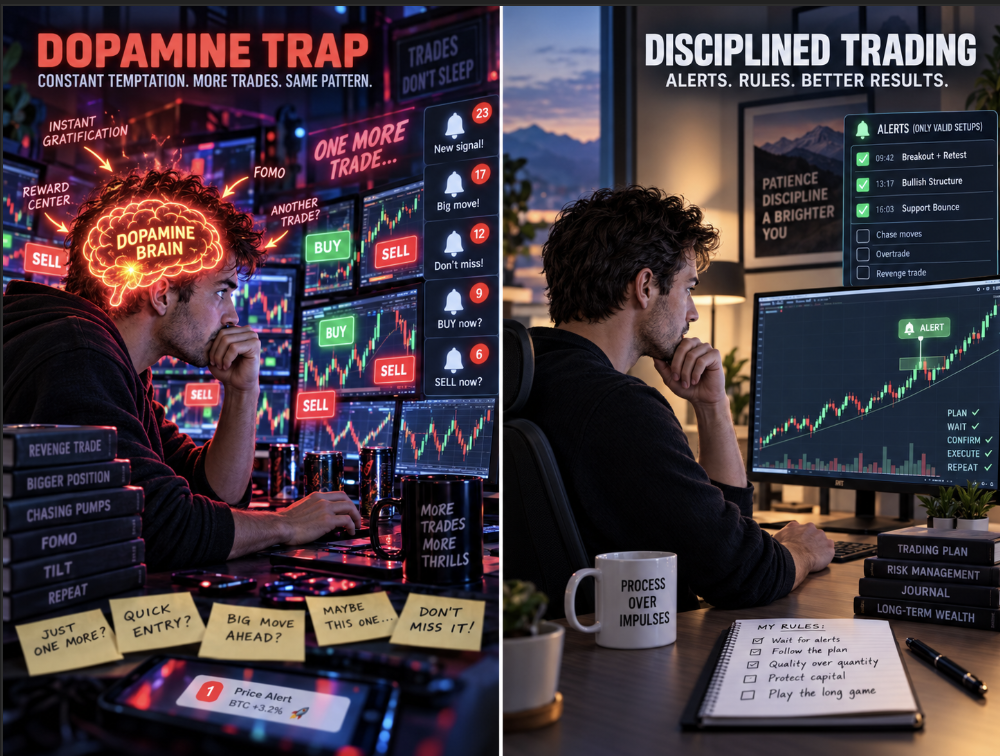
The ADHD brain releases dopamine in anticipation of a reward — not just when the reward arrives. This means placing a trade itself produces a dopamine hit completely separate from whether that trade is profitable. The entry is the reward. And when the entry is the reward, the brain stops caring about setup quality and starts seeking new entries constantly. The signs are specific: trading feels compulsive even when you know you shouldn’t be. You feel excitement the moment you enter regardless of whether the setup met your criteria. You become restless or anxious when you are flat. You find yourself checking charts during times you defined as off-limits. The antidote is structure — not willpower. Defined setup criteria, mandatory waiting periods, daily trade limits, and Trade Ideas scanners configured only to surface alerts when specific conditions are met interrupt the compulsive cycle by replacing emotional triggers with systematic ones.
How ADHD Traders Can Build a Successful Structure
The core principle is simple: ADHD traders need external structure to compensate for executive-function challenges that can make internal discipline unreliable. The goal isn’t to force the ADHD brain to operate like a neurotypical one.
- Use a pre-market routine as an anchor. A defined, repeatable pre-market process gives the ADHD brain a stimulating, purposeful activity to channel its energy before the market opens.
- Make the scanner the starting point. Defining setup criteria in advance with Trade Ideas means you’re looking for opportunities that meet your rules instead of hunting for trades because the market feels exciting.
- Set trade limits, not just loss limits. A maximum number of trades per day creates a hard stop against overtrading, even when the market remains stimulating.
- Use alerts instead of constant chart-watching. Specific alerts let you step away between opportunities, reducing boredom-driven trading.
- Favor shorter timeframes and clear structures. Rules-based setups such as an opening-range breakout, a first-30-minute setup, or a specific catalyst play provide clear decision points and enough stimulation to maintain engagement.
- Build in accountability. A trading partner or accountability system can provide an external check when impulsive behavior is stronger than the trader’s ability to self-regulate in the moment.
If you have ADHD and feel drawn to trading, the market’s speed, stimulation, and constant stream of patterns may fit the way your brain naturally works. But those same traits can become liabilities without structure—hyperfocus can make it difficult to walk away, stimulation can fuel overtrading, and pattern recognition can lead you to see setups that aren’t really there. ADHD isn’t a disqualifier for trading; it simply means you need a system built around the way your brain works.
Trade Ideas gives you that structure: real-time scanners help you find the setups that match your criteria, alerts help you stay focused without constantly watching the market, and a rules-based process can help turn your natural strengths into repeatable habits. Don’t fight your brain—build a trading system that works with it. Log into Trade Ideas today, build your setup criteria, set your alerts, define your daily trade limits, and put your ADHD strengths to work.