
The Hardest Part of Trading Isn’t the Market. It’s the Mirror: Why honest self-review is the most underrated skill in day trading
The Hardest Part of Trading Isn’t the Market. It’s the Mirror: Why honest self-review is the most underrated skill in day trading
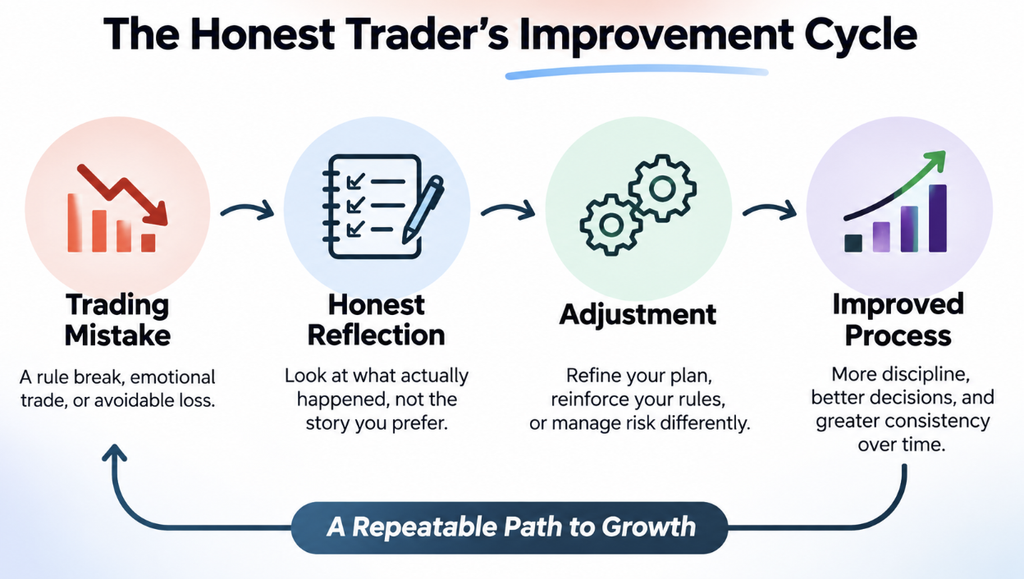
The group chat asks how your day went. You type “just a rough market, nothing worked.” What you leave out is that you broke your own rules on the second trade, sized up to win back the first loss, and moved your stop when it got uncomfortable. The market didn’t do that. You did, and you’re the only one who knows it. Anyone who’s spent time in therapy will recognize this moment, because progress starts with the same thing: telling yourself the truth about what you’re actually doing, not the version that’s easier to live with. Trading isn’t therapy, but it demands the same honesty. The market is an impartial mirror, and it reflects your decisions, not your intentions. Most traders don’t struggle because they lack a strategy. They struggle because it’s far easier to blame the tape than to admit what the P&L is actually showing.
Why is self-honesty the real edge?
Strategies are everywhere. Setups are taught for free, scanners surface them in real time, and most traders can recite a handful of rules they believe in. So the difference between traders is rarely the setup. It’s whether they execute it honestly.
Just like in therapy, you have to be brutally honest in your reflections, from your wins to your losses to your mistakes. The market doesn’t grade your intentions. Your P&L reflects the decisions you actually made, including the rule breaks you’ve already explained away. That’s what makes self-deception so expensive: every rationalized exception compounds, and every loss you label “bad luck” is a lesson you’ve skipped.
You can’t fix a problem you’ve reframed as something outside your control. Honesty has to come first, because it’s the step that makes every other improvement possible, from better risk management to cleaner execution. The traders who last are the ones willing to look at what’s actually in the data, the ones who approach their trading sessions as honestly as a therapy session.
The Stories Traders Tell Themselves
Every trader has a script for explaining a bad day. “The market was rigged today.” “That one was an exception to my rules.” “I’ll make it back tomorrow.” “I wasn’t really revenge trading, I just saw a good setup.” And the most tempting one of all: “My strategy stopped working,” when the real problem is that you stopped following it. These stories aren’t lies, but defenses, and they work because they protect something. Blaming the market shields your ego, and calling a rule break an exception keeps you from feeling like a rule-breaker. Promising to make it back tomorrow postpones the discomfort of admitting fault. Loss aversion makes it worse, because the pain of a loss is so strong that almost any explanation feels better than the truth. Therapy has a name for this pattern: avoidance and rationalization are defenses that keep people stuck. In trading, they do the same thing to your account.
What Honest Reflection Actually Looks Like
- Separate outcome from process: a loss that followed your rules isn’t a failure, and a win that broke them isn’t a success
- Name the emotion: fear, greed, boredom, FOMO, anger. Identifying it reduces its control
- Ask the uncomfortable questions: Did I follow my plan? Was I trading to make money or to feel something? Would I take this trade if it were my first of the day?
- Look at patterns, not single trades: the same mistake repeated at the same time of day tells you something.
- Stay curious, not punishing: honest self-review isn’t self-criticism. Harsh self-judgment pushes people back into avoidance.
Tools That Make Honesty Easier
Honesty gets easier when you build it into your process instead of relying on willpower. The trade journal is the most direct tool: record the setup, your reasoning, your emotional state, and what you’d do differently. Predefined written rules help too, because setting criteria in advance leaves less room to rationalize in the moment. Lean on data over memory. Memory flatters us, and records don’t, so review your actual trade logs and scan results rather than how the week felt. Accountability adds another layer. A trading partner or trading community will ask the questions you’d skip. A systematic, criteria-based scanner like Trade Ideas supports all of this by making it clear whether a trade met your defined setup or you talked yourself into it. When your criteria live in the scanner, “it was basically a setup” stops being an available story.
When Honesty Gets Hard: The Emotional Moments
Honesty is easy on a quiet day and hardest when it matters most. After a big loss, the urge to blame the market is strongest, which is exactly when an honest review is most valuable. After a big win, overconfidence is its own kind of self-deception: you start believing the outcome proved the process, even if you broke your rules to get it. During a losing streak, avoidance tempts you to stop reviewing at the worst possible time. And sometimes the honest realization is that you’re trading for the wrong reasons: boredom, excitement, or a need to feel in control. Know your limits, too. If trading is consistently triggering significant distress, anxiety, or compulsive behavior, talk to a qualified professional. Self-reflection is a trading skill, but it isn’t a substitute for mental health care.
The Payoff: What Honest Traders Gain
Honest traders gain more than they expect. They learn faster because they identify mistakes instead of repeating them. They manage risk better, because they stop lying to themselves about what they can tolerate. Their confidence is steadier, because it’s rooted in process rather than recent results. They’re less emotionally volatile, because nothing is being suppressed or spun. And they last longer: the traders who can face their own mistakes tend to be the ones still here in year five. The market doesn’t care about your story. It only reflects your decisions. Therapy and trading reward the same habit: looking at what’s actually there instead of what you wish were there. So tonight, write down one trade you’ve been rationalizing and describe it honestly. Then log into Trade Ideas, build your setup criteria into the scanner, and let the data hold your process accountable. The best trading decisions come from an honest look at what the market is showing you and what you’re actually doing about it.