
Are Trading Bots Really Worth It? The Honest Answer Every Trader Needs to Hear
Are Trading Bots Really Worth It? The Honest Answer Every Trader Needs to Hear
“Set it and forget it.” “Make money while you sleep.” “Take emotion completely out of trading.”
You’ve probably seen every pitch. Trading bots have become some of the most heavily marketed products in the retail trading world, promising to automate the hard parts of trading and, in some cases, deliver consistent profits with almost no effort.
But here’s the question every trader should ask before buying one: Are trading bots actually worth it—or are they simply a more sophisticated way to lose money on autopilot?
The honest answer is more complicated than either side of the argument suggests. Trading bots can be extremely useful for certain traders, strategies, and market conditions. They can also be completely inappropriate for others—understanding which category you fall into matters far more than finding the best bot.
What Trading Bots Actually Do
At its simplest, a trading bot is software that automatically executes trades according to predefined rules or algorithms. Instead of manually watching the market and placing every order yourself, the software monitors conditions and acts when its criteria are met.
Not all bots are the same. Some are simple rule-based systems that execute trades when specific price, volume, or indicator conditions occur. Others automate established strategies such as moving-average crossovers or momentum trading. More sophisticated systems incorporate artificial intelligence or machine learning to analyze market data and identify patterns. Copy-trading bots take a different approach by automatically replicating another trader’s trades.
There are legitimate advantages to automation. Bots can monitor markets continuously, execute orders faster than a human, apply the same rules consistently, and backtest strategies against historical data. In markets that operate around the clock, such as crypto, automation can also provide coverage no individual trader could realistically maintain.
But there’s an important distinction between executing a strategy automatically and creating a profitable strategy. A bot can execute flawlessly. It can’t guarantee that what it’s executing is actually a good idea.
When Trading Bots Actually Work
The strongest case for trading bots comes when the strategy itself is clearly defined, and the advantages of automation are obvious:
Speed: Certain strategies depend on extremely fast execution, where even a small delay can materially affect the outcome. An automated system can react in milliseconds—far faster than a human trader can analyze a chart, make a decision, and place an order.
Automation: remove emotional interference. A bot doesn’t panic after a losing trade, revenge trade to make the money back, or hesitate when a valid setup appears. For a trader whose biggest weakness is inconsistent execution, automating specific parts of the process can be valuable.
Consistency: a properly designed system follows its parameters every time: no fatigue, distraction, boredom, or temptation to change the rules halfway through the session.
Backtesting: helps traders evaluate a strategy before risking real capital. And for certain applications—such as portfolio rebalancing, systematic strategies, or monitoring multiple crypto markets simultaneously—automation can be genuinely practical.
The important word is specific; bots tend to work best when there is a clearly defined reason for automation in the first place.
Where Trading Bots Go Wrong
The biggest problem with trading bots is also their biggest misconception: automation does not create an edge. If the underlying strategy is bad, automating it simply allows it to lose money more efficiently. That’s the classic “garbage in, garbage out” problem. Other weaknesses include:
Overfitting: A bot can look spectacular in backtests because its parameters have been optimized around historical data. But markets don’t repeat themselves perfectly. A strategy engineered to perform beautifully under yesterday’s conditions may behave very differently when volatility, liquidity, or market structure changes.
Market context: A momentum strategy might perform well during a strong trend and struggle badly in a choppy market. A bot following its rules doesn’t necessarily know the difference. It can keep executing the same signals long after the environment that made them effective has disappeared.
Automated systems: despite the “set it, and forget it” principle, these systems aren’t truly passive. They require monitoring, maintenance, testing, and adjustment. Data feeds, API access, infrastructure, and subscriptions can add high costs. And no matter how sophisticated the technology is, unexpected market events can expose weaknesses that weren’t apparent during testing.
Retail trading bot marketplace: Traders should be extremely skeptical of these products that promise extraordinary returns with little risk. Backtests can be selectively presented, performance claims can be difficult to verify, and impressive-looking results don’t necessarily translate into live trading.
The Middle Ground: Intelligent Automation
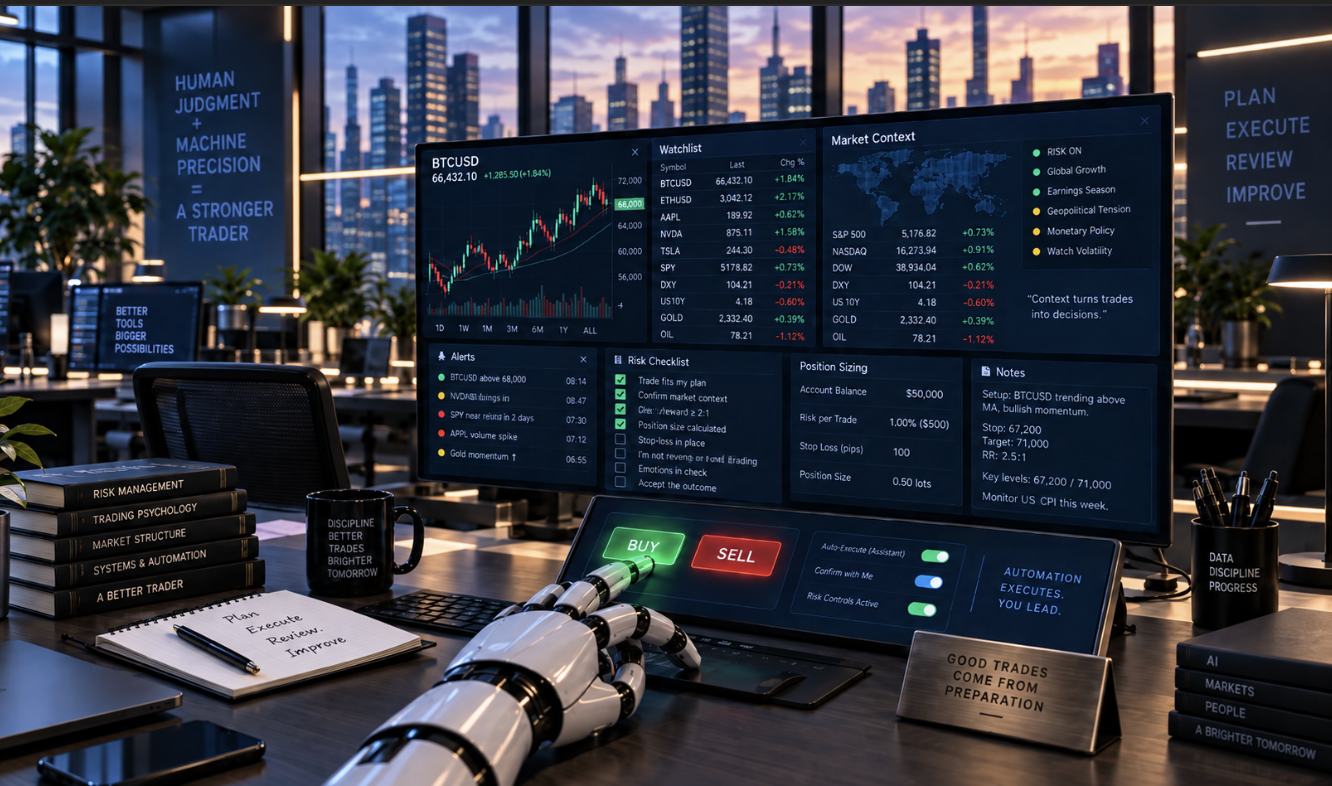
For many retail day traders, the better answer isn’t full automation; it’s intelligent augmentation. Instead of having software make every trading decision, traders can automate the mechanical and repetitive parts of the process while keeping human judgment where context matters most.
Trade Ideas isn’t a trading bot that blindly executes every signal. It’s an AI-powered real-time trading intelligence platform designed to help traders find and evaluate opportunities. Its scanners can monitor the market for stocks that meet predefined criteria, while alerts can tell traders when potentially relevant setups appear. That distinction is important. The technology does the monitoring; the trader does the thinking.
Holly AI can identify patterns and potential opportunities. At the same time, the trader remains responsible for deciding whether the setup makes sense in the broader market context and whether it fits their strategy and risk parameters. This approach captures many of the practical benefits of automation—speed, monitoring, consistency, and reduced search time—without handing over every important decision to an algorithm. For a discretionary trader, that’s often a much more useful application of technology than trying to eliminate the human element.
Questions to Ask Before Buying a Trading Bot
Before spending money on any automated trading system, ask:
- Does it have a verified live track record, rather than just impressive backtests?
- What market conditions does it perform best in?
- What happens when those conditions change?
- What are the historical and live maximum drawdowns?
- How much monitoring and maintenance does it require?
- What is the total cost, including data, APIs, infrastructure, and subscriptions?
- Who built it, and can you independently verify their trading and technical background?
- Can you paper trade or thoroughly test the system before risking real money?
- If this bot can generate extraordinary, consistent returns with minimal risk, why is the primary business model selling it to retail traders?
There may be legitimate answers. But you should be satisfied with those answers before putting your capital behind the system.
Who Should—and Shouldn’t—Use Trading Bots?
Bots may make sense for experienced traders with a well-defined strategy who want to automate mechanical execution. They’re also potentially useful for traders who have identified emotional execution as a specific weakness, crypto traders who need continuous market coverage, and technically skilled traders who can build, test, and maintain their own systems.
They’re generally a poor starting point for new traders who haven’t yet demonstrated that their underlying strategy works. Automating an unprofitable strategy doesn’t fix it—it can simply make the losses happen faster. They’re also a poor fit for anyone looking for effortless passive income or anyone attracted primarily by extraordinary return claims.
The Bottom Line
Trading bots aren’t magic. They’re tools. And like every tool, their value depends on how they’re designed, how they’re used, and whether they’re appropriate for the job. For many retail day traders, the smarter path isn’t replacing human judgment with automation. It’s using technology to augment that judgment—letting AI handle the scanning, monitoring, and pattern recognition while the trader stays in control of the decisions that require context.
The traders who succeed over the long term aren’t necessarily the ones who find a bot to trade for them. They’re the ones who build the strongest possible trading process and use technology to make that process faster, more informed, and more consistent.
Ready to see what intelligent trading augmentation looks like? Log in to Trade Ideas today and explore real-time AI-powered scanning, Holly AI pattern recognition, and automated alerts that surface potential setups for you—while keeping you in control of every decision that matters.