
PDT Rule Gone: How Small-Account Traders Can Approach Summer Day Trading Smarter
PDT Rule Gone: How Small-Account Traders Can Approach Summer Day Trading Smarter
The PDT rule gone conversation has opened the door to a lot of excitement, especially among traders with smaller accounts.
For years, the pattern day trader rule made active trading harder for anyone with less than $25,000 in a margin account. Now that the old framework has changed, many traders are asking the same question:
Can I finally day trade more freely with a smaller account?
The answer is yes, there may be more flexibility now. But that does not mean day trading suddenly becomes easy.
More access can also mean more temptation. More trades. More emotional decisions. More chances to turn a small loss into a bigger one.
That matters even more during summer trading, when volume can be lighter, moves can fade faster, and the best setups often require more patience.
So instead of looking at the PDT rule removed update as permission to trade everything, small-account traders should see it as a reason to trade smarter.
What Changed With the PDT Rule in 2026?
The old pattern day trader rule required traders who made four or more day trades within five business days in a margin account to maintain at least $25,000 in equity.
That rule created a major barrier for traders trying to learn active trading with smaller accounts.
FINRA has now adopted new intraday margin standards that replace the old day trading margin requirements, including the day-trade count requirement and the $25,000 pattern day trader minimum equity requirement. The effective date is June 4, 2026, with a phase-in period ending October 20, 2027.
Here is the important part: the old PDT structure being removed does not mean there are no rules.
Brokerage firms may still monitor intraday margin risk. FINRA also notes that firms may block trades that create margin deficits, calculate intraday margin requirements after the trading day, issue margin calls, or apply a combination of approaches.
So the opportunity is real, but so is the responsibility.
What This Means for Small-Account Day Trading
For small-account traders, the biggest change is flexibility.
The old rule often forced traders to choose between waiting days to place another trade or keeping more capital in the account than they were ready to risk.
Now, small-account day trading may become more accessible for many traders. That can be a positive shift, especially for people who want to build skill through repetition, testing, and real market experience.
But there is a catch.
More access does not create a trading edge.
A trader can take more trades and still lose money faster if the setups are weak, the position size is too large, or the plan changes mid-trade.
That is why the new environment rewards traders who are selective.
Instead of asking, “How many trades can I take now?” a better question is:
“Which trades actually deserve my attention?”
That is where tools like real-time scans, alerts, and strategy testing become more useful. Trade Ideas is built around helping active traders identify real-time opportunities, use market alerts, test strategies, and work with AI-powered trading insights without manually watching every ticker on the screen.
One important decision hasn’t changed, even though the PDT rule has. Before you think about strategies or setups, make sure you’re trading with the account type that matches your experience, goals, and risk tolerance. The quick comparison below can help you understand the key differences.
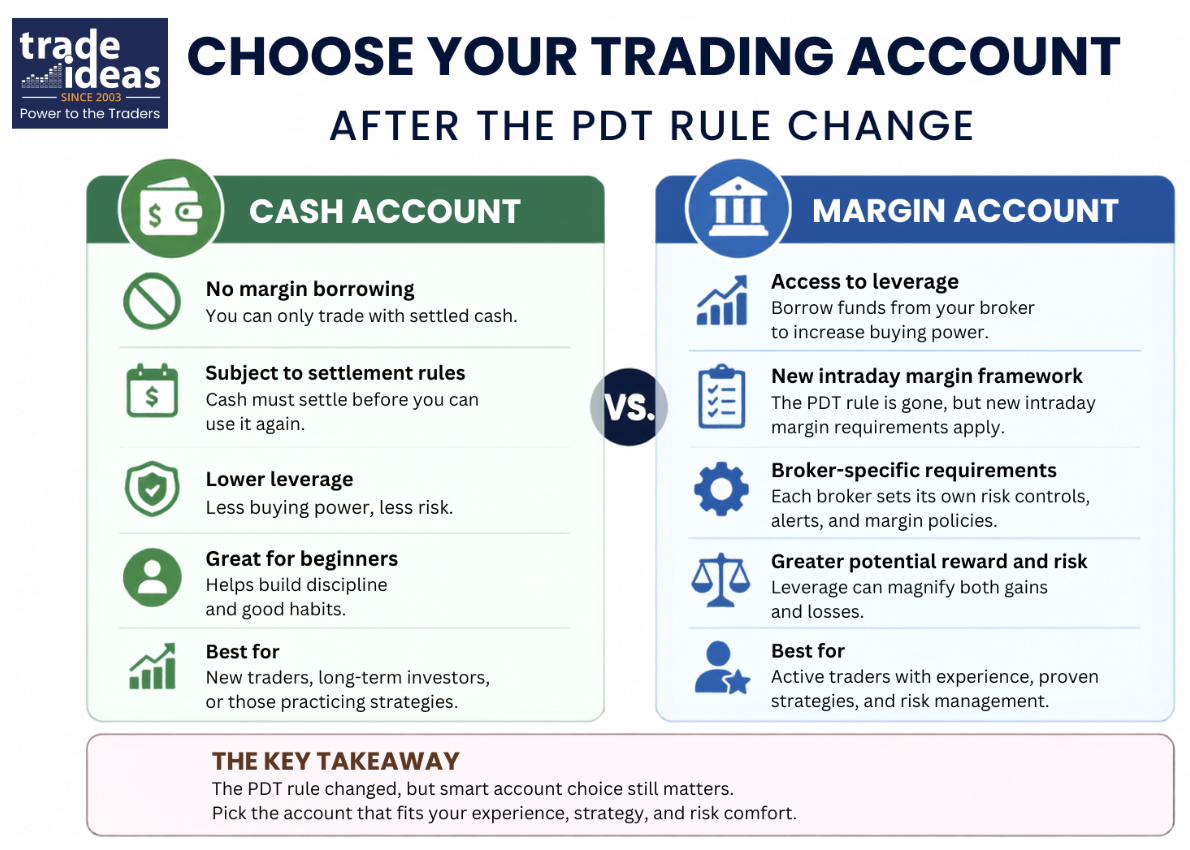
Once you’ve chosen the account structure that fits your trading style, the next challenge is adapting to current market conditions. During the summer months, that means being even more selective about the setups you trade and the risk you take.
Why Summer Day Trading Requires Extra Discipline
Summer trading has its own rhythm.
Markets can still move, but not always in a clean or predictable way. Some days bring strong momentum. Other days feel slow, thin, and choppy.
During summer, many traders watch for:
- Lower overall participation
- Reduced volume in certain names
- Faster failed breakouts
- More selective momentum
- News-driven spikes
- Sector-specific movement
- Shorter trading windows
That does not mean summer is a bad time to trade. It means traders need a stronger filter.
A good summer day trading strategy should not be built around forcing trades. It should be built around waiting for liquidity, volume, and confirmation.
Summer trading often requires more patience because lower participation can lead to inconsistent momentum. Understanding how low-volume summer markets behave can help traders become more selective rather than chasing every move.
For small-account traders, that matters even more.
When your account is smaller, one undisciplined trade can do more damage. A wide spread, poor entry, or low-volume fakeout can quickly turn into a painful lesson.
A Smarter Summer Trading Framework After the PDT Rule Change
The pattern day trader rule removed update may give traders more room to act, but smart trading still starts with structure.
Here is a simple framework small-account traders can use before taking a summer day trade.
| Step | What to Check | Why It Matters |
| Market condition | Is the overall market trending, choppy, or slow? | Helps avoid forcing trades in weak conditions |
| Volume | Is the stock trading with unusual or strong volume? | Confirms real participation |
| Liquidity | Is the spread manageable? | Protects small accounts from poor fills |
| Catalyst | Is there news, earnings, sector movement, or another reason? | Helps separate real moves from random spikes |
| Key level | Is price near VWAP, premarket high, opening range, or support/resistance? | Gives the trade structure |
| Risk level | Do you know where the trade is wrong? | Prevents emotional exits |
| Position size | Is the trade size reasonable for your account? | Keeps one trade from causing major drawdown |
This framework is simple, but it keeps traders focused.
The goal is not to catch every move. The goal is to find trades where the reason, risk, and setup all make sense together.
Better Filtering Matters More Than More Trading
The biggest risk after the PDT rule update is overtrading.
A trader who was previously limited to a few day trades may suddenly feel like every move is an opportunity. That mindset can be dangerous.
More trades do not automatically mean more progress.
In fact, for small accounts, better filtering usually matters more than higher activity.
A stronger trade filter may include:
- Relative volume
- Float
- Price range
- News catalyst
- Sector strength
- Gap percentage
- VWAP relationship
- Opening range behavior
- Liquidity and spread
- Prior support and resistance
This is where scanner-based trading can help.
Instead of jumping from ticker to ticker, traders can define the kind of setup they want to see and wait for stocks that match those conditions.
For example, a trader looking for a gap-and-go setup may want to filter for premarket gainers, high relative volume, strong liquidity, and a clean opening range. A trader looking for a VWAP reclaim may want to watch for stocks that lost VWAP, stabilized, and then reclaimed it with volume.
The point is not to make the scanner think; it is to use scanning to reduce noise.
How Trade Ideas Fits Into the New Day Trading Environment
The new day trading under $25k conversation is not just about access. It is about decision quality.
Traders may now have more flexibility, but they still need a way to separate high-quality setups from random movement.
Trade Ideas can support that process in a few practical ways.
Real-Time Scans Help Traders Find Active Setups
A real-time scanner can help traders focus on stocks that are actually moving, instead of guessing where momentum might appear.
Useful scan ideas for summer trading include:
- High relative volume stocks
- Premarket gappers
- Stocks breaking above key levels
- VWAP reclaim setups
- Opening range breakout candidates
- Stocks with unusual volume
- Momentum names with liquidity
This is especially useful during summer, when broad market action may be slower but individual names can still create strong intraday opportunities.
Alerts Help Reduce Screen Fatigue
Small-account traders often make mistakes when they stare at too many charts for too long.
Alerts can help reduce that pressure.
Instead of watching every stock manually, traders can set conditions and wait for the market to come to them.
That encourages patience, which is one of the most important skills after the PDT rule removed change.
Backtesting Helps Traders Avoid Guesswork
A trading idea may sound good, but that does not mean it works consistently.
Backtesting helps traders review how a setup has performed historically before they risk real money.
For small accounts, that can be valuable because every mistake has a bigger impact. Testing a setup before using it live can help traders avoid treating their account like an experiment.
AI Can Support Idea Generation
Trade Ideas’ Holly AI provides real-time stock suggestions for premium subscribers, including entry and exit signals, and the system updates based on past data and simulated backtesting.
That can help traders discover opportunities they may not have found manually.
Still, AI should not replace risk management. It should support a process that already includes position sizing, setup quality, and a clear exit plan.
Small-Account Mistakes to Avoid After the PDT Rule Is Gone
The new rules may create more flexibility, but they can also expose bad habits faster.
Here are the mistakes small-account traders should watch closely.
Mistake 1: Trading More Just Because You Can
The old rule limited activity. The new structure may reduce that limitation.
But freedom is not the same as edge.
If the setup is not strong, skipping the trade is still a valid decision.
Mistake 2: Chasing Every Gap
Gap stocks can be exciting, especially in the morning.
But not every gap is a good gap-and-go candidate.
A better setup usually has volume, liquidity, a catalyst, and follow-through. Without those, a gap can fade quickly.
Mistake 3: Ignoring Liquidity
Low-volume stocks can move fast, but they can also trap traders.
Wide spreads, poor fills, and sudden reversals can hurt small accounts quickly.
Before entering, check whether the stock is liquid enough for your trade size and risk plan.
Mistake 4: Oversizing to Make the Trade “Worth It”
Small accounts can make traders feel pressure to size up.
That is risky.
A trade should not be larger just because the account is smaller. Position size should come from risk, not emotion.
Mistake 5: Averaging Down Without a Plan
Averaging down can turn a small planned loss into a large unplanned loss.
If the trade breaks your level, the setup has changed. Hope is not a strategy.
Mistake 6: Treating Alerts Like Automatic Buy Signals
Alerts are useful, but they are not a complete trading plan.
An alert should tell you something is worth checking. It should not replace your entry criteria, risk level, or exit plan.
Example Scanner Criteria for Summer Day Trading Setups
A good scanner does not need to show every moving stock. It should help you find the kind of stocks that match your trading plan.
Here are a few setup ideas traders may watch during summer.
| Setup Type | Scanner Criteria to Consider | Why It Helps |
| Gap and Go | Premarket gap, relative volume, news catalyst, strong opening range | Helps find early momentum candidates |
| VWAP Reclaim | Price reclaiming VWAP, volume increase, trend shift | Helps identify possible intraday reversals |
| Relative Strength | Stock outperforming the market or sector | Helps avoid weak names |
| High-Volume Breakout | Unusual volume, key level break, range expansion | Confirms stronger participation |
| Low-Float Momentum | Float, volume, spread, volatility | Can identify fast movers, but requires strict risk |
These are not automatic buy signals. They are filters.
The trader still needs to confirm the setup, define risk, and decide whether the trade fits their plan.
A Simple Risk Checklist Before Taking a Summer Day Trade
Before entering a trade, ask these questions:
- Is the stock moving on real volume?
- Is there a catalyst or clear technical reason?
- Is the spread manageable?
- Is the stock liquid enough for my position size?
- Is price near a meaningful level?
- Do I know where I am wrong?
- Is my risk small enough for my account?
- Am I taking this trade because it fits my plan?
- Have I tested or practiced this setup before?
- Would I still take this trade if I only had a limited number of trades left?
That last question is important.
Even if the old PDT structure no longer limits traders the same way, disciplined traders should still behave as if every trade matters.
Because it does.
Does the PDT Rule Gone Update Mean Day Trading Is Easier?
Not exactly.
The PDT rule gone update may make day trading more accessible, especially for smaller accounts. But easier access does not remove the hard parts of trading.
Traders still need to manage:
- Risk
- Emotions
- Trade selection
- Position sizing
- Market conditions
- Slippage
- Losses
- Broker-specific margin rules
For many traders, the real challenge will be avoiding overactivity.
The traders who benefit most from the new environment will likely be the ones who build repeatable processes, not the ones who simply trade more often.
Final Thoughts: More Flexibility Means More Responsibility
The PDT rule update is a major shift for active traders.
For small-account traders, it may create more freedom to participate in intraday markets. It may also make it easier to practice, learn, and respond to real-time opportunities.
But the market does not reward freedom alone.
It rewards preparation, patience, risk control, and the ability to choose better setups.
That is especially true during summer trading, when volume can be lighter, and follow-through can be less reliable.
So if you are approaching small account day trading under the new day trading rules 2026, do not focus only on how many trades you can take.
Focus on which trades are worth taking.
Real-time scans, alerts, backtesting, simulated practice, and AI-powered insights can help traders create more structure around that decision. The goal is not to trade more just because you can.
The goal is to trade smarter because now every decision matters even more.
FAQs About PDT Rule Gone, Small Accounts, and Summer Day Trading
1. Can I use a cash account to avoid PDT-style restrictions?
Cash accounts are different from margin accounts, but they still have settlement rules. Traders should understand good faith violations, settled funds, and broker-specific policies before relying on a cash account for frequent intraday trading.
2. Does the PDT rule gone update apply to options trading?
The old PDT framework applied to day trading activity in margin accounts, including options. Under the new intraday margin framework, traders should check how their broker applies margin rules to stocks, ETFs, and options.
3. Should beginners start day trading now that the PDT rule is removed?
Beginners should not rush into live trading just because access is easier. A better path is learning setups, practicing in simulation, tracking results, and starting with small risk before increasing trade activity.
4. What type of stocks are better for small-account day traders?
Small-account traders often need liquid stocks with strong volume, manageable spreads, and clear price levels. Extremely thin or volatile stocks may look attractive, but they can increase slippage and risk quickly.
5. How many day trades should a small-account trader take per day?
There is no perfect number. A small-account trader should focus on setup quality, risk per trade, and emotional control. Taking fewer high-quality trades is usually better than forcing several low-quality trades.