
Is AI Trading a Good Option for Beginners in 2026?
Is AI Trading a Good Option for Beginners in 2026?
What’s actually changed, what still trips people up, and how active retail traders are using AI to get a real edge in today’s market.
AI in trading isn’t a future thing anymore. It’s already here, it’s running on your competition’s screens, and it’s generating real signals while you’re still scrolling through charts manually.
But most beginner content about AI trading is written for a general audience, people who might trade crypto, forex, or ETFs, or who are just curious. That’s not who this is for.
This guide is written for active retail stock traders in the US, people who want to find momentum, spot breakouts, and trade smarter every session. If that’s you, here’s what you actually need to know about AI trading in 2026.
A study covering 8 million trader profiles over 28 years found that 74–89% of retail traders lose money during volatility events, not because the market is rigged, but because emotional decision-making kicks in at exactly the wrong moment. That’s the problem AI trading tools are built to solve.
What is AI Trading Really?
At its core, AI trading means using software to analyze market data, find patterns, and either suggest trades or execute them automatically, without you second-guessing everything in real time.
For active stock traders, this usually shows up in three practical ways: real-time scanners that surface momentum setups, AI signals that give you specific entry and exit points, and backtesting tools that tell you whether a strategy actually holds up historically.
What it doesn’t mean: building Python models, writing algorithms from scratch, or understanding machine learning theory. Modern platforms have already done that work. Your job is to know how to use the output.
How AI Actually Helps Active Traders
Here’s the honest version, not the marketing version.
It Scans Faster Than Any Human Can
There are over 8,000 publicly traded US equities. On any given morning, a handful of them are setting up for a meaningful move. Finding those in real time manually is essentially impossible. AI-powered scanners do this continuously, filtering the entire market down to the setups that match your criteria the moment they trigger. No lag, no refresh button.
It Removes Emotion From the Equation
Fear and greed are the two most expensive feelings in trading. According to a Dalbar study, the average retail investor underperformed the S&P 500 by 6.1% annually over 20 years, largely because of emotional exits during downturns. AI executes the plan you set, not the panicked version of you at 9:45 AM.
It Keeps Learning From Market Conditions
Static strategies go stale. The market that worked in 2022 isn’t the same market as today. Good AI tools continuously backtest and recalibrate, not against decades of old data, but against what’s actually been happening recently. That’s a real edge for active traders who don’t have time to manually re-optimize strategies every week.
It levels the playing field
Institutional desks have run algorithmic strategies for decades. Platforms like Trade Ideas are closing that gap for retail traders, giving individual traders access to the same real-time scanning and pattern detection that used to require an entire quant team. That’s not hype; that’s the actual direction the market has moved.
“Scanning beats screening every time. Traditional screeners are like slow econo-cars. Trade Ideas is the high-performance machine built to win races.”
— Trade Ideas, on why real-time scanning changes the game for active traders
What AI Trading Looks Like in Practice: Meet Holly
If you want a concrete example of what AI trading tools actually do day-to-day, Holly, Trade Ideas’ AI, is a good place to start.
Holly AITrade Ideas
Holly runs over 60 algorithms every night, adapts based on what actually worked in today’s market, and delivers 5–25 specific trade ideas each session with entry and exit levels included.
- Real-time buy/sell signals with entry & exit levels
- Algorithms updated every night based on recent data
- No coding or setup required to use signals
- Connects directly to your brokerage for one-click execution
Holly isn’t making vague predictions. She’s flagging specific stocks at specific price levels with a defined trade plan. You still decide whether to take the trade, but the heavy lifting of scanning 8,000+ stocks and identifying the setup is already done.
See how Holly’s AI signals work.
From Market Open to Trade Signal: How It Works
Here’s how an AI-powered trading workflow like Holly actually runs, from overnight recalibration to a signal hitting your screen at market open.
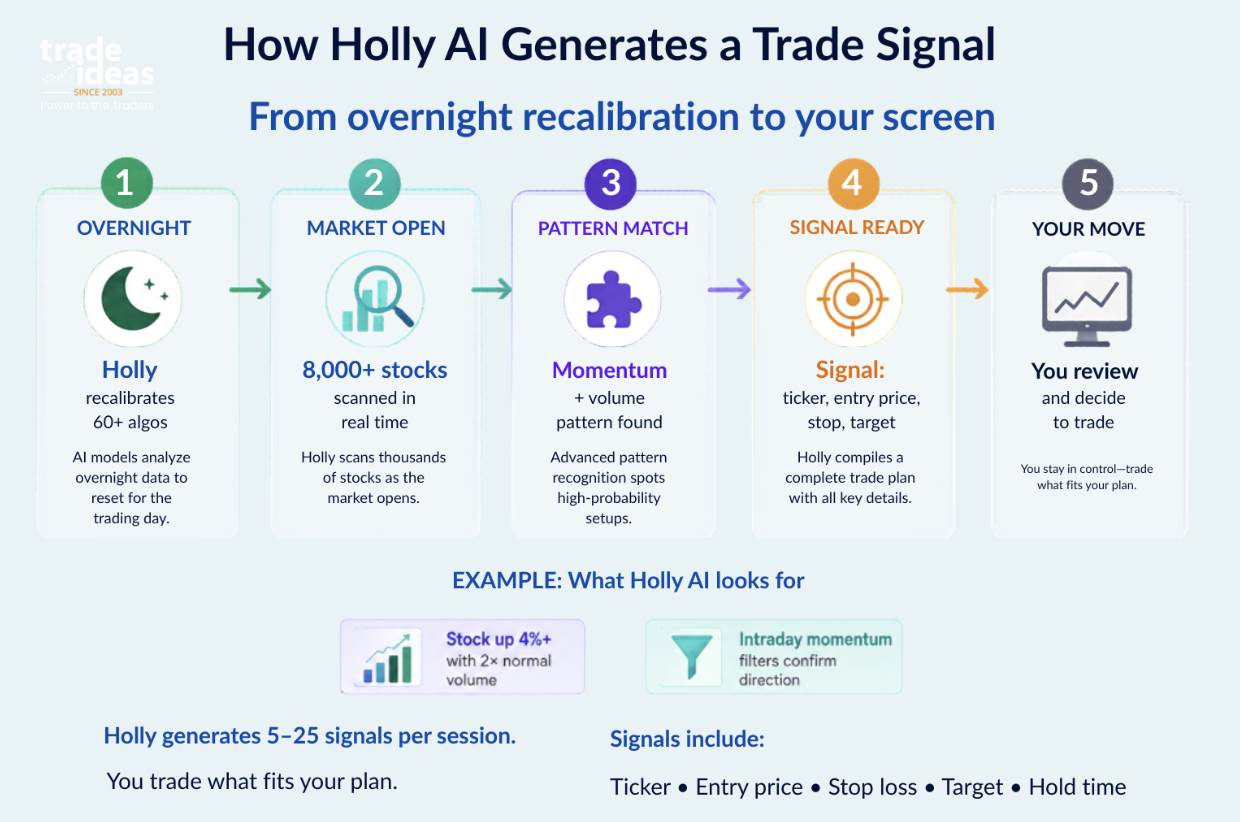
There are many ways AI shows up in trading, but most of them aren’t relevant if you’re actively trading US equities. Here are the four types worth knowing:
1. AI-Powered Real-Time Scanning
This is the most practical for active traders. Instead of manually filtering stocks, AI continuously scans the entire market for momentum, volume spikes, breakouts, and pattern setups, alerting you the moment a trigger fires. Trade Ideas’ streaming alerts work exactly this way.
2. AI Signal Generation
Goes a step beyond scanning by not just flagging a stock but giving you a full trade plan: entry, stop, and target. The AI has already run the analysis; you decide whether to act on it.
3. Algorithmic / Automated Trading
You define the rules; the system executes. Useful for traders who’ve validated a strategy and want to remove execution hesitation. Requires understanding your edge before automating it.
4. AI-Assisted Backtesting
Tools like Trade Ideas’ OddsMaker let you score a strategy against recent historical data before you risk real money on it. Not glamorous, but one of the most consistently useful things AI can do for a trader.
Risks to Watch Out For in AI Trading
No tool eliminates risk, and overselling AI trading is its own kind of danger. Here’s an honest look at what can go wrong:
| Risk | What it actually means for you | Level |
| Over-reliance on signals | Taking every signal without context removes your judgment from the equation, which is still valuable, especially around news events and earnings. | High |
| Black-box decision making | If you don’t understand why a signal fired, you can’t evaluate whether it fits your risk tolerance or current market conditions. | Medium |
| Flash volatility failures | AI trained on recent patterns can misfire in sudden macro-driven moves: Fed decisions, geopolitical events, flash crashes. Stops exist for a reason. | High |
| Platform security | Any platform connected to your brokerage is a security surface. Use two-factor authentication and vet platforms before linking live accounts. | Medium |
| Regulatory changes | AI trading regulations in the US are still evolving. FINRA and the SEC have been increasing oversight of algorithmic trading activity. Stay current. | Low–Med |
How to Actually Get Started (Without Overcomplicating It)
You don’t need to learn Python. You don’t need to build a model. Here’s what actually moves the needle for a retail trader starting with AI tools:
1. Know What You’re Trying to Solve First
Are you missing setups because you can’t scan fast enough? Taking losses because you hold too long? AI tools fix specific problems, know yours before picking a platform.
2. Start With a Platform That Shows You Why, Not Just What
The best AI tools give you signals and context: volume, price action, momentum data. Signals you can’t evaluate are just noise. Use Trade Ideas’ simulated trading to practice before going live.
3. Backtest Before You Risk Real Money
This is the step most beginners skip. Run your chosen strategy through the OddsMaker backtester first. See how it performed over the last few months in real market conditions, not just theory.
4. Use AI to Narrow the Field, Not Replace Your Judgment
Think of it as a filter, not an oracle. The AI surfaces the candidates; you make the call. That combination; machine speed, human judgment, is the actual edge.
5. Watch a Live Session Before Trading Live
Trade Ideas’ live Trading Room lets you watch experienced traders using the platform in real time. One good session teaches you more than a week of reading about it.
See Holly AI signals in action
Real-time trade signals with entry, stop, and target, no setup required
Common Myths Cleared Up
| Myth | Reality |
| “AI trading guarantees profits if you follow every signal.” | No signal has a 100% win rate. AI improves your probability; it doesn’t remove market risk. Even Holly’s best days have losing trades mixed in. |
| “You need to understand machine learning to use AI trading tools.” | Modern platforms abstract all of that away. If you can read a chart and understand a trade setup, you can use AI trading tools effectively today. |
| “AI trading is only for institutional players or quants.” | Retail adoption has grown significantly. Retail investors now hold 38.5% of the algo trading market; the gap is closing fast. |
| “Once you set up an AI system, you can step away completely.” | Markets change. Strategies that worked last quarter may need recalibration this quarter. Active oversight even minimal is still necessary. |
Where AI Trading Is Headed in 2026 and Beyond
A year ago, “the future of AI trading” sections were full of speculation about quantum computing and blockchain. Those things are real, but they’re not what’s changing your trading day right now.
What is actually happening right now: AI tools are getting faster at adapting to current market conditions (not just historical patterns), the line between scanning and signal generation is blurring, and execution is getting tighter with direct brokerage integrations that remove the gap between signal and order.
For retail traders, the most meaningful shift is this: the tools that used to require a full trading desk are now available for the price of a monthly subscription. The global AI trading platform market is growing at 20% annually, which means more competition among platforms and better tools for traders at every level.
The traders who win in this environment aren’t the ones who outsource everything to AI. They’re the ones who use AI to do the mechanical work; scanning, filtering, pattern recognition, while applying their own judgment to setup quality, position sizing, and market context.
FAQs on AI Trading

What’s the difference between a stock scanner and an AI trading signal?
A scanner finds stocks meeting certain criteria (volume, price action, etc.) and shows you a list. An AI signal goes further; it identifies a specific stock, tells you when to enter, where to put your stop, and what your target is. Scanners give you candidates; signals give you a full trade plan. Trade Ideas offers both, and using them together is more powerful than either alone.
Can I use AI trading tools if I only trade for an hour in the morning?
Yes; and honestly, AI tools are especially valuable for traders with limited time. A real-time scanner surfaces setups as they happen, so you’re not spending your first 30 minutes manually searching. You can focus entirely on evaluating the opportunities already in front of you and managing positions. Trade Ideas’ streaming alerts are designed for exactly this workflow.
How do I know if an AI trading platform’s backtesting results are reliable?
Look for platforms that backtest against recent data (last few months, not decades), that show you the number of trades and not just win rate, and that allow you to test your own strategy — not just pre-built ones. Overfitted backtests that look perfect on historical data often fall apart live. Trade Ideas’ OddsMaker is transparent about this; it scores how a scan and strategy would have performed over recent history before you commit real capital.
Is it safe to connect an AI trading platform directly to my brokerage account?
It can be, but choose carefully. Look for platforms that use secure broker APIs, offer two-factor authentication, and have a clear record of reliability. Many traders prefer to receive AI signals and execute them manually in their broker. Trade Ideas supports this approach for brokers that don’t connect directly to their Brokerage+ module, giving you full control over execution while still benefiting from AI-generated ideas.
Are AI trading signals taxed differently from trades I execute myself?
No, the IRS treats trades the same way regardless of how the signal was generated. What matters is your holding period (short-term vs. long-term capital gains) and your account type. That said, active AI-assisted trading can generate a high volume of short-term trades, which has tax implications worth discussing with a qualified tax professional before scaling up. The IRS has specific guidance for day traders that’s worth reviewing.
Recent Posts
- You don’t need a rocket ship. You need a great trade.
- Don’t Write Off a Stock Just Because It’s Already Up 1,000%
- What Makes This Trade Great: Low-Priced China Stocks Are Back in the Spotlight
- Every Stock Has a Secret Schedule — And Trade Ideas Just Cracked the Code
- When Good Earnings Don’t Matter — How Our AI Caught a Short on a Down Market Day