
Bitcoin Miners Are Ditching Crypto for AI — And It Could Be the Trade of the Year
Bitcoin Miners Are Ditching Crypto for AI — And It Could Be the Trade of the Year
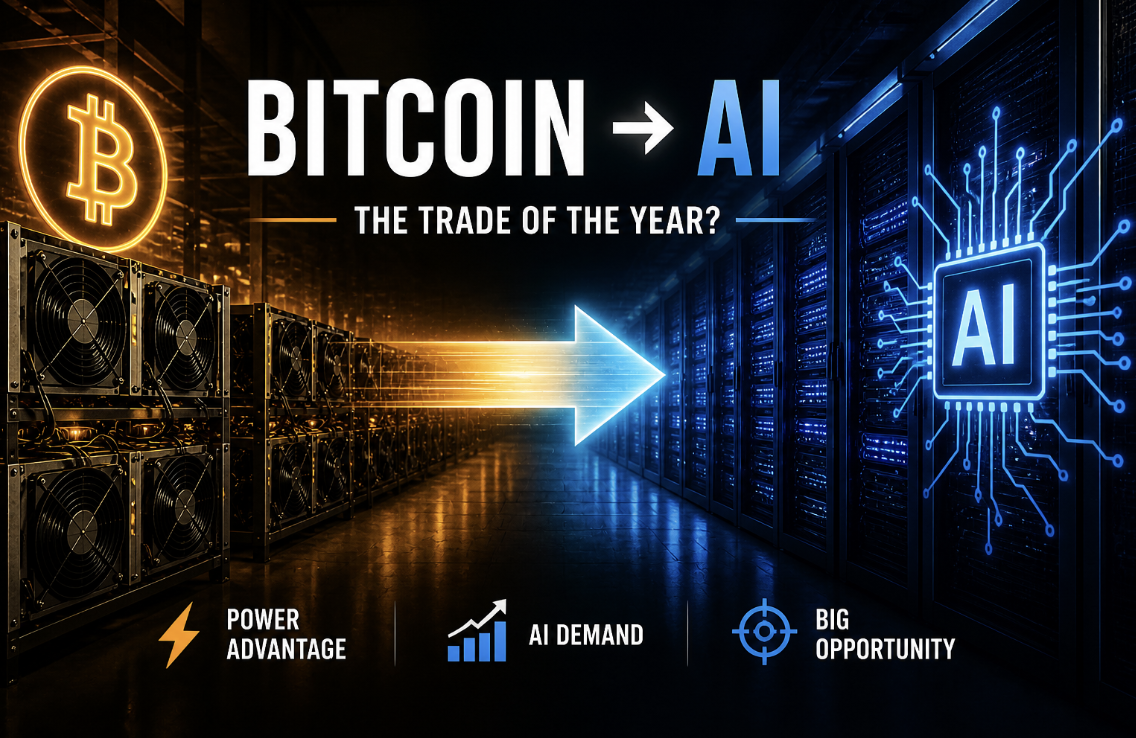
The Bitcoin mining business model is quietly breaking down, and the smartest players in the industry know it. Since the April 2024 halving, block rewards have been cut in half overnight, leaving mining margins so squeezed that survival and growth require a new strategy. Now THAT AI data center demand is explodinG, companies that built massive, power-hungry crypto facilities now see servicing artificial intelligence as their next move. This shift offers more opportunity than most traders realize. Yet, this transition is not simple, and the challenges ahead are as important as the opportunities. In this article, we’ll show which Bitcoin mining stocks are pivoting, what they must do, and why the market hasn’t priced in what this shift could mean for names like RIOT, MARA, and HIVE.
The Bitcoin Mining Crisis: Why the Old Model Is Dying
To understand why Bitcoin miners are scrambling for a new business model, you have to start with the halving. In April 2024, the programmatic reward for mining a Bitcoin block was cut from 6.25 BTC to 3.125 BTC — overnight, revenue was slashed in half while energy costs, equipment financing, and operational overhead stayed exactly the same. That alone would have been painful enough, but the compounding problem is that mining difficulty continues to rise as the network grows, meaning miners are working harder for less. Energy costs, always the dominant expense in mining operations, are now consuming margins that barely existed to begin with, and older, less efficient rigs have gone from marginally profitable to money-losing almost overnight. Smaller operators are being wiped out entirely, accelerating an industry consolidation that is leaving even the large-scale survivors struggling to justify expansion under the current economics. For publicly traded miners like RIOT, MARA, and HIVE, this isn’t a temporary headwind; it’s a structural shift that investors are losing patience with fast. The pure-play Bitcoin mining story is broken, and the industry knows it. What comes next needs to be a fundamentally different pitch, and right now, artificial intelligence is providing exactly that.
The AI Data Center Crisis
The demand side of the AI data center equation is not in question. Microsoft, Google, Amazon, and Meta are collectively committing hundreds of billions of dollars to build out the compute infrastructure that powers modern AI, and supply cannot keep up. On paper, the opportunity for anyone who can provide that infrastructure is enormous. The problem nobody fully anticipated is that Americans, it turns out, don’t actually want a data center in their backyard. Communities across the country are pushing back hard against new facilities, and the objections are visceral:
- The noise is relentless and industrial, running 24 hours a day.
- The lights never go off.
- The power consumption strains local grids.
- The water demands for cooling systems are drawing fierce opposition in drought-prone regions.
Local zoning boards and city councils are rejecting permits at unprecedented rates. Projects that once had momentum are now stalled indefinitely. The backlash crosses political lines, with rural and urban communities alike saying no. This has created a genuine supply constraint in one of the fastest-growing infrastructure markets. As a result, companies with approved, operational, power-connected facilities now hold enormous strategic value. That is exactly the hand Bitcoin miners are sitting on, and they are starting to play it.
The Critical Distinction: Why You Can’t Just Flip a Switch
Here’s a common misconception: Bitcoin miners cannot simply switch their machines to AI workloads. The hardware is fundamentally incompatible. Bitcoin mining uses ASICs (Application-Specific Integrated Circuits), single-purpose chips built only to solve cryptographic puzzles, which are useless for other tasks. AI relies on GPUs (Graphics Processing Units), especially high-end NVIDIA chips, to perform complex computations such as training AI models. GPUs need different racks, higher power density, and advanced cooling. Turning a mining facility into an AI-ready data center means:
- Ripping out the existing hardware
- Upgrading power distribution systems to handle the denser energy loads that GPU clusters (groups of GPUs working together to support heavy computational tasks) demand
- Overhauling cooling infrastructure
- Building out high-bandwidth networking
- Procuring GPU hardware that is itself expensive and supply-constrained
- Doing the contractual and regulatory work required to bring in a hyperscaler tenant.
The timeline for these conversions spans months to years, not weeks, and the capital requirements are significant. Yet, none of that is the primary challenge. The real difficulty lies in securing land, locking in large-scale power contracts, obtaining permits, and building operational facilities—tasks these miners have already completed. As a result, they are paying the conversion cost to access a market that is orders of magnitude larger than the one they are leaving behind. Given the alternative of enduring shrinking margins in a structurally broken business, the decision becomes clear.
The Companies Making the Pivot
Several publicly traded Bitcoin miners are already deep into this transition, each at a different stage and with a different strategic angle. Here’s a look at the names worth tracking:
- RIOT Platforms (RIOT) — Developing HPC/AI hosting capabilities at its massive Rockdale, Texas campus, backed by one of the largest power contracts in the industry
- Marathon Digital (MARA) — Leveraging its large-scale infrastructure base to diversify into high-performance computing as mining margins compress
- HIVE Digital Technologies (HIVE) — Already operating GPU-based infrastructure across Canada and Europe, making it arguably the most operationally advanced in the actual AI pivot
- Core Scientific (CORZ) — Signed a landmark HPC hosting deal with CoreWeave that has become the blueprint for how this transition works; the one to study
- Iris Energy (IREN) — Aggressively building out GPU capacity and pursuing AI cloud services alongside its existing mining business
- TeraWulf (WULF) — Nuclear-powered facilities give it a clean energy profile that ESG-conscious hyperscaler tenants find increasingly attractive
- Cipher Mining — Earlier stage, but sitting on strong power infrastructure assets that make it a credible pivot candidate
The key metric is revenue mix: watch how the percentage of total revenue from HPC/AI hosting versus bitcoin mining shifts. HPC (High Performance Computing) means providing advanced computational resources, such as hosting powerful GPUs for tasks like AI model training. This percentage is the clearest signal of who is executing versus who is just talking about it.
The Investment Case: What Traders Need to Know
The market is still largely pricing these companies as Bitcoin mining stocks, and that mispricing is the opportunity. As HPC and AI hosting revenue begins to displace mining income on quarterly earnings reports, the re-rating potential is significant. Core Scientific’s CoreWeave deal already showed what a single contract announcement can do to a share price, and that playbook is far from exhausted. The risks are real: these conversions are capital-intensive and slow; a sharp BTC rally could pull management’s attention back toward mining; and not every company on this list has the operational depth to actually execute. However, the collision of two powerful forces: Bitcoin mining’s structural decline and AI infrastructure, is creating a transition story that the market is still early in pricing. The NIMBY backlash isn’t going away, which means every day that passes makes existing permitted, power-connected facilities more strategically valuable. The window to identify the winners before the crowd does is open right now, but it won’t stay open forever.
Use Trade Ideas’ real-time scanners to track contract announcement catalysts that move these stocks fast. Set your alerts on RIOT, MARA, HIVE, CORZ, IREN, and WULF, so you’re ready when the next deal is announced. In a noisy market, this is one of the clearest structural setups for 2026. Join Trade Ideas to seize this crossover opportunity before it’s too late.