
How Traders Are Using AI to Research Stocks — And Where It Actually Helps
How Traders Are Using AI to Research Stocks — And Where It Actually Helps
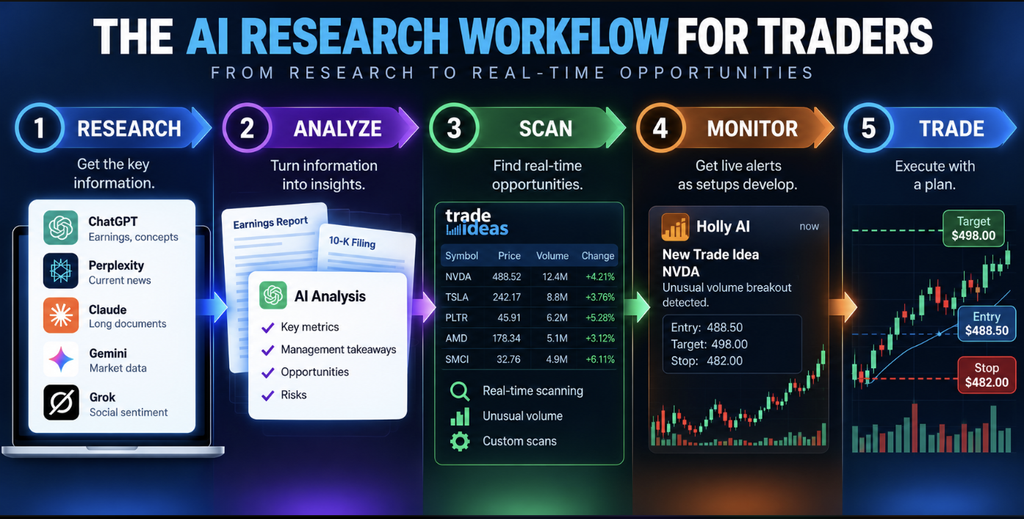
It’s 5 AM, and the market opens in four hours. Five years ago, a serious trader would have spent that entire window manually reading earnings reports, pulling SEC filings, and scanning news aggregators. Today that same trader opens ChatGPT, asks three targeted questions, gets a synthesized earnings preview in 30 seconds, pulls up Perplexity for current news, and walks into the session with a cleaner research picture than they ever had manually — in 20 minutes instead of two hours. This is not hypothetical. It is happening right now across trading communities of every size and experience level. But here is the nuance that separates traders using AI correctly from those developing a false sense of preparation: not all AI tools are equally useful for trading research, and knowing which tool to use for which task is the difference between a genuine edge and an expensive illusion.
The Research Problem AI Solves
Before AI tools became accessible, thorough pre-market research meant manually reading multiple news sources, pulling earnings transcripts, scanning SEC filings, and synthesizing everything into a coherent picture — a process that consumed the entire pre-market window and still left gaps. AI changed that equation almost overnight. ChatGPT and its peers summarize earnings reports and conference call transcripts in seconds — not surface-level summaries but detailed syntheses of key metrics, management commentary, and forward guidance. They explain complex financial concepts and macroeconomic data in plain English. They synthesize multiple news sources into a single coherent narrative. They answer specific research questions instantly — debt-to-equity ratios, competitive landscapes, historical sector comparisons — on demand. Research that used to take two hours now takes twenty minutes, giving traders more time to actually trade and less time buried in manual preparation.
How Traders Are Using ChatGPT — The Specific Use Cases
ChatGPT has become one of the most widely used research tools in retail trading. Before earnings, traders ask it to summarize recent quarters, identify key metrics Wall Street is watching, and explain consensus expectations in minutes. For sector context, traders use it to understand why a sector is moving — what macro factors or regulatory developments are driving the action — before building a position. For news synthesis, rather than reading five articles about the same story, traders paste in headlines and get a synthesized summary of what’s happening and why it matters. For strategy development, traders pressure-test trade ideas by describing a setup and asking the AI to identify potential weaknesses or historical analogies. And for newer traders, ChatGPT has dramatically compressed the learning curve — understanding options strategies, balance sheets, and Fed language no longer requires hours of self-study. The critical limitation: While ChatGPT can access current information through web searches and connected tools, it is not a dedicated real-time market scanner continuously monitoring stock prices, volume, and trading setups throughout the session.
The Full Research Stack — Other AI Sites Traders Are Using
The most effective traders in 2026 are building multi-tool research stacks that deploy different platforms for different purposes. Perplexity AI pulls current information from the web rather than relying on a training cutoff — traders use it specifically for current news and recent earnings data that ChatGPT might miss. Claude handles long documents exceptionally well — traders upload full earnings transcripts and 10-K filings for detailed analysis. Gemini, integrated with Google’s data ecosystem, synthesizes current search results and financial data from Google Finance. And Grok, integrated with X, has found a niche among traders wanting real-time social sentiment — synthesizing what the trading community is discussing about specific stocks right now. The research stack that works: Perplexity for current news, Claude for deep document analysis, ChatGPT for strategy and concepts, Grok for sentiment. A pre-market research capability that would have required a team of analysts five years ago is now available to any retail trader with a laptop.
What AI Research Tools Cannot Do — The Critical Gap
Every AI research tool shares one fundamental characteristic: they are backward-looking by design. They synthesize what has already happened, what has already been reported, and what is already publicly known. While AI research tools can retrieve current market information, they are not designed to replace dedicated real-time stock scanners. They generally lack the continuous, market-wide monitoring and integrated trading alerts needed to identify developing setups as they occur throughout the trading session. A trader who has done exceptional AI-powered research — who knows the earnings history, the competitive landscape, the macro tailwinds, and the technical setup — still has no tool to tell them when the right moment to enter the trade has arrived unless they have a real-time market intelligence platform running alongside their research tools. That is the critical gap. Knowing everything about a stock and knowing exactly when to trade it are two completely different things — and only one of them requires a platform watching the market every second of the session.
Where Trade Ideas Fits — The Tool That Watches While You Research
Trade Ideas goes beyond traditional AI research tools by continuously monitoring the stock market in real time. While chatbots are valuable for researching and analyzing stocks, Trade Ideas is purpose-built to identify developing trading opportunities and deliver live scanner alerts. The server-side event engine monitors 8,000+ US equities simultaneously and pushes alerts the millisecond a defined condition is met. While you are reading an earnings summary on ChatGPT, Trade Ideas is watching the tape. While you are synthesizing sector news on Perplexity, Trade Ideas is scanning for unusual volume. Holly AI identifies live setups during the active trading session and delivers specific trade ideas with defined entry points, price targets, and stop-loss levels — in the window when the opportunity can actually be acted on. The agentic scanner builder lets you describe what you want to find in plain English, and Trade Ideas builds and runs the scan live against real market data instantly.
The Bottom Line
Five years ago, the research synthesis now available through AI chatbots required a Bloomberg Terminal or a team of analysts. AI has genuinely democratized the research layer of trading — narrowing the knowledge gap between retail traders and institutional analysts dramatically. The remaining institutional edge is real-time data infrastructure and live market intelligence — and that is exactly what Trade Ideas provides at a fraction of institutional cost. The traders winning in 2026 aren’t the ones who pick one AI tool and use it for everything. They are the ones who understand what each tool is built for and deploy them in combination. AI research tools for preparation. Trade Ideas for real-time intelligence. Holly AI for live signals. A disciplined process connecting the research layer to the execution layer. Log in to Trade Ideas today and build that stack — because knowing everything about a stock is only half the equation. Knowing exactly when to trade it is the other half. And that is what Trade Ideas is built to tell you.