
How to Use AI for Day Trading (8 Best Ways Included)
How to Use AI for Day Trading (8 Best Ways Included)
AI is becoming a practical part of the day trader’s toolkit. Instead of manually reviewing hundreds of stocks, price movements, news events, and potential setups, traders can use AI to process large amounts of market data and narrow their attention to opportunities that match predefined criteria.
Using AI for day trading can help with stock scanning, setup identification, news analysis, backtesting, real-time alerts, risk monitoring, and post-trade review. The goal is not to hand every decision over to an algorithm. It is to use AI where speed, consistency, and data processing can make the trading workflow more efficient.
For traders who are still getting familiar with the technology, understanding how artificial intelligence is actually used in trading is a useful starting point. In practical terms, AI is most valuable when it helps traders find, evaluate, and monitor opportunities while the trader remains responsible for strategy, execution, and risk.
Below are eight practical ways traders can use AI before, during, and after the trading session.
Want to put AI-assisted market scanning and trading signals into practice? Compare Trade Ideas plans and choose the tools that fit your trading workflow.
| Quick Answer: How Can You Use AI for Day Trading?Day traders can use AI to scan stocks in real time, identify potential trading setups, analyze market catalysts, test strategies against historical data, generate alerts, monitor risk, and review previous trades.The most effective approach is to use AI as a decision-support tool. AI can narrow thousands of possibilities into a manageable group of opportunities, while the trader remains responsible for assessing the setup, determining acceptable risk, and deciding whether to place a trade. |
What Can AI Actually Do for Day Traders?
AI is particularly useful when a trading task involves processing large amounts of information quickly and applying the same criteria repeatedly.
AI can help traders:
- Scan large numbers of stocks for specific conditions;
- Identify momentum, volume, volatility, or breakout setups;
- Rank potential opportunities;
- Analyze market news and catalysts;
- Test strategies against historical market data;
- Generate real-time alerts;
- Monitor exposure and trading risk;
- Analyze previous trades for performance patterns.
However, AI does not remove uncertainty from trading.
It cannot guarantee that a stock will move in a particular direction, eliminate losses, or make every trading signal profitable. Unexpected news, changing market conditions, poor liquidity, and execution costs can all affect the outcome of a trade.
The SEC, FINRA, and NASAA specifically caution investors against relying solely on AI-generated information for investment decisions because AI output can be based on inaccurate, incomplete, outdated, or misleading information. Their joint investor guidance on AI and investing explains these limitations in more detail.
The stronger approach is therefore AI-assisted trading rather than blind automation.
1. Use AI to Scan for Day Trading Opportunities
One of the most practical ways of using AI for day trading is market scanning.
A trader manually watching 10 or 20 charts may miss opportunities developing elsewhere in the market. An AI-powered stock scanner can continuously evaluate a much larger universe of securities and identify stocks that meet predefined conditions.
A trader might screen for combinations such as:
- Unusually high relative volume;
- Strong pre-market movement;
- Price breaking through a defined range;
- Sudden acceleration in momentum;
- Increased volatility;
- Unusual price or volume behavior;
- Sufficient liquidity and manageable spreads.
The purpose is not to treat every scan result as a trade.
Instead, AI reduces the market to a smaller watchlist that deserves further investigation.
Example
Suppose a trader focuses on momentum stocks after the opening bell.
Instead of manually searching through hundreds of symbols, an AI-assisted scanner can identify stocks showing elevated relative volume, strong price movement, and suitable liquidity.
The AI performs the initial filtering. The trader can then review the chart, catalyst, entry conditions, broader market environment, and risk before deciding whether an opportunity fits the trading plan.
This division of work is important. AI is good at continuously searching large datasets. The trader is responsible for deciding what to do with the results.
2. Use AI to Identify and Rank Trading Setups
Finding a stock that is moving is only the first step.
Traders also need to determine whether the move matches a repeatable setup.
AI can help compare current market behavior with predefined trading criteria and historical patterns. Depending on the trading strategy, that can include:
- Momentum breakouts;
- Opening-range setups;
- Mean-reversion opportunities;
- Unusual volume events;
- Gap-and-go patterns;
- Volatility expansions;
- Price moves following a catalyst.
AI can also help rank several potential setups instead of returning an undifferentiated list of stocks.
This matters because not every technically valid signal deserves equal attention.
A stock with strong momentum, high relative volume, sufficient liquidity, and a clear catalyst may deserve more attention than a stock meeting only one of those conditions.
The trader should still decide whether the setup is appropriate. AI’s role is to make discovery and prioritization faster and more consistent.
3. Use AI to Analyze News and Market Catalysts
Day trading is influenced by more than charts.
Earnings announcements, analyst actions, company guidance, economic releases, regulatory developments, and unexpected headlines can quickly change a stock’s volatility.
AI and natural language processing can help traders process this information faster.
Instead of manually reading every headline, an AI system can help classify events and highlight information potentially relevant to a stock or trading strategy.
Useful applications include:
- Identifying earnings-related news;
- Detecting changes in company guidance;
- Finding analyst upgrades or downgrades;
- Monitoring sector-specific developments;
- Classifying market sentiment;
- Identifying events associated with unusual volatility.
The important point is to use news analysis as context, not as an automatic buy-or-sell instruction.
A positive headline does not guarantee that a stock will rise. Market reaction can depend on existing expectations, liquidity, positioning, broader market conditions, and how quickly the information has already been priced in.
For day traders, AI’s value is its ability to filter information quickly enough that relevant catalysts can be investigated while they still matter.
4. Use AI to Backtest Day Trading Strategies
Before relying on an AI-generated setup, traders should understand how the underlying strategy behaved under previous market conditions.
Backtesting applies a defined set of trading rules to historical data so traders can evaluate how those rules would have performed.
Useful metrics can include:
- Win rate;
- Average winner and average loser;
- Profit factor;
- Expectancy;
- Maximum drawdown;
- Time in trade;
- Adverse price movement;
- Performance under different market conditions.
A useful backtest should also reflect realistic trading conditions.
Spreads, commissions, slippage, liquidity, and execution timing can turn a strategy that looks attractive in a simplified simulation into something very different during live trading.
Traders should also be careful about repeatedly changing rules until historical results look perfect. This can lead to overfitting, where a strategy is highly optimized for past data but performs poorly when conditions change.
Trade Ideas’ Holly workflow provides an example of how strategy testing can be incorporated into an AI process. The Holly AI Strategy Window presents strategies selected after backtesting and optimization for the upcoming trading session.
That historical analysis is useful, but it still does not turn a tested strategy into a guaranteed outcome.
5. Use AI to Support Entry and Exit Decisions
AI can also help traders monitor the conditions surrounding an entry or exit.
For example, a trader may define an entry that requires:
- Confirmation of the trading setup;
- Minimum trading volume;
- An acceptable spread;
- Sufficient liquidity;
- Price movement through a predefined level.
An AI-assisted platform can continuously monitor those conditions and alert the trader when they align.
The same approach can be applied to exits.
A trader may use a combination of:
- Technical invalidation levels;
- Predefined stop losses;
- Profit targets;
- Time-based exits;
- Changes in momentum;
- Deterioration in liquidity.
The important distinction is that AI can monitor predefined logic, while the trader should determine the trading rules before entering the position.
Changing entry, exit, or risk rules emotionally once a trade is already open defeats much of the benefit of using a systematic process.
6. Use AI for Day Trading Risk Management
Finding another opportunity is less important than controlling the risk attached to the opportunities already being traded.
Risk controls should therefore be part of any AI-assisted day trading workflow.
AI can help monitor:
- Position size;
- Total account exposure;
- Concentration in correlated stocks;
- Daily losses;
- Unusual changes in volatility;
- Liquidity conditions;
- Repeated losses from the same setup.
For example, a trader can establish a maximum daily loss before the session begins. Once that threshold is reached, trading can be reduced or stopped instead of allowing frustration to drive additional trades.
Similar controls can apply after a sequence of losses or when market conditions become significantly different from those in which a strategy was tested.
This matters because day trading itself carries substantial risk. FINRA notes that day traders should be prepared for the possibility of losing the funds used for day trading and emphasizes the importance of understanding both market and brokerage execution risks. FINRA’s day-trading guidance outlines these risks and account considerations.
AI makes monitoring easier, but it should operate inside clearly defined limits.
The objective is not simply to automate more activity. It is to make the trading process more controlled and consistent.
7. Use AI to Adapt to Different Market Conditions
A day trading strategy rarely performs equally well in every environment.
A momentum strategy that performs strongly during expanding volatility may struggle when the market becomes quiet and range-bound.
AI can help traders classify changing market conditions and determine whether a strategy is operating in an environment similar to the one in which it historically performed well.
Conditions worth monitoring include:
- Overall market volatility;
- Trading volume;
- Time of day;
- Sector strength;
- Broader market direction;
- Liquidity.
The opening session, midday, and the final hour of trading can also behave differently.
Rather than applying the same trading logic throughout every session, traders can use market-condition filters to determine when a particular setup deserves attention and when it may be better to remain selective.
This is especially important when an AI model has been trained or tested against historical data. Markets evolve, correlations shift, and strategy performance can deteriorate.
AI models and trading rules therefore need ongoing review rather than being treated as permanent systems.
8. Use AI to Review and Improve Your Trades
AI can continue to provide value after the market closes.
Post-trade analysis is one of the more useful but often overlooked applications of AI in day trading.
Instead of simply recording whether each trade won or lost, traders can analyze patterns across their trading history.
AI can help explore questions such as:
- Which setups perform best?
- Which setups generate the largest losses?
- What time of day produces the strongest results?
- Does performance change during high-volatility sessions?
- Are losses occurring because of poor entries or poor exits?
- Is slippage reducing expected returns?
- Are certain stocks or sectors consistently underperforming?
- Are traders repeatedly ignoring the same risk rule?
This turns the trading journal into a source of structured feedback.
For example, a trader may discover that a strategy performs well during the first hour after the market opens but deteriorates during midday.
Instead of abandoning the strategy entirely, the trader can investigate whether limiting it to a particular session improves consistency.
AI is useful here because it can identify patterns across a large number of trades that may be difficult to spot manually.
How to Use AI Before, During, and After the Trading Day
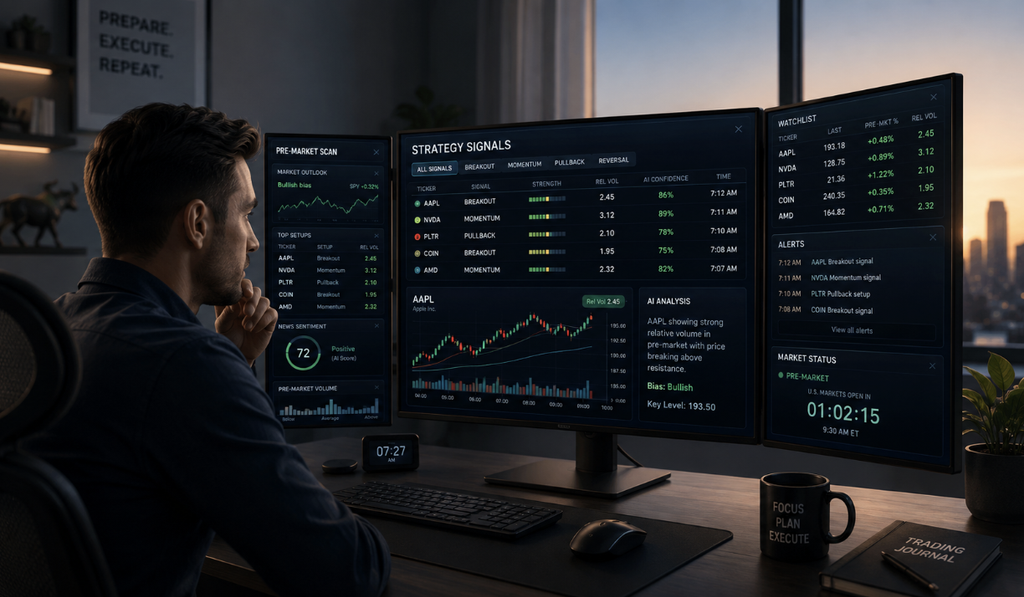
Using AI for day trading becomes easier when it is treated as part of the complete trading workflow rather than as a single standalone tool.
Before the Market Opens
AI can help traders:
- Scan pre-market activity;
- Identify unusual volume;
- Review overnight news;
- Find relevant catalysts;
- Build a focused watchlist;
- Rank potential setups.
The objective is preparation.
By the opening bell, the trader should already have a better understanding of which stocks deserve attention and what conditions would need to occur before taking action.
During the Trading Session
AI can help:
- Monitor watchlist stocks;
- Identify when setup conditions appear;
- Generate real-time alerts;
- Track changes in momentum or liquidity;
- Monitor predefined risk limits.
The trader can then spend more time evaluating opportunities instead of constantly searching for the next stock.
Traders who are newer to this process may also benefit from understanding how AI trading tools fit into a beginner’s workflow before adding more automation.
After the Market Closes
AI can support:
- Trade journaling;
- Performance analysis;
- Strategy comparison;
- Mistake identification;
- Backtesting;
- Preparation for future sessions.
This creates a continuous process:
Scan → Evaluate → Trade → Review → Refine.
The value of AI does not come from one individual signal. It comes from making each stage of the trading process more structured.
Example: What Day Trading With AI Can Look Like
Consider a trader looking for momentum opportunities shortly after the market opens.
During pre-market trading, an AI-powered scanner identifies a stock showing unusually high relative volume and a significant price move following company news.
The stock is added to the trader’s watchlist.
After the market opens, the trader waits for the predefined setup instead of entering immediately. The system continues monitoring volume, price movement, and other specified conditions.
When the setup criteria appear, the trader receives an alert.
Before entering, the trader checks the spread, liquidity, entry level, stop placement, catalyst, and overall risk.
If the conditions still match the trading plan, the trader decides whether to enter.
Once the position is open, predefined risk and exit rules guide the trade rather than an assumption that the AI signal must be correct.
After the position closes, the result is logged and later compared with similar setups.
In this workflow, AI performs much of the repetitive work of scanning, monitoring, and organizing information. The trader remains responsible for judgment, execution, and risk.
Where Trade Ideas Fits Into an AI-Assisted Trading Workflow
A practical AI trading platform should reduce the amount of market information a trader needs to process manually without removing visibility into what is happening.
Trade Ideas combines real-time market scanning with strategy analysis, backtesting, alerts, and AI-generated opportunities.
Holly AI, for example, evaluates strategy-driven opportunities and surfaces them for traders during the trading session.
The useful part is not simply receiving an AI signal. It is having the ability to evaluate that opportunity alongside:
- Current market conditions;
- Chart structure;
- Volume;
- Liquidity;
- Entry and exit parameters;
- Individual risk limits.
That keeps the technology in the appropriate role: finding and organizing potential opportunities while the trader remains accountable for the trade.
Final Thoughts
Using AI for day trading is most useful when it helps traders process information faster, apply rules more consistently, and learn from previous results.
AI can scan markets, rank setups, analyze catalysts, backtest strategies, generate alerts, monitor risk, and review trading performance. What it cannot do is remove uncertainty from the market.
The better objective is therefore not to automate every decision.
It is to combine AI’s speed and ability to process large amounts of information with a clearly defined trading strategy, realistic execution assumptions, disciplined risk management, and human judgment.
When those pieces work together, AI becomes less of a shortcut and more of a practical tool for building a repeatable trading process.
Ready to build AI, real-time scanning, and strategy testing into your trading setup?
Compare the available Trade Ideas plans and choose the level of tools that matches how actively you trade.
Related Reads
- Understanding Stock Market Fluctuation and Opportunities
- Ways to Use Chart Patterns to Predict Stock Moves
FAQs
What is the 3-5-7 Rule in Trading?
It is a profit-taking strategy where you scale out at predefined reward levels:
- Take partial profits at 3R and 5R
- Let the rest run toward 7R or more
This balances risk and reward, helping you lock gains while still capturing bigger moves.
What is the 90% Rule in Trading?
Roughly 90% of traders lose money because they lack a real edge, risk discipline, or a repeatable process. This rule is a reminder that without structure, the odds are against you.
What is the $25,000 Rule for Day Trading?
U.S. traders with margin accounts must maintain a minimum balance of $25,000 to place more than 3 day trades in 5 days. Falling below this restricts further day trading.
Why Does 99% Fail in Trading?
Most fail due to poor risk management, emotional decisions, overtrading, and unrealistic expectations. Without a tested edge and discipline, long-term success is unlikely.
Can AI be used for day trading?
Yes. AI can support day trading by scanning stocks, identifying patterns, analyzing information, backtesting strategies, generating alerts, monitoring risk, and reviewing previous trades.
Traders should still evaluate individual opportunities and apply their own risk-management rules.
How do day traders use AI?
Day traders commonly use AI to reduce the amount of market information they need to process manually.
AI can filter stocks, rank potential setups, monitor predefined conditions, process market catalysts, and analyze patterns across previous trades.
What is the best way to use AI for day trading?
AI is most useful for repetitive and data-intensive tasks such as stock scanning, setup ranking, backtesting, signal monitoring, and post-trade analysis.
It should be incorporated into a defined trading process rather than used as a replacement for strategy or risk management.
Can AI find day trading opportunities?
Yes. AI-powered tools can scan large numbers of securities and identify stocks that meet predefined conditions involving volume, momentum, volatility, price behavior, or other factors.
An identified opportunity is still only a candidate and should be evaluated before a trade is placed.
Can ChatGPT be used for day trading?
General-purpose AI tools can help explain trading concepts, structure research, create journal templates, analyze data supplied by the trader, or help think through trading rules.
However, traders should not assume that a general-purpose chatbot has complete or real-time market information. Its output should not be treated as a substitute for verified market data or a tested trading system.
Can AI automate day trading?
Parts of a trading workflow can be automated, including scanning, alerts, strategy monitoring, order rules, and some risk controls.
The degree of automation depends on the platform, brokerage integration, and trader’s strategy.
Automation still requires testing, monitoring, and safeguards.
Is AI day trading profitable?
AI does not guarantee profitability.
Trading results depend on factors including strategy quality, changing market conditions, execution, trading costs, liquidity, and risk management.
An AI-powered strategy can produce both profitable and losing trades.
What are the risks of day trading with AI?
Important risks include overfitting, inaccurate data, changing market conditions, execution delays, unexpected events, excessive automation, and relying too heavily on AI-generated signals.
Traders should test strategies carefully, monitor live performance, and maintain predefined risk limits.