
Vacation Mode Trading: How to Stay in the Market Without Being Glued to a Screen
Vacation Mode Trading: How to Stay in the Market Without Being Glued to a Screen

You’ve packed, booked the hotel, and your family’s excited. Still, you’re at the airport, laptop open to your portfolio. Sound familiar? The market doesn’t stop for vacations. Earnings seasons roll on. That gap-down you miss sightseeing isn’t refunded. But being glued to a screen on the beach isn’t the answer. Half-watching your phone at dinner ruins both your trip and your trading. The good news: you don’t have to choose between enjoying your summer and managing your portfolio. The traders who get this right prepare differently before traveling.
The Real Cost of Trading While Distracted
Let’s be honest about what vacation trading actually looks like for most — and why it fails. Checking your phone frequently by the pool isn’t monitoring your portfolio. It ruins both your vacation and your trading. Trading while distracted means reacting rather than trading. Half your attention on a volatile position is riskier than not watching at all. You react late, make emotional decisions, and usually fare worse than if you were focused or fully out. Travel stress amplifies costly emotional trading habits: overtrading, panic selling, cutting winners, holding losers. The goal was never constant market presence, but being in the right trades, managed by pre-set rules. A solid plan and automation always outperform distracted app-refreshing between margaritas.
Step 1: Pre-Vacation Audit
The single most important thing you can do before leaving for vacation has nothing to do with packing — it’s running an honest audit of every open position before you walk out the door. Vacation is not the time to be holding anything you wouldn’t be comfortable leaving unattended. Before you leave, ask three questions about every position in your portfolio. Is the trade thesis still intact — or are you holding it out of hope? Do you have clearly defined stops and targets already set? And are you genuinely comfortable if this position moves significantly while you’re not watching? Any position that can’t answer yes to all three gets closed or sized down before departure — no exceptions. Pay special attention to earnings risk. July is earnings season, which means there is a real chance one or more of your positions have a report scheduled during your travel window. Identify every one of those names now and make a deliberate decision: hold through the number with a plan, or exit cleanly before you leave. The goal of the pre-vacation audit isn’t to close everything and go to cash. It’s to make sure every position you hold has a plan that doesn’t require you to sit at a desk to execute it.
Step 2: Set Your Stops, Targets, and Alerts before you leave
Before you go, every position needs a hard stop loss and profit target—set as rules that execute, not suggestions you’ll review later. A pre-vacation stop loss is a clear-headed decision. A stop set from the beach, as a reaction, is usually costlier. Set your stops, profit targets, and price alerts on important watchlist levels before you leave. Stocks don’t stop for your trip. With Trade Ideas alerts, you stay informed only about key events you define, not constant noise. That’s the difference between being informed and obsessed, letting you enjoy your trip.
Step 3: Use Automation to Work While You Relax
This is where Trade Ideas earns its keep for the traveling trader — let your tools do the monitoring. Trade Ideas’ scanners run continuously, flagging the setups you defined before you left; there’s no need to watch a screen. Automation keeps you aware of key opportunities and risks without constant oversight. Every scan, filter, and criterion you specify continues running in real time while you’re at dinner, on the beach, or somewhere without wifi. Holly AI takes it further. Trade Ideas’ AI assistant identifies and executes setups based on your criteria, so strategies are managed objectively, reducing emotional trading and response times.
Before you leave, save watchlist scans so check-ins surface curated, relevant information (not an overwhelming stream you have to sort in five minutes). Real-time alerts on your phone keep you informed without constantly being attached. The key: automation isn’t giving up control. It’s extending your decision-making beyond physical availability—giving traveling traders the edge they need.
Step 4: Define Your “Check-In” Schedule in Advance
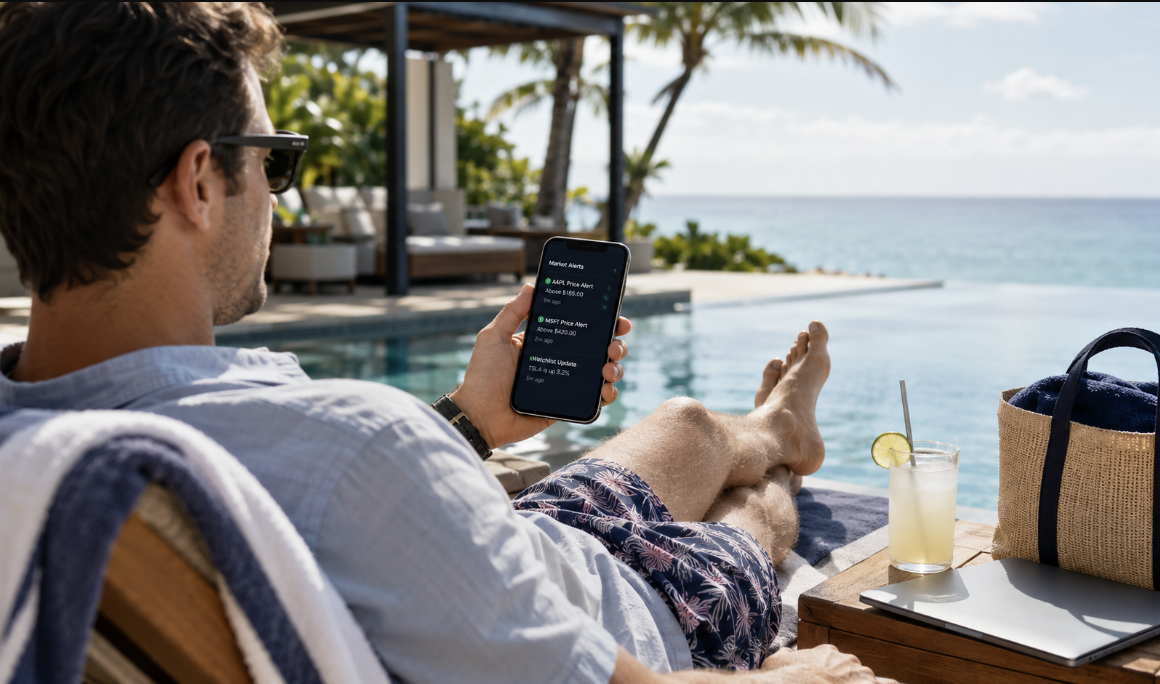
The real issue isn’t checking the market but having no rules for when to do so. Unstructured monitoring is just anxiety with an app. Before your trip, set a defined check-in schedule and stick to it. Once in the morning, once at close. Unless a scheduled Trade Ideas alert flags something, leave your phone down. Pre-market: review overnight news, confirm stops, and check positions with earnings that day. Post-close: review the day, assess adjustments, and scan watchlist results. Twenty minutes total—structured focus beats constant distraction. Boundaries aren’t a weakness; they are the system.
The Emergency Protocol
Preparation can’t cover everything; sometimes, the market demands attention mid-vacation. The key is to have an emergency protocol ready before you leave, not to invent it under pressure. If a stop is hit, it triggers automatically—no extra action needed. For big macro events, give yourself 15 focused minutes to assess and adjust. Then return to your vacation. Before leaving, know which positions truly need monitoring if the market shifts. Successful traders plan for emergencies in advance, not while stressed.
The Bigger Picture — Trading Smarter, Not Harder
The best traders in the world are not the ones glued to a screen twelve hours a day. They are the ones with the best systems, the clearest rules, and the discipline to let their process work without constant intervention. Vacation is actually one of the most honest tests of how good your trading system really is. If your portfolio can’t survive four days without your constant attention, the problem isn’t the vacation — it’s the system. A well-built trading plan with proper stops, alerts, and automation in place should be able to run largely on autopilot for short windows. That’s not lazy trading, it’s professional trading. You worked hard in the first half of 2026 — you deserve the break. The market will be here when you get back.
The question is simply whether your portfolio will be in better or worse shape depending on how well you prepared before you left. The traders who do this right — audit their positions, set their stops, build their alerts, and let Trade Ideas automation run their scanners — come back from summer refreshed, positioned, and ready to attack the second half. The ones who try to trade distracted from the pool come back stressed, overtired, and down money. Before you pack your bags, log into Trade Ideas, set your alerts, build your vacation watchlist, and let the platform work while you finally take a break. You’ve earned it.