
Payment for Order Flow Exposed: How Robinhood and Schwab Profit from Your Trades
Payment for Order Flow Exposed: How Robinhood and Schwab Profit from Your Trades
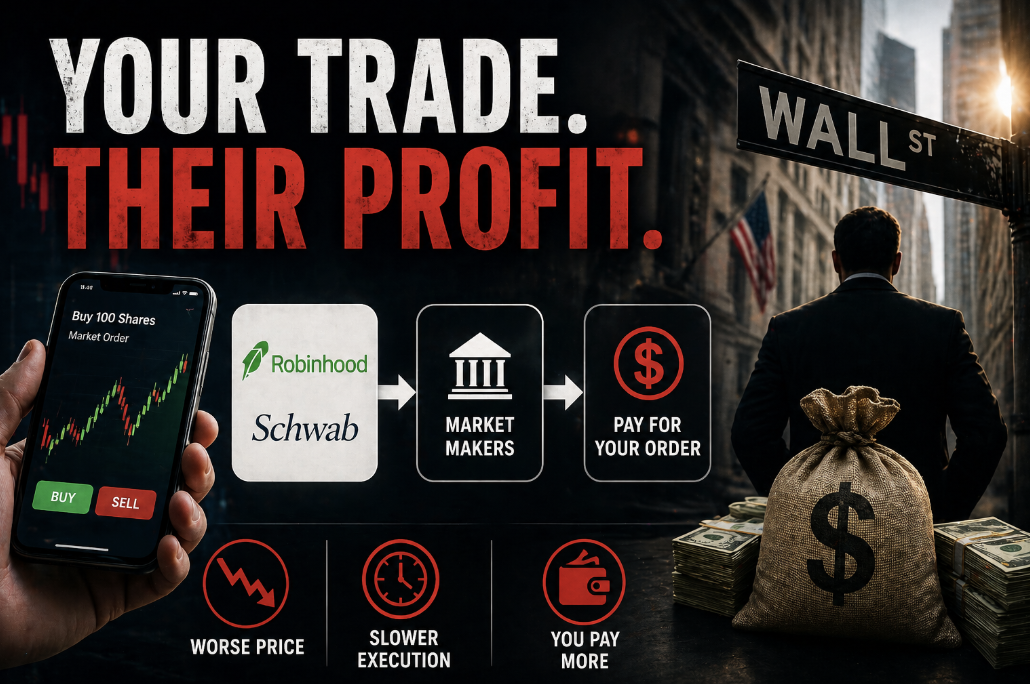
The “free trading” revolution represents one of Wall Street’s most successful deceptions, convincing millions that brokers eliminated commissions from generosity rather than greed. The reality: brokers like Robinhood and Schwab make billions more from “zero commission” trades through Payment for Order Flow (PFOF). PFOF is a predatory practice that systematically transfers wealth from retail traders to Wall Street insiders, allowing brokers to sell your order information to market makers before trades hit public exchanges. This creates hidden costs on every transaction while sophisticated players profit from advanced knowledge of your activity. These hidden costs erode trading profits through worse execution, wider spreads, and systematic disadvantages that cost active traders thousands annually. Understanding this legal but predatory practice represents the difference between building wealth and unknowingly funding Wall Street’s profits as a stock trader.
What Is Payment for Order Flow?
Payment for Order Flow represents a fundamental betrayal of the broker-client relationship: your broker receives your order but avoids public exchanges, instead selling it to market makers such as Citadel Securities, Virtu Financial, and Jane Street, which pay for trade execution privileges. The players include retail brokers (Robinhood, Schwab, TD Ameritrade, E*TRADE) selling your orders, market makers buying exclusive retail flow access, and you, whose order information becomes the commoditized product. While you receive a nominal “price improvement” of pennies, market makers extract significantly more by seeing orders before public markets, creating systematic information asymmetry. Your order flow becomes a literal commodity, giving market makers advance knowledge of retail patterns, sentiment, and positioning to optimize their strategies, fundamentally destroying the fairness and transparency public markets should provide.
The Robinhood PFOF Machine
Robinhood’s business model represents the ultimate bait-and-switch operation, generating over $600 million in 2025 from selling order flow while marketing itself as “commission-free,” with Q1 2026 revenue of $180 million showing sustained growth in this predatory practice. The January 2021 GameStop trading halt exposed the fundamental conflict in Robinhood’s business model, revealing their loyalty to market makers like Citadel Securities rather than their customers. Congressional hearings uncovered their willingness to halt trading to protect their real customers—the market makers who pay them. Real cost examples demonstrate the hidden wealth transfer: a simple $100 stock purchase costs you an additional $0.12-$1.20 in PFOF-related execution degradation (updated for 2026 market conditions), while a 10-contract options trade now generates $6-$25 in payment for order flow revenue. Active traders face annual hidden fees of $2,800-$22,000+ that systematically erode their trading profits while enriching Robinhood and its market maker partners.
Traditional Brokers Aren’t Innocent
Charles Schwab, despite its “investor-first” marketing and reputation as a traditional full-service broker, generated nearly $350 million in PFOF income during 2025; a fundamental shift from its historical commission-based model to the same order-flow-dependent business model that defines Robinhood’s strategy. This transformation reveals how supposedly reputable brokers have abandoned transparent fee structures in favor of hidden revenue streams that systematically disadvantage their own customers. TD Ameritrade and E*TRADE follow identical PFOF business models, with 2025 regulatory filings revealing $4.8 billion in total industry PFOF payments, showing that order flow selling has become an industry-wide standard rather than an exception. The false choice between “free” trading and traditional commissions obscures a crucial reality: transparent $5- $10 commissions might actually be cheaper for most traders than the hidden costs of PFOF execution.
Market Makers: The Real Winners
Citadel Securities has achieved near-monopolistic dominance by handling over 45% of retail stock orders in 2026 (increased from previous years), generating billions in annual profits while maintaining insurmountable information advantages by seeing your orders before public markets. Market makers extract profit through systematic advantages:
- Capturing bid-ask spreads while knowing the direction and size of incoming flows.
- Using advanced knowledge of retail sentiment to optimize their trading strategies.
- Deploying high-frequency algorithms specifically designed to exploit retail orders with superior speed and information access.
The information asymmetry is deliberate—market makers see your order first, enabling them to adjust prices based on retail flow patterns and to maintain an advantage in knowing when retail traders buy or sell specific securities. This creates inherent conflicts: market makers pay brokers for order flow while being incentivized to provide worse execution in exchange for higher payments.
How PFOF Costs You Money
PFOF’s execution-quality impact becomes clear when comparing “price improvement” claims to actual market prices, revealing that while brokers attempt to save pennies, market makers extract significantly more through systematic execution degradation and hidden slippage costs that multiply during volatility. The compound effect creates devastating wealth destruction: active traders lose $12-$65 daily in hidden costs and $250-$1,950 monthly, leading to $3,000-$23,400+ in annual erosion of trading profits (2026 figures reflect increased trading costs and volume).
International Perspective and Regulation

The European Union’s MiFID II regulations demonstrate that meaningful reform is possible, implementing strict PFOF limitations, comprehensive transparency requirements, and superior investor protection standards that prioritize client interests over broker profits. UK and Canadian markets emphasize transparency and fairness over the U.S. broker-friendly framework. Despite early 2026 Congressional hearings and the current SEC’s consideration of new transparency requirements, meaningful reform faces intense lobbying by brokers and market makers, who profit billions annually from the current system. The contrast with international markets reveals the U.S. as an outlier, favoring broker profits over investor protection.
How to Protect Yourself & Take Back Control
Knowledge and strategic broker selection can protect you and minimize PFOF impact:
- Choose direct market-access brokers (e.g., Interactive Brokers and TradeStation) that offer commission-based models without selling order flow.
- Carefully read disclosures and 606 reports that reveal true execution practices.
- Use limit orders instead of market orders.
- Understand bid-ask spreads and time trades for optimal execution
- Utilize tools like Level II data and execution quality analysis to track your actual costs.
- Consider alternative platforms with transparent fee structures and brokers that offer direct exchange access
Above all else, remember the fundamental truth: if the trading product is free, you are the product being sold. True investment success requires understanding who profits from your trades and ensuring your broker’s incentives align with your financial interests rather than those of market makers who systematically exploit retail order flow for billions in annual profits. Visit Trade Ideas to learn more about how to protect your portfolio from PFOF impact in 2026.