
Day Trading Signals for Volatile Market Conditions
Day Trading Signals for Volatile Market Conditions
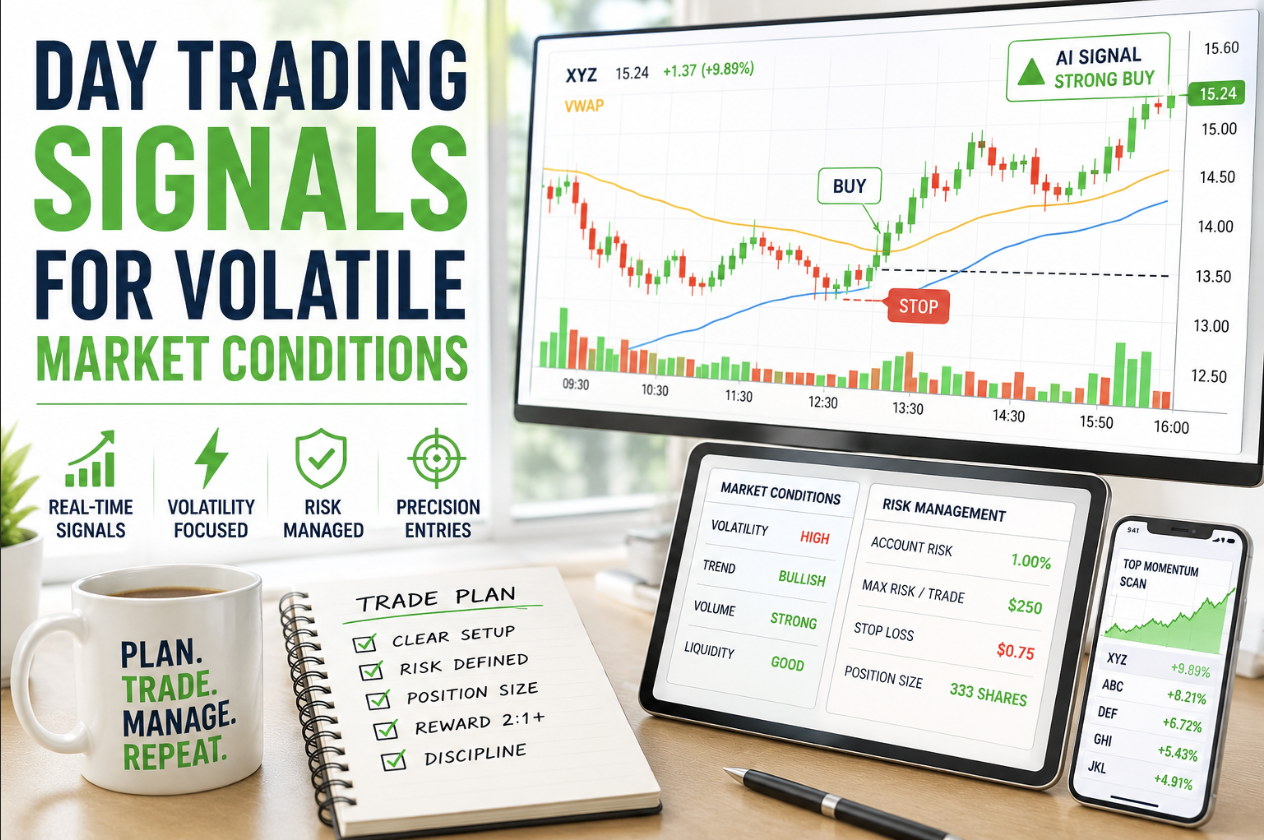
A stock rips through the pre-market high, volume flashes green, and the first entry feels obvious. Ten minutes later, the breakout fails, the stop is wider than planned, and a clean signal turns into a position size problem.
That is where day trading signals for volatile market conditions need risk rules attached before the order goes in. Fast markets can help active day traders find movement, give swing traders better timing context, and help risk-focused traders avoid setups where the reward does not justify the stop.
The goal is simple: trade only when volatility, volume, structure, and risk line up. Here’s how to make it work.
When Do Volatile Market Signals Work Best?
Day trading signals work best in volatile markets when the move has structure, not just speed. A stock moving 6% in the first 20 minutes can create an opportunity, but only if volume confirms the move, the spread stays manageable, and the stop-loss fits the account.
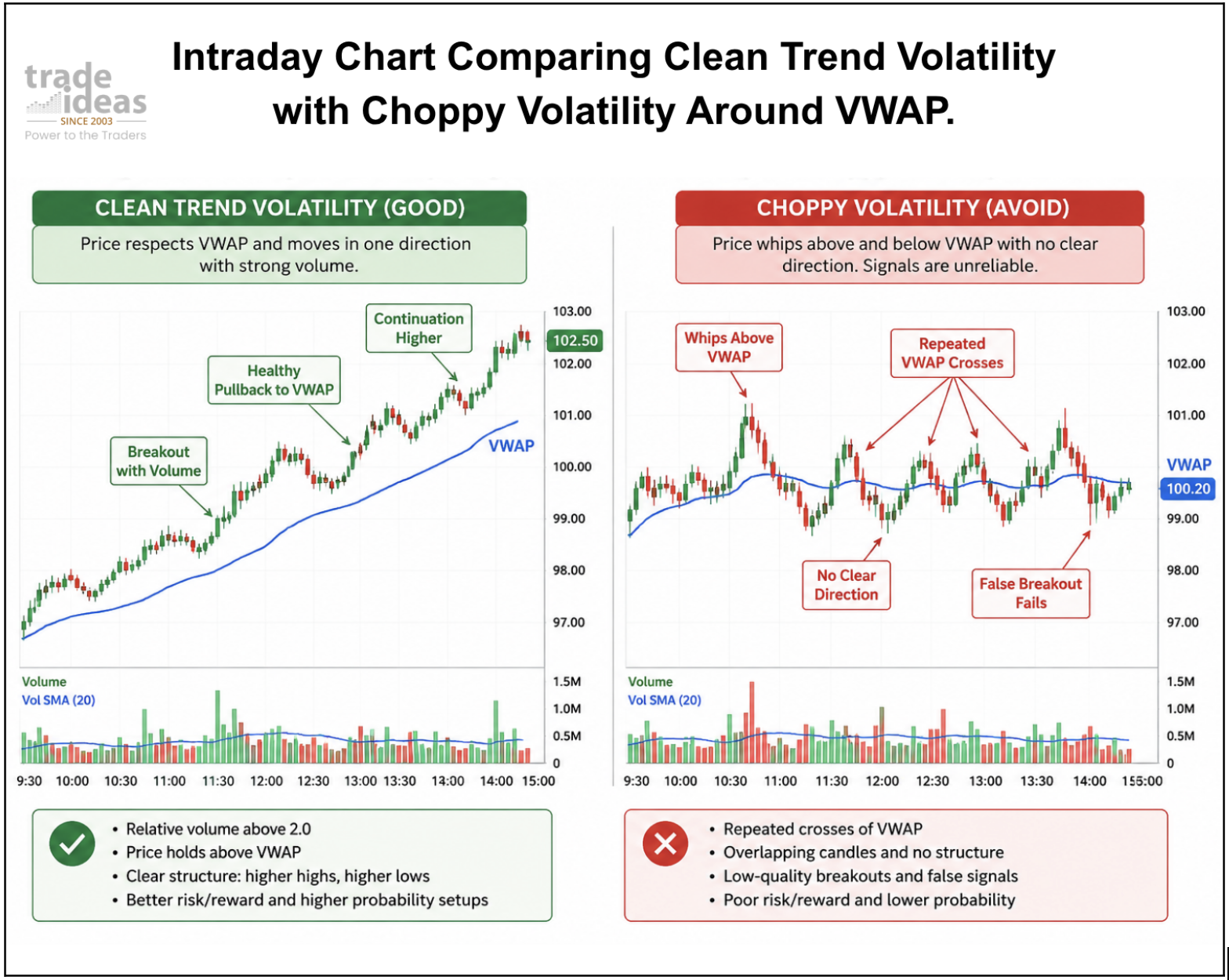
A tradable volatile setup usually has relative volume above 2.0, a clear pre-market or opening range level, and price action that respects VWAP or another intraday reference point. VWAP, or volume-weighted average price, helps show whether buyers or sellers control the session. If price whips above and below VWAP every few candles, the signal is usually noise.
| Condition | Favors | Avoid |
| Relative volume above 2.0 | VWAP reclaim, breakout, pullback continuation | Thin names with wide spreads |
| Clear opening range | Opening range breakout or breakdown | Overlapping candles with no direction |
| Price holding above VWAP | Long continuation or pullback entry | Repeated VWAP crosses |
| Stop distance under planned risk | Full or partial position | The stop is too wide for the account size |
| Reward potential of 2:1 or better | Planned trade | Late entry with limited upside |
Volatility is useful only when it creates a tradable range. If the stop is too wide or the reward target is too close, the signal should be skipped.
Also Read: Swing Trading vs. Day Trading: Understanding the Differences and Benefits
Why Is Risk Management Harder in Volatile Markets?
Volatile markets change the cost of being wrong. A normal day trading signal might need a $0.50 stop. A similar signal during a fast session might need a $1.25 stop because candles are larger and pullbacks are sharper.
On a $25,000 account, a trader risking 1% per trade has a maximum dollar risk of $250. With a $0.50 stop, the position size is 500 shares. With a $1.25 stop, the position size drops to 200 shares. The signal can look similar on the chart, but the correct share size is not.
Fixed Shares vs. Fixed-Dollar Risk
Methodology: This risk comparison uses a $25,000 account, a 1% max risk rule, and 10 sample volatile-market signals. The fixed-share column assumes the trader keeps trading 500 shares even when the stop distance expands. The fixed-dollar column recalculates position size so risk stays near $250 per trade.
| Trade | Stop Distance | Fixed Shares | Fixed-Share Risk | Fixed-Dollar Shares | Fixed-Dollar Risk | Result If Stopped |
| 1 | $0.50 | 500 | $250 | 500 | $250 | Planned risk |
| 2 | $1.25 | 500 | $625 | 200 | $250 | Fixed shares risk 2.5x more |
| 3 | $0.80 | 500 | $400 | 312 | $250 | Fixed shares risk 1.6x more |
| 4 | $1.10 | 500 | $550 | 227 | $250 | Fixed shares risk 2.2x more |
| 5 | $0.65 | 500 | $325 | 384 | $250 | Fixed shares risk 1.3x more |
| 6 | $1.40 | 500 | $700 | 178 | $249 | Fixed shares risk 2.8x more |
| 7 | $0.75 | 500 | $375 | 333 | $250 | Fixed shares risk 1.5x more |
| 8 | $0.90 | 500 | $450 | 277 | $249 | Fixed shares risk 1.8x more |
| 9 | $1.20 | 500 | $600 | 208 | $250 | Fixed shares risk 2.4x more |
| 10 | $0.55 | 500 | $275 | 454 | $250 | Fixed shares risk 1.1x more |
Across these 10 stopped trades, fixed-share sizing would risk $4,550, compared with about $2,498 using fixed-dollar risk. That is the practical issue in volatile markets: keeping share size constant can turn a normal losing streak into a much larger drawdown.
The common mistake is keeping the same share size while the stop distance expands. In fast markets, the stop-loss, share size, and exit plan must be set before entry because false breakouts can fail quickly.
Which Day Trading Signals Work in Volatile Markets?
The strongest volatile-market signals combine price structure, volume, VWAP, and defined risk. A single indicator is not enough. Each signal below works best when the trade has at least 2:1 reward potential and a stop that fits the account.
1. Trade VWAP Reclaim Signals After the Open
A VWAP reclaim works well when a stock sells off early, finds demand, and closes back above VWAP with volume. This is most useful after the first few minutes of the session, once the opening move has formed.
Entry rules: Enter after a 1-minute or 5-minute candle closes above VWAP with relative volume above 2.0. Stronger setups also reclaim a pre-market level or opening range midpoint.
Exit rules: Take partial profits near the prior intraday high or at 1.5:1 risk-to-reward. Exit the rest near 2:1, or if the price closes back below VWAP.
Stop-loss placement: Place the stop below the reclaim candle low or just below VWAP, whichever better defines invalidation.
Position sizing: Risk 0.5% to 1% of account equity. If the VWAP stop is wider than normal, reduce share size.
Risk warning: Skip the setup if the price has crossed VWAP repeatedly. That usually signals chop, not a clean reclaim.
2. Use Opening Range Breakout Confirmation
Opening range breakouts work best when the first 5 to 15 minutes create a clean high and low. The signal becomes stronger when volume expands as the price breaks the range.
Entry rules: Enter when the price breaks the opening range high, and volume is higher than the prior 5-minute average. Avoid entries where price breaks the range on declining volume.
Exit rules: Take the first partial at 1.5:1 and the second near 2:1 to 3:1, depending on the next resistance level.
Stop-loss placement: Place the stop below the opening range midpoint or below the breakout candle low.
Position sizing: If the opening range is wide, cut share size so the dollar risk stays fixed.
Risk warning: Breakouts fail when the stock breaks the range and immediately returns inside it. That is a failed signal, not a reason to average down.
3. Fade Failed Breakouts After Volume Stalls
A failed breakout fade is a reversal signal. It works when the price pushes above a key level, cannot hold, and closes back below the breakout area.
Entry rules: Enter short after the price closes back below the breakout level and volume stalls or reverses. Stronger setups also lose VWAP or the 9 EMA.
Exit rules: Cover partial size near VWAP or the prior consolidation area. Target 2:1 risk-to-reward for the full plan.
Stop-loss placement: Place the stop above the failed breakout high.
Position sizing: Risk 0.5% of account equity because failed breakouts can retest the high before rolling over.
Risk warning: Avoid fading strong relative volume trend days too early. A failed breakout setup needs actual failure, not just an extended candle.
4. Follow Relative Volume Momentum Signals
Relative volume momentum signals work when a stock is trading with far more activity than normal, and pullbacks remain controlled. This is one of the cleaner signals for active day traders because volume confirms attention.
Entry rules: Look for relative volume above 3.0. Enter on the first pullback that holds VWAP or the 9 EMA after a strong push.
Exit rules: Exit partial size at 1.5:1 and trail the rest under the 9 EMA or VWAP. Exit fully if price closes below VWAP.
Stop-loss placement: Place the stop below the pullback low.
Position sizing: Size from stop distance. If the stop is twice the normal size, cut shares by half.
Risk warning: Do not enter after three or four extended candles without a pullback. The reward often shrinks while risk expands.
Pro Tip: For momentum signals, treat relative volume as a filter, not an entry trigger by itself. A stock with 3.0 relative volume still needs a clean structure and a defined stop.
Also Read: Momentum Trading Strategies
5. Use ATR Expansion to Adjust Stop Placement
Average True Range, or ATR, measures how much a stock moves in a typical trading period. In volatile conditions, ATR expansion helps decide whether the stop should be wider and whether the trade still offers enough reward.
Entry rules: Take the signal only if the target is at least 2 times the required stop distance. If a $0.80 stop is needed, the setup should offer at least $1.60 of realistic upside.
Exit rules: Take profits when price moves 1.5 to 2 ATR units from entry or momentum slows near a key level.
Stop-loss placement: Place the stop about 1x the current 5-minute ATR away from entry, adjusted to a logical chart level.
Position sizing: Keep dollar risk fixed. Wider ATR means fewer shares.
Risk warning: A wider stop does not permit risking more money. It only gives the trade more room if position size is reduced.
6. Trade News-Driven Pullbacks Only After Structure Forms
News can create fast price movement, but the first move is often unstable. The cleaner signal usually appears after the first push, when the price forms a higher low above VWAP.
Entry rules: Enter after price forms a higher low, holds above VWAP, and breaks the pullback high.
Exit rules: Exit into the next resistance level or at 2:1 risk-to-reward. If price loses VWAP, exit earlier.
Stop-loss placement: Place the stop below the higher low.
Position sizing: Start with half-size until the spread and liquidity stabilize.
Risk warning: Avoid entering immediately after a headline if spreads are wide or candles are overlapping. Wait for structure.
7. Stand Down When Signals Conflict
A no-trade signal is still a signal. In volatile markets, standing down protects capital when the chart does not offer a clean edge.
Entry rules: Take no trade unless at least 3 of 4 conditions align: trend, VWAP position, relative volume, and clean stop placement.
Exit rules: No exit is needed because no trade is opened.
Stop-loss placement: The stop is avoided because the entry is avoided.
Position sizing: Position size is zero until signal alignment returns.
Risk warning: Skipping mixed signals is not a missed opportunity. It is risk control.
Pro Tip: If two volatile-market signals fail in the same direction, reduce risk by 50% or stop trading that setup for the session. The market may have shifted from trend volatility to chop volatility.
Volatile-Market Signal Summary
| Signal | Best Used When | Entry Trigger | Stop-Loss | Position Size |
| VWAP reclaim | Early selloff reverses with volume | Candle closes above VWAP | Below the reclaim candle or VWAP | 0.5% to 1% risk |
| Opening range breakout | First 5 to 15 minutes from the clean range | Break above the range with volume | Below the midpoint or breakout candle | Reduce the size if the range is wide |
| Failed breakout fade | Breakout loses level | Close back below the breakout area | Above failed high | 0.5% risk |
| Relative volume momentum | RVOL above 3.0 with trend | Pullback holds VWAP or 9 EMA | Below pullback low | Size from the stop distance |
| ATR-adjusted setup | Volatility expands | Target is at least 2x stop | Around 1x 5-minute ATR | Fewer shares as ATR expands |
| News pullback | Catalyst move stabilizes | Higher low and break of pullback high | Below the higher low | Start half-size |
| No-trade filter | Signals conflict | No entry | No stop needed | Zero shares |
How Should Traders Execute Volatile-Market Signals?
A volatile market signal needs a process before the order. The goal is to avoid reacting to movement and instead trade only when the signal meets predefined conditions.
1. Build a Pre-Market Volatility Watchlist
Look for stocks with:
- Gap up or down of 2% or more
- Relative volume above 2.0
- Clear news or catalyst
- Average daily volume above 1 million shares
- Spread that does not distort the stop-loss plan
2. Mark VWAP, Opening Range, and Key Levels
Before entry, mark:
- Pre-market high and low
- Prior day high and low
- VWAP
- Opening range high and low
- Nearest support and resistance
3. Require Signal Confirmation
Use a 3-of-4 rule before entry:
- Price structure supports the trade
- Volume confirms the move
- VWAP supports direction
- Reward potential is at least 2:1
4. Calculate Share Size Before Entry
Use this formula:
Position size = dollar risk per trade ÷ stop distance
Example: A trader risking $250 with an $0.80 stop can take 312 shares, rounded down to 300 shares.
5. Place the Stop Immediately
Use a hard stop or bracket order when available. If the planned stop feels too wide, reduce size or skip the trade.
6. Scale Out at Planned Reward Levels
A simple model:
- Sell one-third at 1.5:1
- Sell one-third at 2:1
- Trail the final piece under VWAP or the 9 EMA
7. Review the Signal After the Session
Track the signal type, entry quality, stop distance, exit quality, and whether volatility helped or hurt execution.
Common Mistake: Entering because the stock is moving.
What to do instead: Enter only when movement, volume, structure, and stop placement line up.
Pre-trade checklist:
✅ Relative volume is above 2.0
✅ VWAP supports the trade direction
✅ Stop-loss level is visible before entry
✅ Reward target is at least 2:1
✅ Position size is calculated from dollar risk
✅ Spread is acceptable for the planned stop
Pro Tip: Review skipped trades, too. A clean no-trade decision often teaches more than a forced entry.
What Mistakes Hurt Traders in Volatile Markets?
1. Trading Every Volatility Spike
Why it happens: Fast movement feels like an opportunity.
What to do instead: Require trend, volume, VWAP, and risk-to-reward alignment before entry.
2. Using the Same Share Size on Wider Stops
Why it happens: Traders focus on shares, not dollar risk.
What to do instead: Calculate position size from the stop distance every time.
3. Chasing the Third or Fourth Candle
Why it happens: Momentum looks obvious after the move is already extended.
What to do instead: Wait for a pullback to VWAP, the 9 EMA, or a prior breakout level.
4. Moving the Stop After Entry
Why it happens: The trader wants to give the setup more room after the trade starts.
What to do instead: Define the invalidation point before entry and respect it.
5. Ignoring Spread and Liquidity
Why it happens: The chart looks clean, but execution conditions are poor.
What to do instead: Avoid trades where the spread changes the planned risk by more than a small amount.
How Can Traders Improve Signal Quality?
Use Signal Stacking
Do not trade one indicator by itself. A stronger setup combines relative volume, VWAP alignment, price structure, and a 2:1 or better reward target.
Cut Risk After Two Failed Signals
Two failed trades in the same condition are useful feedback. Reduce risk by 50%, switch to a smaller size, or stop trading that setup for the day.
Treat the First 15 Minutes Differently
The open often has the widest candles and fastest reversals. Use a smaller size, require cleaner confirmation, and avoid entries where the stop would sit too far from the price.
Separate Trend Volatility From Chop Volatility
Trend volatility creates higher highs, higher lows, and clean pullbacks. Chop volatility crosses VWAP repeatedly and traps both long and short entries.
Keep a No-Trade Rule
A no-trade rule should be written before the session. Example: no trade if the spread is too wide, price crosses VWAP three times in 10 minutes, or the setup cannot offer at least 2:1 reward.
Track Signal Quality, Not Just P&L
A profitable trade with a poor entry still needs review. A stopped trade with the correct size and a clean plan may be a good execution.
How Can Trade Ideas Help Find These Signals?
Trade Ideas can support volatile-market signal trading by turning the setup rules into scanner filters and alerts. The goal is to find qualified movement, not every fast-moving stock.
Scanner setup example:
| Filter | Example setting |
| Relative volume | Above 2.0 |
| Price movement | Gap up or down above 2% |
| Liquidity | Average daily volume above 1 million shares |
| VWAP condition | Price above VWAP for long setups |
| Momentum trigger | New high of the day or opening range break |
| Risk filter | Spread within planned risk tolerance |
Alert configuration examples:
- VWAP reclaim after opening weakness
- New high of the day with relative volume above 2.0
- Opening range breakout after the first 5 to 15 minutes
- Pullback holding near VWAP
- Price crossing pre-market high
Trade Ideas also includes 40+ real-time scanning channels, which can help traders compare momentum, unusual volume, and sector-specific movement without building every scan from scratch. Simulated trading can be used to practice these signal rules before applying them with live capital.
What Is the Safest Way to Use Volatile-Market Signals?
Volatile-market signals are useful only when they come with structure. The safest approach is to define the entry, stop-loss, position size, and target before the order. Practice the process in paper trading first, then review whether each trade followed the plan, not just whether it made money.
Build the habit before risking capital. Explore paper trading with Trade Ideas and practice volatile-market signal rules in a simulated environment.
Frequently Asked Questions
What is the best day trading signal for volatile markets?
There is no single best signal for every volatile session. VWAP reclaim plus relative volume is a strong starting point when price structure supports the trade and the stop-loss allows at least 2:1 reward potential.
How much should traders risk per trade in volatile markets?
A practical range is 0.5% to 1% of account equity per trade. Use the lower end when spreads are wide, candles are large, or the stock has already made an extended move.
Should stop losses be wider in volatile markets?
Stops can be wider when volatility expands, but the dollar risk should stay fixed. If the normal stop is $0.50 and the volatile stop is $1.00, the share size should be cut in half to keep risk controlled.
Are opening range breakouts reliable in volatile markets?
Opening range breakouts work best when the range is clean, volume confirms the break, and price holds outside the range. They are weaker when the price breaks the range and immediately returns inside it.
When should traders avoid day trading signals?
Avoid signals when the spread is wide, liquidity is weak, price crosses VWAP repeatedly, or the trade cannot offer at least 2 times the planned risk.
How can swing traders use intraday signals?
Swing traders can use intraday signals to improve timing. A stock holding above VWAP with strong relative volume may confirm strength, while repeated failed breakouts can warn against entering too early.