
The End of the PDT Rule: What Traders Need to Know in 2026
The End of the PDT Rule: What Traders Need to Know in 2026
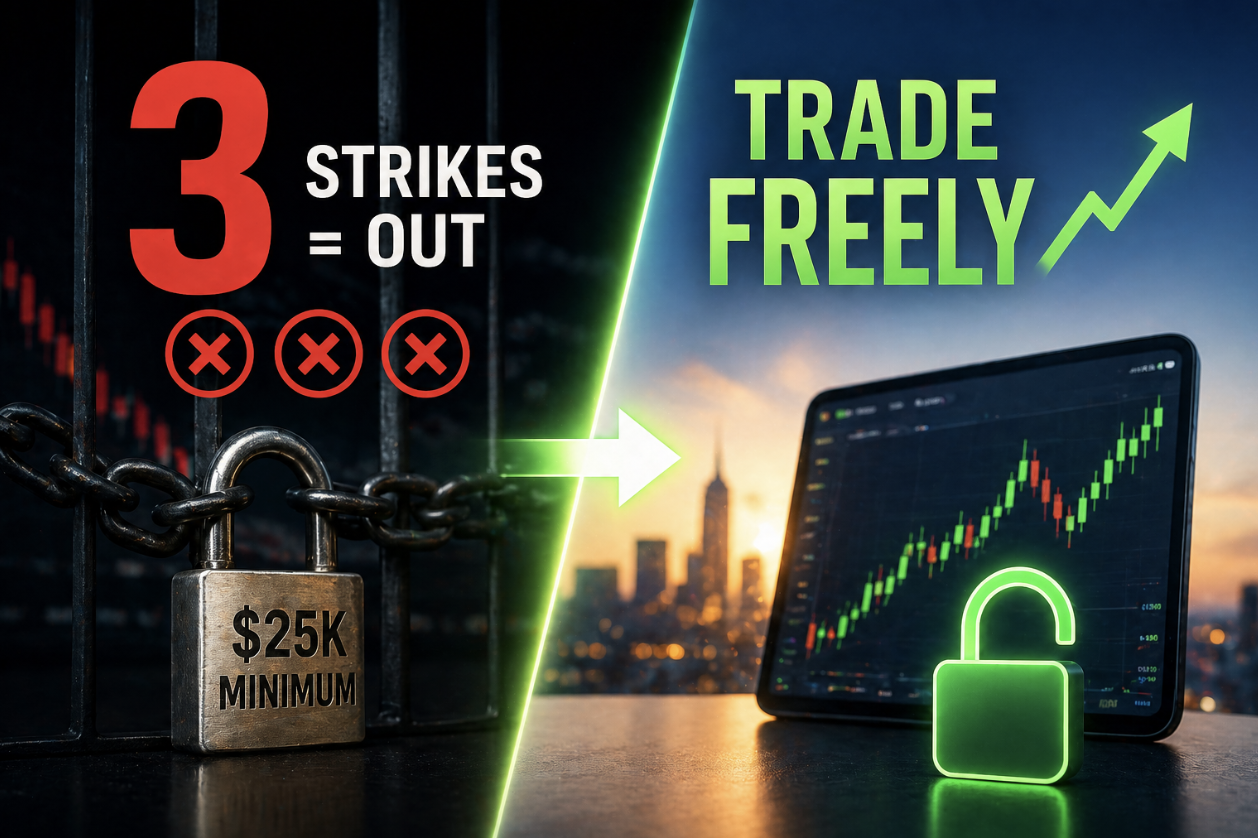
For 25 years, three trades stood between millions of everyday Americans and the markets they wanted to participate in. The Pattern Day Trading rule, with its $25,000 minimum balance requirement, functioned as a velvet rope around active trading, keeping out anyone who couldn’t maintain a balance that most households simply don’t have sitting in a brokerage account. It was sold as investor protection. In practice, it was a barrier that disproportionately locked out younger, lower-income, and first-time traders, while institutional players faced no equivalent restrictions whatsoever; that has since changed. The SEC is repealing the trade-count component of the PDT rule effective this summer, and the implications for retail trading are enormous. In this article, we’ll break down what the rule actually was, why it was always flawed, what replaces it, and why the second half of 2026 could usher in a whole new world for small-account traders and the platforms built to serve them.
What was the Pattern Day Trading Rule?
The Pattern Day Trading rule was born out of the panic that followed the 2000 dot-com crash. FINRA introduced it in 2001 with a straightforward rationale: protect retail traders from the dangers of frequent short-term trading by requiring anyone who executed three or more day trades within a rolling five-business-day window to maintain a minimum account balance of $25,000 (3 strikes and you’re out). On paper, it sounded reasonable; in practice, it created one of the most lopsided two-tiered systems in modern finance. The mechanics were brutally unforgiving: if your balance dropped below $25,000 by even a single dollar, your broker restricted your account to closing transactions only for 90 days, meaning you could exit positions but not open new ones.
Some brokers froze accounts immediately upon violation. A losing streak mid-week could knock you out of trading entirely until you deposit fresh capital to restore the minimum. The cruelest irony of the rule was that it actually punished active risk management. The trader disciplined enough to buy in the morning and exit by afternoon (exactly the behavior that limits overnight exposure) was the one getting flagged and frozen. Meanwhile, a trader with $25,001 faced no restrictions, and institutional players were never subject to any equivalent rule. For younger traders, gig workers, and anyone building a portfolio from scratch, the $25,000 threshold wasn’t a guardrail. It was a locked door.
Why this Rule Never Made Sense
The PDT rule was designed for a market that no longer exists. In 2001, retail trading meant calling a broker, paying $20 commissions, and working with limited real-time data. Today, it means a smartphone, a commission-free app, and access to the same charts and scanners that professional traders use. The entire retail trading infrastructure has been democratized beyond recognition, yet the $25,000 velvet rope built for the dot-com era stayed firmly in place as everything around it evolved. Institutional traders and hedge funds never faced anything remotely equivalent, which meant the rule’s burden fell exclusively on the people who could least absorb it. Worst of all, the rule produced the exact opposite of its intended effect: by preventing small-account traders from exiting positions intraday, it forced them to hold losing trades overnight — taking on more risk, not less, simply to avoid triggering a strike. As commission-free trading, fractional shares, and sophisticated retail platforms made active trading more accessible than ever, the $25,000 threshold became less a protective guardrail and more an arbitrary tax on anyone who wasn’t already wealthy enough to ignore it.
The Repeal: What is actually changing
Starting July 1, 2026 (with transition guidance rolling out from June 20th), the 3-strikes-in-5-days trade count trigger is gone, and the blanket $25,000 minimum balance requirement goes with it. 25 years of rule, widely condemned as paternalistic and anti-competitive, finally comes to an end. But it’s important to understand what the SEC is actually doing here: this isn’t a deregulation story, it’s a modernization story. The blunt, one-size-fits-all trade-count mechanic is being replaced by an AI-driven, automated risk-monitoring framework that evaluates each account’s actual risk profile in real time.
Instead of asking “how many trades did this person make this week,” the new system asks smarter questions:
- How much overnight risk is this account carrying?
- What is the leverage level?
- Is there a dangerous concentration in volatile securities?
- What does the overall portfolio exposure look like?
If a trader’s profile crosses defined risk thresholds, the system flags the account and can require position reductions. However, that intervention is triggered by genuine risk, not arbitrary trade counts. For small-account traders, the practical impact is immediate and significant: the 3-trade ceiling is lifted, day trading is no longer gated behind a $25,000 minimum, and risk management finally becomes dynamic and personalized rather than punitive and indiscriminate.
The New Market this Creates

The traders who are about to enter the market aren’t inexperienced; they’ve been waiting. Millions of Americans with $5,000 to $15,000 in brokerage accounts have spent years watching the market from the sidelines, not because they lacked the knowledge or appetite, but because a balance requirement kept them from active participation. Younger traders who built small accounts through Robinhood and Webull, gig economy workers without the stable income to maintain a $25,000 minimum, part-time investors who learned the craft but couldn’t afford the ticket price — this is the cohort that is about to arrive, and they are arriving with intent. Their trading style will be distinct and immediate:
- A strong gravitational pull toward lower-priced stocks in the $2 to $10 range (smaller capital generates more meaningful percentage moves)
- Higher trade frequency now that the count ceiling is gone
- Heavy reliance on momentum and technical setups over fundamental analysis.
Real-time scanning and alert tools stop being nice-to-haves and become essential infrastructure for this group. The market impact will be measurable — expect a surge in volume and intraday volatility across small and micro-cap names in the second half of 2026 as this wave of newly empowered traders finally gets its shot.
Why Trade Ideas Is Perfectly Positioned for This Moment
The Pattern Day Trading rule was a 25-year experiment in paternalism that largely kept everyday Americans out of the markets they wanted to participate in. Its replacement is a dynamic, AI-driven risk model that evaluates actual exposure rather than punishing trade counts. This smarter, fairer framework will make the second half of 2026 feel markedly different. A wave of newly empowered small-account traders is coming, and they are not coming in tentatively. They are financially literate, technically curious, momentum-driven, and hungry for the tools that let them compete on a level playing field for the first time.That is precisely the trader that Trade Ideas was built for. The platform’s AI-powered scanners don’t require years of screen time to be effective; they surface momentum setups, volume surges, and low-priced breakout patterns. The paper-trading and simulation tools let new participants build confidence and test strategies before committing real capital. Then the pre-built scans for high-momentum, lower-priced stocks are essentially a ready-made toolkit for the post-PDT market. The playing field just got leveled in a way it hasn’t been in a quarter century. Whether you’re a seasoned trader welcoming the change or a new participant finally getting your shot, there has never been a better moment to have the right tools behind you. The three strikes are gone. Trade Ideas helps make sure you don’t need them.