
AI Stock Picker: How to Find and Evaluate AI-Generated Stock Picks for Day Trading
AI Stock Picker: How to Find and Evaluate AI-Generated Stock Picks for Day Trading

You’re looking at AI-generated picks that show a ticker and a green arrow, but no entry, no stop, and no record of the trades that failed. So you guess, enter late, and chase.
That’s the core problem with any AI stock picker: a name isn’t a trade plan. A pick is worth considering only if it has a defined entry, stop, and target you can test.
This guide explains what these tools do, a five-point audit for judging picks, and how to confirm a setup before you trade. You’ll learn to separate testable picks from marketing and confirm each day trading entry instead of chasing it.
Key Takeaways
- An AI stock picker scores, ranks, or signals stocks. It surfaces candidates and does not guarantee outcomes.
- A usable day trading pick includes a symbol, entry, stop, and target. Without them you can’t measure risk.
- No tool reliably beats the market, and regulators have acted against firms that overstated their AI claims.
- Audit every pick on five points: transparency, data speed, testability, risk definition, and track-record context.
- Confirm before you enter: check volume, price versus entry, liquidity, and size the position from the stop distance.
What Is an AI Stock Picker?
An AI stock picker trains models on price history, fundamentals, and sometimes alternative data, then outputs a score, ranking, or trade signal for individual stocks. It helps you decide what to research next. It does not decide for you.
Three tools often get lumped together:
- Stock screener: ranks the market by filters you set. Trade Ideas Top Lists, for example, refresh every 15 seconds.
- Stock scanner: alerts you when a condition occurs. Trade Ideas alerts fire on every trade, not on candle close.
- AI stock picker or signal engine: selects candidates for you using models, ideally with trade levels attached.
How Does an AI Stock Picker Generate Day Trading Picks?
Pickers fall into two broad types.
Score-based pickers rate thousands of stocks daily across factors such as value, quality, and momentum. These suit longer holding periods more than intraday trading.
Signal-based pickers fire during the session when a stock meets a strategy’s rules. Holly AI signals from Trade Ideas work this way. Holly tests its strategies every night, and only the ones that pass can signal the next day, each with an entry and a stop. Signals also carry a target, and Trade Ideas itself says many signals won’t work out.
How to Find Stocks Using AI: A Step-by-Step Workflow
- Define the setup. Decide what you’re looking for, such as a breakout with rising volume, and set basic limits for price and liquidity.
- Build a screen. Ask an AI tool to find stocks that match your criteria. For example: “Show stocks above $5 with unusually high volume breaking above resistance.” Trade Ideas’ Holly AI Assistant can turn plain-language requests into scanner alerts or screener lists.
- Review the candidates. Check each stock’s chart, volume, spread, and relevant news. An AI-generated list is a starting point for research, not a trade instruction.
- Test before using the setup. Check how your rules performed on historical data, then practice in a simulator. Trade Ideas’ OddsMaker can test configured alerts against historical market data.
Can AI Pick Winning Stocks?
AI can narrow thousands of symbols to a short list quickly. Whether that list produces profit after costs is a separate question.
The wider evidence on day trading is sobering, though it measures human traders, not AI tools:
- A Brazilian study of everyone who began day trading equity futures between 2013 and 2015 found that 97% of those who persisted beyond 300 days lost money.
- Barber and Odean found the most active US households trailed the market by roughly 6.5 percentage points a year, largely from overtrading and costs.
Regulators are also watching AI marketing. The SEC penalized two investment firms a combined $400,000 over misleading AI claims. In a more recent case, the SEC alleged a purported trading platform advertised “AI-generated trading signals” with 98% accuracy while conducting no actual trades. The regulators’ own advice is simple: claims that sound too good to be true usually are.
How to Evaluate AI Stock Picks: The 5-Point Pick Audit
Use this framework on any tool before you risk money. Score each point 0 (fails), 1 (partial), or 2 (clear).
| Audit point | Ask this | Red flag |
| Transparency | Does every pick show entry, stop, and target? | A ticker with no levels |
| Data speed | Is the data real-time, and is the entry price current? | Entries based on delayed quotes |
| Testability | Can you backtest the logic or paper trade it? | No way to verify before going live |
| Risk definition | Is the stop explicit, and does the provider explain gap risk? | “Can’t lose” language |
| Track-record context | Are results shown in full, with losers and sample size? | Only selected winners |
How to read your score: 8–10 means a candidate worth paper trading. 5–7 means proceed with caution. Below 5 means skip it.
Two notes on applying it:
- Data speed: The Trade Ideas free account uses 15-minute delayed data, and real-time starts at a paid tier. Delayed data is fine for learning, but not for judging a live entry.
- Track-record context: Trade Ideas labels its Holly examples as selected, says results are not typical, and notes that past results don’t guarantee future ones. That is the kind of disclosure to look for in any provider.
How to Confirm an AI Stock Pick Before You Trade
A pick is a starting point. Confirmation is what makes it a trade. Run through this sequence:
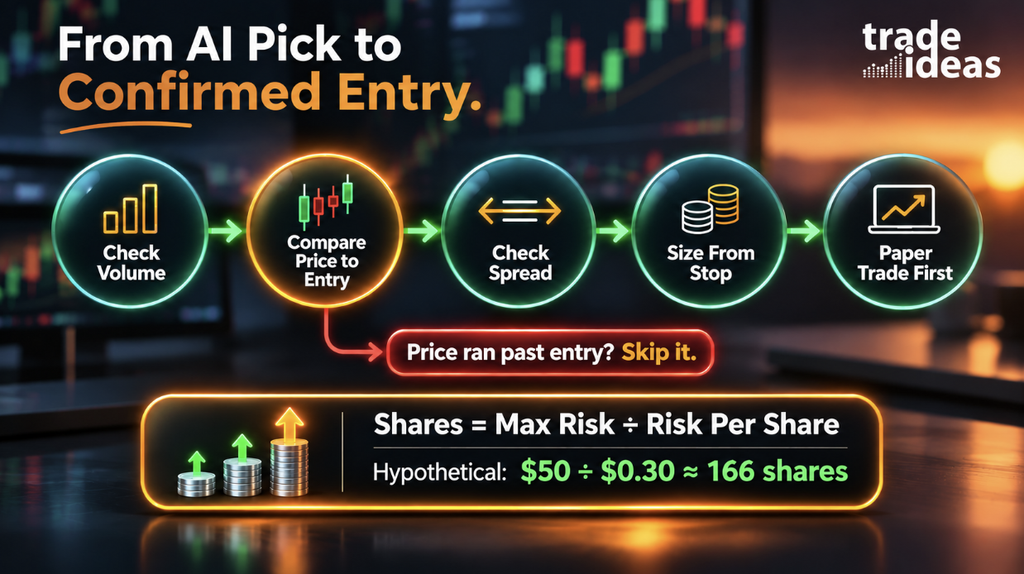
1. Confirm Trading Volume. Check whether trading activity is increasing compared with the stock’s normal volume. Low volume can make it harder to enter or exit a position at your intended price.
2. Check the Current Price Against the Entry. Compare the stock’s current price with the suggested entry point. If the price has already moved significantly beyond the entry, the risk-to-reward ratio may no longer be favorable. Avoid chasing the move.
3. Assess Liquidity and Bid-Ask Spread. Make sure the stock has sufficient liquidity and a reasonable bid-ask spread. Wide spreads can increase trading costs and reduce potential profits.
4. Calculate Position Size Based on Risk. Determine how much you’re willing to risk on the trade, then divide that amount by the difference between your entry price and stop-loss level. This helps you calculate an appropriate position size.
5. Test the Setup Through Paper Trading. Practice executing AI-generated signals in a simulated trading account before risking real money. This helps you evaluate the strategy and understand how it performs under different market conditions.
Stock Screeners vs. Scanners vs. AI Signal Tools
These tools help at different stages of a trading search. Some platforms combine them.
| Tool | What it does | Best for | What to check |
| Stock screener | Filters stocks by criteria such as price, volume, or technical indicators | Building a shortlist of stocks to research | Available filters and how often data updates |
| Stock scanner | Watches market activity for conditions such as volume spikes or breakouts and can send alerts | Finding potential intraday setups as they develop | Data speed, alert timing, and customization |
| AI signal tool | Analyzes market data to surface potential trade ideas or signals | Getting system-generated ideas to investigate | How signals are tested, what a signal includes, and whether results account for trading costs |
Quick guide: Use a screener to narrow the field, a scanner to spot changing conditions, and AI signals to generate ideas you can review. Treat any signal as a starting point, and test it against your own rules.
Trade Ideas combines real-time scanning with Holly AI Signals and OddsMaker backtesting. Holly AI Signals and OddsMaker are included with TI Premium; OddsMaker lets you test alerts you configure against your own rules. Learn more about OddsMaker backtesting.
Not sure where to start? Explore the free Trade Ideas account to learn the interface. It requires only an email and uses delayed data.
How to Find and Research Stocks Using Trade Ideas
Start with Top Lists to find stocks that meet your price, volume, or momentum criteria. Follow promising candidates with Streaming Alerts, which flag events such as breakouts or volume surges.
Holly AI Assistant and Holly AI Signals serve different purposes: the Assistant helps you build scanners and screeners from plain-language requests and review chart context. Holly AI Signals provide specific trade ideas, including a stock, entry price, and suggested stop.
Before acting on a signal, review the chart and your own criteria. Then test the setup in OddsMaker and practice it in a simulator. Backtests and AI signals don’t guarantee future results.
Common Mistakes When Using AI Stock Picks
- Treating a pick as advice. It is a candidate, not a recommendation.
- Chasing after the move. If the entry has passed, the plan no longer applies.
- Moving the stop mid-trade. It defeats the reason you sized the trade as you did.
- Judging a tool by a few screenshots. Demand full results, including losers.
- Skipping paper trading. A week of simulated trades reveals fit faster than any review.
Final Thoughts
An AI stock picker narrows the field, but the audit and the confirmation steps decide whether a pick is worth trading. Look for defined levels, real-time data, and a way to test, and treat claims of certainty as a warning sign.
Your next step: pick one tool, run the five-point audit with the free AI Stock Pick Audit and Entry Confirmation Checklist (PDF), and paper trade its signals for a week before using real money.
Don’t wait for a perfect entry, because it doesn’t exist. Choose day trading entries that meet your rules, wait for confirmation, and size every trade from your stop.
| Ready to try the screening process?Use the audit to set your criteria, then apply them to potential picks.Try the Trade Ideas Stock Screener |
Frequently Asked Questions
What is the best AI stock picker for day trading?
There is no single best tool. Prioritize real-time data, defined entry, stop, and target levels, and a way to test the logic. Score each candidate with the 5-Point Pick Audit.
Are AI stock picks accurate?
Accuracy claims need scrutiny. The SEC alleged one purported platform advertised 98% accuracy for AI trading signals while conducting no actual trades. Ask for full results, including losing trades, and test the logic yourself.
Is an AI stock picker legit or a scam?
Legitimate tools exist, but so do misleading ones. The SEC has penalized firms for misleading AI claims. Red flags include guaranteed returns, no stop levels, and results shown only for winners.
Is there a free AI stock picker?
Free tools exist, but check data delay and what’s included. Trade Ideas offers a free account with browser dashboards on 15-minute delayed data. Delayed data suits learning, not live entries.
How do I backtest an AI stock pick?
Define the signal’s rules as a testable event, run them over historical data, and include realistic costs. Then paper trade before using real capital, since backtests don’t guarantee future results.
How does an AI stock picker generate day trading picks?
An AI stock picker analyzes market data, such as price movements, trading volume, and technical indicators, then ranks stocks based on its model’s criteria. Some tools also factor in news or sentiment. Picks are signals to research, not guaranteed outcomes.