
What Is Real-Time Market Data and Why Does It Matter for Day Traders
What Is Real-Time Market Data and Why Does It Matter for Day Traders

You see a stock moving on your screen. It looks like the perfect setup. You pull the trigger — and get filled at a completely different price than you expected. Not because the market moved against you. Because the data you were looking at was already 15 minutes old. This happens to more traders than most people realize — and it happens because of one of the most misunderstood and most consequential concepts in retail trading: the difference between real-time market data and delayed market data. In active day trading, 15 minutes is not a small lag. It is the difference between catching a move and chasing one that is already over. This is the complete guide to what real-time market data actually is, why it matters, what delayed data costs you, and where to get it.
What Is Market Data?
Market data is the stream of information generated by financial markets—price, volume, bid and ask quotes, and trade activity—that traders and investors use to make decisions. Three components make up the foundation every trader needs to understand. Price data is the last traded price of a security — what a stock most recently sold for. Quote data is the current bid price, what buyers are willing to pay, and the ask price, what sellers are willing to accept — the spread between them is what traders pay every time they enter or exit a position. Volume data shows how many shares have traded, telling traders how much interest and activity a security has at any given moment. Every trading decision — entry, exit, stop loss, position sizing — is based on market data. The quality and speed of that data directly determine the quality of the decisions made from it.
What Is Real-Time Market Data?
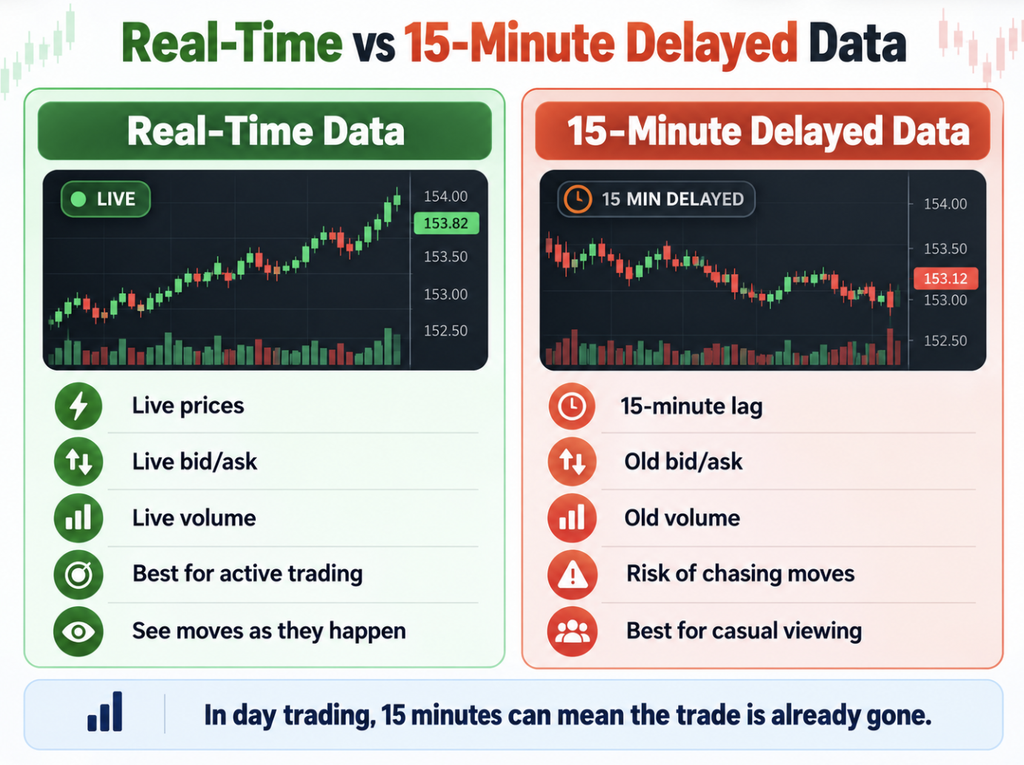
Real-time market data is price, quote, and volume information delivered to traders as it happens. There is zero delay between when a trade occurs on an exchange and when that information reaches the trader’s screen. When a trade executes on the NYSE or NASDAQ, the exchange transmits the transaction to data vendors, who distribute it to platforms and traders within milliseconds. Real-time data includes live bid and ask quotes that update continuously, last sale price that updates with every transaction, real-time volume accumulation throughout the session, live Level 2 data showing the full order book, and time and sales data showing every transaction as it happens. In active day trading, price action moves fast — a stock breaking out on volume can move 2-3% in 60 seconds. A trader with real-time data sees that move as it develops. A trader with delayed data sees it after it happens.
What Is Delayed Market Data — And Why Most Free Platforms Use It
Delayed market data is price and quote information transmitted to traders with a built-in lag — most commonly 15 to 20 minutes behind real-time activity. Stock exchanges charge fees to distribute real-time data, and free or low-cost platforms offset that cost by providing delayed data instead. When a trader using delayed data sees a stock at $25.00, that price reflects where the stock was 15 minutes ago. The actual current price could be $24.00, $26.00, or anywhere in between. Traders encounter delayed data more often than they realize: free financial websites like Yahoo Finance and Google Finance default to delayed quotes, basic brokerage accounts without real-time subscriptions, low-tier platform subscriptions that include charts but not live exchange feeds, and many mobile trading apps on their free tiers. Traders who don’t realize their data is delayed make decisions based on a picture of the market that no longer exists.
Real-Time vs. Delayed — The Practical Difference
Here is a concrete scenario that makes the difference undeniable. At 10:15 AM, a stock breaks out above a key resistance level on heavy volume and begins moving sharply higher. A trader with real-time data sees the breakout as it happens, gets an alert, evaluates the setup, and enters at $25.10 as the stock moves. A trader with 15-minute delayed data sees the breakout at 10:30 AM — after the stock has already moved to $26.50. The opportunity is gone. The trader either misses it entirely or chases it at the worst possible entry. In a fast-moving market, 15 minutes of delay does not just mean missing one trade — it means every decision made during that window is based on stale information. For swing traders holding positions for days or weeks, a 15-minute lag is relatively immaterial. For active day traders, real-time data is not a premium feature. It is a fundamental requirement. A day trader using delayed data is not trading. They are guessing based on a market that no longer exists. A real-time data subscription almost always costs less than a single bad fill or missed opportunity caused by delayed data.
Real-Time Data and Stock Scanners — Why Speed Matters
This is where real-time data becomes most critical for active day traders. A stock scanner that uses delayed data is not a trading tool — it is a history report. When it surfaces a breakout setup based on 15-minute-old data, that setup has already played out. The fastest and most powerful scanners use server-side event-driven architecture — the scanner runs on powerful servers that process real-time data continuously and push alerts the millisecond a condition is met. Client-side scanners run in the trader’s browser and update on a refresh cycle, adding latency on top of any existing data delay. Trade Ideas’ server-side event engine continuously monitors 8,000+ US equities using real-time exchange data. It pushes alerts the millisecond a defined condition is met — no delay, no manual refresh, no stale data. Holly AI analyzes live real-time market data during the active trading session to identify setups and deliver specific trade ideas — a capability only possible with institutional-grade real-time data infrastructure. The quality of a trading scanner is inseparable from the quality and speed of the underlying data it runs on.
How to Get Real-Time Market Data
Most brokers offer real-time data as part of their standard account, but coverage and quality vary significantly. When evaluating any platform, ask: is the data truly real-time or is there a built-in delay? Which exchanges are covered? Is Level 2 data included? Is the scanner built on server-side streaming or client-side polling? Real-time data subscriptions typically range from free through qualifying brokerage accounts to $20-30 per month for comprehensive standalone coverage — negligible compared to the value of making decisions based on accurate current information. Trade Ideas includes institutional-grade real-time data for all major US exchanges as part of its subscription — no separate data fees, no exchange packages, no delayed data by default. The scanner, the alerts, and Holly AI all run on the same real-time infrastructure that powers the platform’s edge.
The Bottom Line
Real-time market data is not a luxury feature for advanced traders. It is the foundational infrastructure that every active trader’s decisions depend on. The difference between real-time and delayed data is the difference between seeing the market as it is and seeing it as it was — and in day trading, that distinction determines whether you catch the move or chase it. Every tool in a trader’s arsenal — charts, scanners, alerts, AI signals — is only as good as the data it runs on. Real-time data is not an upgrade. It is the baseline. Log into Trade Ideas today and experience what institutional-grade real-time market data actually looks like in practice — scanners that update the millisecond conditions are met, Holly AI signals based on live market activity, and the confidence of knowing that every decision you make is based on what the market is doing right now, not what it was doing 15 minutes ago.