
The Data Center That Orbits the Earth: Can SpaceX Beat Everyone to the Sky?
The Data Center That Orbits the Earth: Can SpaceX Beat Everyone to the Sky?
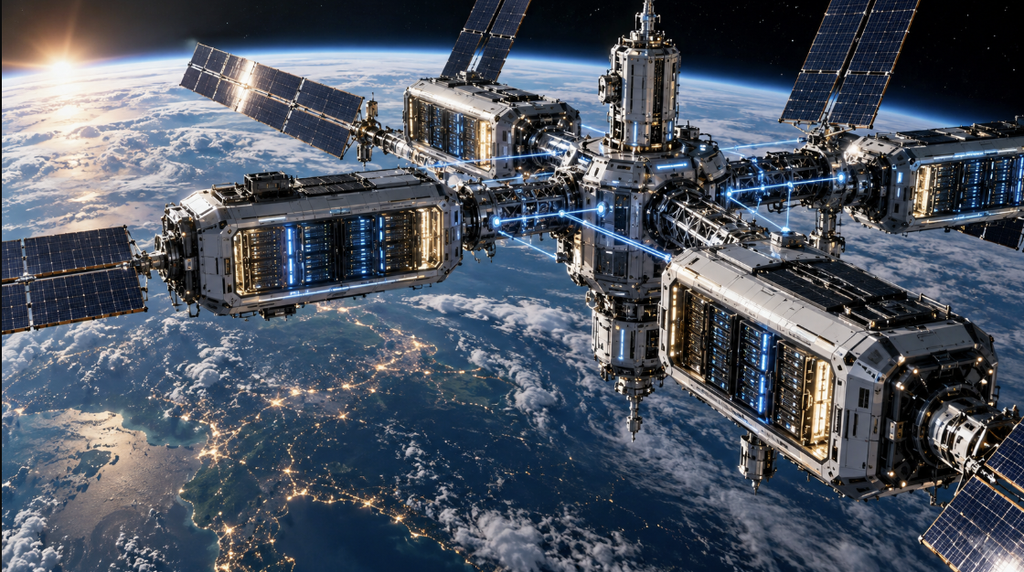
Every major tech company is in a frantic race to build data centers on the ground as fast as possible, burning through billions in capital and fighting permitting delays, power constraints, and land scarcity at every turn. But here is the question almost nobody in the investment community is asking yet: what if the next generation of dominant data center infrastructure isn’t built on the ground at all? Space-based data centers represent one of the most audacious and potentially transformative ideas in the entire AI infrastructure race. And the company best positioned to get there first already has thousands of satellites in low Earth orbit, the cheapest launch costs in history, and a rocket capable of delivering more payload to space than anything that has ever been built. The race is on. The ground has a head start. But the sky has advantages that no amount of terrestrial construction can replicate.
The Terrestrial Data Center Problem
The scale of the terrestrial challenge is staggering. Microsoft, Google, Amazon, and Meta are each spending between $50 and $100 billion on data center infrastructure in 2025 and 2026 alone — and every single one of them is running into the same walls simultaneously. Power is the most immediate constraint: the existing electrical grid cannot support the demand, companies are waiting years for grid connections, and even those being told to build their own power generation are facing timelines measured in years rather than months.
Suitable land near adequate power and fiber connectivity is increasingly scarce and expensive in every major market. Traditional data centers require enormous amounts of water for cooling — a resource under growing pressure in many of the most attractive data center regions. Permitting delays are adding years to timelines in markets that need capacity right now. Not to mention, heat dissipation — removing the extraordinary amounts of thermal energy generated by AI computing at scale — is one of the most expensive and complex engineering challenges in modern data center design. The terrestrial build-out is real, necessary, and already underway. But physical, regulatory, and infrastructure limitations won’t disappear quickly — and that’s where the space-based opportunity begins.
What a Space-Based Data Center Actually Is — And Why It Solves Terrestrial Problems
A space-based data center is what it sounds like: computing infrastructure deployed in orbit—satellites or space stations equipped with processors, storage, and networking capabilities that perform computing tasks from space rather than from ground-based facilities. The problems it solves map almost perfectly onto the issues slowing down the terrestrial build-out. Satellites in orbit have direct, continuous access to solar energy — no grid connection required, no utility bottlenecks, no years-long wait for power infrastructure permits.
Space also presents unique cooling challenges. Unlike terrestrial data centers, which can use air and water to remove heat, orbital computing systems must rely on specialized thermal management systems that radiate excess heat into space. Developing efficient cooling solutions will be critical to making large-scale space-based data centers viable. Orbital slots don’t require zoning approvals or expensive real estate in constrained markets. A constellation of data center satellites in low Earth orbit can provide low-latency computing anywhere on the planet—a global coverage advantage no single terrestrial data center can match. Microsoft has already begun exploring partnerships with space infrastructure companies for orbital computing. Several dedicated space data center startups are in development. But one company has structural advantages that put it in a position to capture this opportunity before anyone else gets close.
SpaceX’s Structural Advantages — Why They Could Get There First
SpaceX has spent the past decade building the infrastructure space-based data centers require—and doing it at a cost structure no competitor can currently replicate. The launch-cost revolution alone is transformative: SpaceX has reduced the cost of getting payload to orbit by an order of magnitude compared to legacy providers, fundamentally changing the economics of deploying computing infrastructure in space from what they were five years ago. Starlink’s existing constellation of thousands of satellites in low Earth orbit provides the communication backbone space-based data centers would need—SpaceX already has it, and building a comparable network would take any competitor years and tens of billions of dollars.
Starship—capable of launching massive payloads to orbit at dramatically reduced cost—changes the scale of what can be deployed in space. Computing infrastructure that would have been impossibly expensive to launch is now potentially economically viable. SpaceX’s vertical integration means it designs, builds, launches, and operates its own spacecraft, creating competitive moats that are extraordinarily difficult to replicate. Its existing relationships with NASA and the Department of Defense also provide revenue and credibility for the large-scale infrastructure deployment space data centers would require. In infrastructure races, getting there first matters enormously. The company that establishes the dominant orbital data center platform before terrestrial alternatives are fully built out could capture a structural position that lasts for decades.
The Challenges — Why This Is Harder Than It Sounds
Honesty requires acknowledging the significant engineering and economic challenges that space-based data centers face. Computing hardware in orbit is exposed to radiation levels that degrade performance and lifespan in ways ground-based hardware never faces — radiation-hardened computing is significantly more expensive and less powerful than conventional hardware. When a server fails in a terrestrial data center, a technician fixes it in minutes. In orbit, the options are far more limited and expensive. Even low Earth orbit introduces measurable latency compared to ground-based facilities — a structural disadvantage for latency-sensitive applications. Data processed in space still needs to reach users on the ground, and atmospheric transmission constraints limit bandwidth on that final link. Regulatory complexity around orbital slots adds another layer of friction. And despite SpaceX’s cost revolution, deploying the computing scale needed to compete with major terrestrial data centers in orbit remains extraordinarily capital intensive.
Terrestrial vs. Space — The Most Likely Outcome
This is almost certainly not an either-or scenario. The most likely outcome is a hybrid architecture where space-based and terrestrial computing serve different use cases. Space wins in global-coverage applications, government and defense computing that prioritizes security and survivability, and edge computing for remote locations. Terrestrial wins on raw computing density, latency-sensitive applications, and most consumer and enterprise AI workloads in the near to medium term. The strategic question for SpaceX is whether they can establish a dominant enough position in the orbital computing segment before terrestrial alternatives are fully built.
What This Means for Traders and Investors
SpaceX remains private — direct investment is not available to most retail traders. But the ecosystem around this theme is very much tradeable right now. Satellite and space infrastructure companies in the supply chain benefit from orbital computing growth regardless of which platform wins. The terrestrial data center build-out continues regardless of space-based competition — Constellation Energy (CEG), Vistra (VST), Eaton (ETN), Vertiv (VRT), and Quanta Services (PWR) remain the most direct plays on AI infrastructure demand. Radiation-hardened semiconductor companies and hardware manufacturers developing space-ready computing represent a niche but potentially significant opportunity. Watch for SpaceX IPO announcements, partnership deals between hyperscalers and space infrastructure companies, and regulatory developments around orbital computing — each of these is a potential market-moving catalyst.
The terrestrial vs. space data center debate is not science fiction. It is an active investment theme with real companies, real capital, and real timelines already in motion. Whether space-based data centers become dominant, complementary, or remain a niche application depends on how quickly the engineering and economic challenges are solved. SpaceX is better positioned than anyone else to solve them first. The traders and investors who understand this theme now — before it becomes mainstream — are the ones positioned for the moves that come when the first major space data center deployment is announced.
Log into Trade Ideas today, build a scanner around AI infrastructure, space technology, and satellite communication names, set your alerts around SpaceX-related catalysts and hyperscaler infrastructure announcements, and start tracking one of the most forward-looking investment themes in the market — because the data center of the future might not need an address.