
Is Day Trading Actually Harder Than it Used to Be? The Answer Might Surprise You
Is Day Trading Actually Harder Than it Used to Be? The Answer Might Surprise You
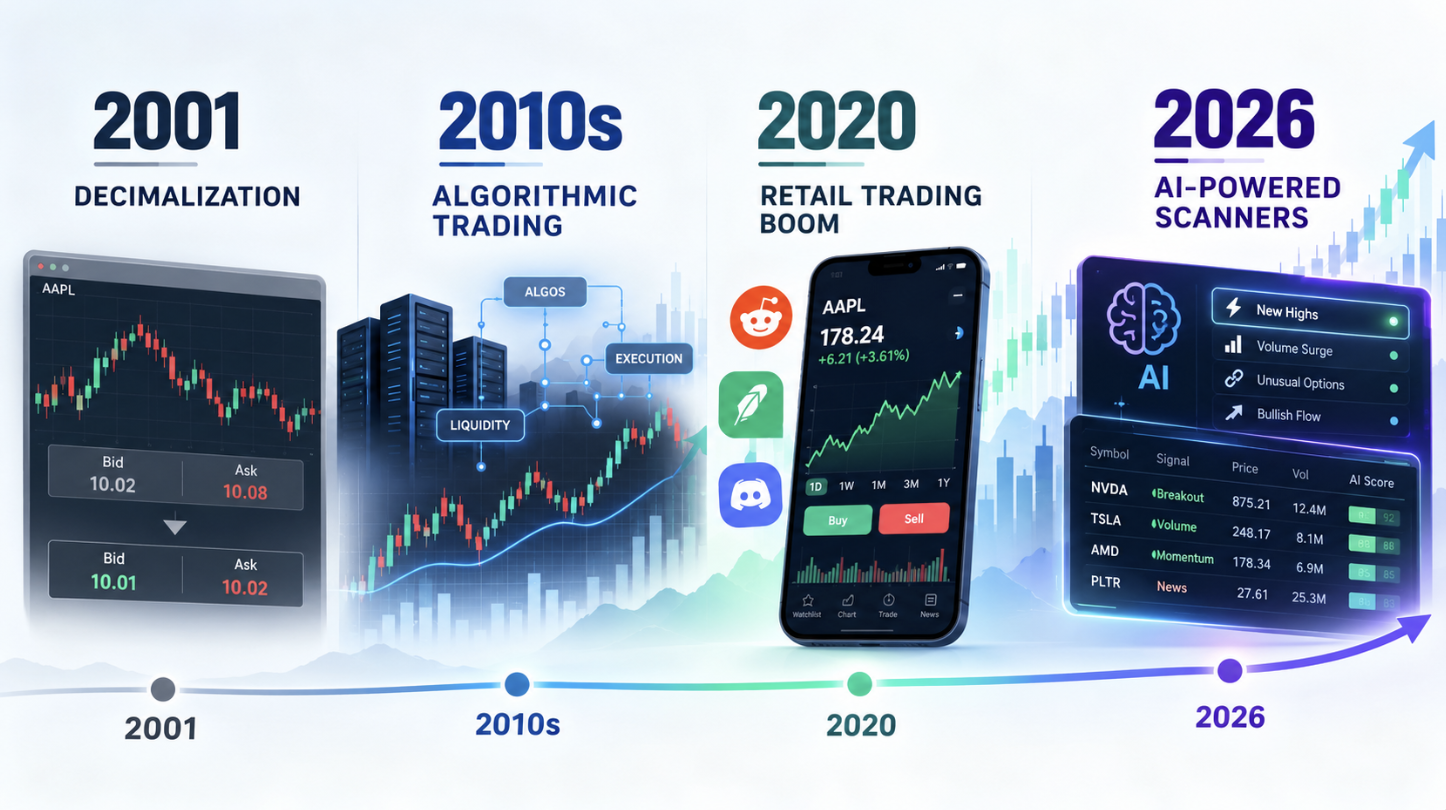
If you’ve been day trading for more than a few years, you’ve probably felt it. Strategies that used to work reliably seem to fail more often. Setups that were textbook clean a few years ago get faded instantly before they have a chance to develop. The market feels faster, less predictable, and less forgiving than it used to — and the wins that used to come with relative consistency now seem to require twice the effort for half the return. So is this just survivorship bias; the natural human tendency to remember the wins from the good old days and quietly forget the losses? Or is day trading genuinely, structurally harder than it was 10 years ago?
The honest answer is both — and understanding which parts have gotten harder and which parts have actually gotten easier is the most important reframe available to any active trader trying to figure out why their results don’t match their effort. The market has changed in fundamental and measurable ways that make certain aspects of day trading significantly more difficult than they were even five years ago. At the same time, the tools, information, and technology available to retail traders in 2026 have never been better.
What Day Trading Looked Like Before — The Golden Era
To understand why day trading feels harder now, you have to understand what it looked like before. In the late 1990s and early 2000s, day trading was genuinely easier in several specific and measurable ways. Bid-ask spreads were wider, meaning more profit opportunity built into every trade — the decimalization of stock prices in 2001 compressed those spreads to fractions of a penny and changed the economics of short-term trading permanently. There were fewer active traders competing for the same setups, which meant more exploitable inefficiencies and slower price discovery.
News moved slowly enough that attentive traders had a real-time advantage — an edge that modern information distribution has almost entirely eliminated. And algorithmic trading was in its infancy — the machines that now dominate daily volume barely existed. Then came 2020 and 2021 — a brief, anomalous throwback to the old days. Massive retail participation, explosive momentum, and inefficiencies everywhere rewarded aggressive day trading in ways that hadn’t been seen in years. The problem: many traders who started in that era formed their entire framework around conditions that were historically unusual. When the environment normalized, the market didn’t get harder; it just went back to normal. For those traders, normal felt impossible.
What Has Actually Changed — The Structural Shifts
- Algorithmic dominance: algorithms now account for the vast majority of daily trading volume — they execute faster than any human and have eliminated many of the simple pattern-based edges that defined the pre-algo era
- Information speed: news that used to take minutes or hours to reach the market now reaches algorithms in milliseconds — the time advantage attentive traders once had is essentially gone
- Retail participation explosion: commission-free trading, mobile apps, social media, and the meme stock era brought millions of new traders into the market — more participants means more competition for the same setups and faster elimination of obvious opportunities
- Tighter spreads: decimalization compressed bid-ask spreads to fractions of a penny — strategies that relied on spread capture or wider differentials became economically unviable almost overnight
- PDT rule removal in 2026: eliminating the $25,000 minimum opened day trading to millions of new smaller accounts — increasing retail competition further at exactly the moment the market may have already peaked
- Social media crowding: when a setup goes viral on Twitter, Reddit, or Discord, the edge evaporates almost immediately — the crowding effect has made many previously
What Has Gotten Easier — The Other Side of the Argument
- Access to information: retail traders in 2026 have access to data, research, and market intelligence that would have required institutional resources 20 years ago
- Commission-free trading: eliminating per-trade commissions removed a meaningful headwind that used to make frequent day trading economically challenging for smaller accounts
- Better tools: real-time scanners, AI-powered pattern recognition, sophisticated charting, and direct market access are all available to retail traders at price points that were unimaginable a decade ago
- Trade Ideas: AI-powered scanning gives retail traders capabilities that previously existed only inside institutional trading desks — real-time pattern recognition, automated alerts, and systematic setup identification (leveling the playing field)
- More education: the volume of high-quality trading education available has never been higher — the barrier to learning is lower than it has ever been
- Volatility creates opportunity: the market is more competitive but also more volatile — and volatility, properly understood and managed, creates exactly the price action day traders need to generate returns.
Which Strategies Have Become Harder vs Stayed Same
The strategies that still work in 2026 share one common characteristic: they exploit conditions that algorithmic systems are less optimally suited to handle.
Relative strength and weakness plays — identifying stocks moving independently of the broader market on genuine surprise catalysts — remain reliable because algorithms are less effective at front-running unexpected moves in less liquid names.
Opening range setups still produce some of the cleanest opportunities of the entire trading day because the simultaneous convergence of volume, volatility, and price discovery creates a window that pure algorithmic execution is not optimally designed to capture.
Earnings and catalyst plays still move in ways skilled traders can position around. And in small and mid-cap names with less algorithmic coverage, retail traders with strong pattern recognition and real-time scanning tools still have a meaningful edge.
What the Traders Who Are Still Winning Are Doing Differently
The traders winning in 2026 have figured this out — and made three specific adaptations that separate them from those still struggling.
- They specialize rather than trade everything, identifying a specific setup, time window, or market condition where their edge is real and executing it with disciplined repetition.
- They use better tools — real-time scanning and alert systems that surface opportunities before the obvious move, before the social media crowd, and before algorithmic front-running begins.
- They trade less, not more — waiting for their specific edge rather than manufacturing trades in every session. They manage risk more precisely than ever, because in a faster and more competitive market the difference between a good trader and a great one is almost never the entry. It’s what happens after.
So is day trading harder than it used to be? Yes — in specific, measurable ways that are the direct result of algorithmic dominance, compressed information speed, and an explosion of retail competition. But impossible? Absolutely not. The traders winning in 2026 prove it, and the difference comes down to one word: adaptation. They stopped trading the market of 2010 or 2021 and built an approach for the market that actually exists today. They specialize, trade less, manage risk more precisely, and use better tools — because the gap between prepared and unprepared retail traders has never been wider. The edge is still there. It just requires more focus and more discipline than it used to. The market has changed. The question is whether your approach has changed with it. Log into Trade Ideas today, use the AI-powered scanner to surface what’s actually working right now, and build the adapted, systematic approach that gives retail traders a genuine edge in the most competitive trading environment in history.