
Simulated Trading: A Beginner’s Guide to Risk-Free Practice
Simulated Trading: A Beginner’s Guide to Risk-Free Practice
New traders often want a way to learn order placement, position sizing, and basic trade management before risking real capital. Simulated trading gives them a controlled environment to do that.
The challenge is using that environment realistically. Clicking through random trades or chasing the biggest virtual profit can create habits that do not translate well to real trading.
This guide explains how paper trading works, what a stock trading simulator can teach you, and how to practice with virtual money in a more structured way.
| Quick answer: Simulated trading, also called paper trading, lets you practice buying and selling stocks with virtual money rather than real capital. It can help beginners learn platform mechanics, order types, position sizing, and trade management, although simulated results do not guarantee the same outcome in live trading. |
How Simulated Trading Works
A stock trading simulator recreates key parts of the trading process without requiring you to put real money into the position.
In a typical simulated trade, the process looks like this:
Market data → Virtual funds → Simulated order → Open position → Price movement → Simulated gain or loss → Review
Here is what that means in practice:
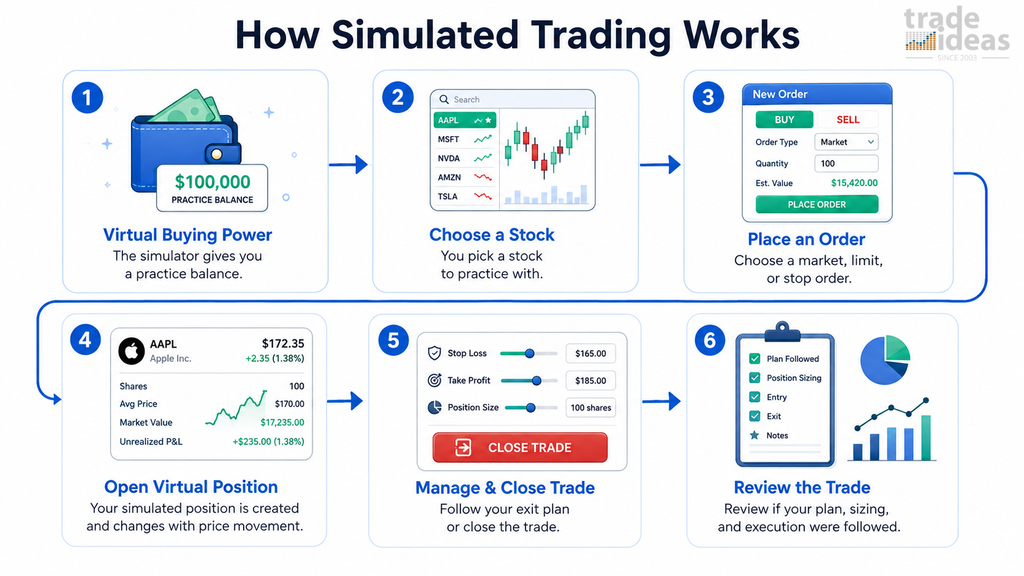
This is what makes simulated trading useful for beginners: it lets you practice the mechanics of trading without every mistake costing real money.
What Can Beginners Learn Through Simulated Trading?
The biggest benefit of paper trading for beginners is not seeing how much fake money you can make. It is learning how trading works through repetition.
Here are some of the most useful skills you can practice.
Learn How to Place Orders
Reading about market and limit orders is different from actually choosing one and placing it.
Simulation lets you practice order entry until the process feels familiar.
This is important because order types behave differently. FINRA notes that market conditions can cause the execution price to differ from the price a trader sees when placing an order, particularly in fast-moving markets. Understanding how different orders work should therefore be part of learning the mechanics of trading.
Learn Your Trading Platform
Before thinking about profits, learn where everything is.
Practice how to:
- Enter an order;
- Change or cancel an order;
- View an open position;
- Set an exit;
- Follow a chart;
- Review previous trades.
Making these mistakes with virtual money is much less costly than discovering that you do not understand your trading software while real money is involved.
Practice Position Sizing
A simulator also lets you see how different position sizes affect a trade.
If you have a $10,000 virtual account, for example, putting the entire balance into one practice trade teaches something very different from using a smaller, planned position.
The goal is not to see the biggest possible virtual gain. It is to practice making decisions under realistic constraints.
Practice Following a Plan
You can decide before entering:
- Why you are taking the trade;
- Your intended entry;
- Your position size;
- Where you would exit if the trade moves against you;
- Where you plan to take profit.
That turns simulated trading from random clicking into structured practice.
Learn From Mistakes Without Losing Trading Capital
You will make mistakes while learning.
You might choose the wrong order type, enter too early, use an unrealistic position size, or forget the rule you intended to follow.
Simulation gives you room to identify mistakes without risking real trading capital.
How to Practice Paper Trading Correctly
Paper trading works best when you treat it like real practice, not a game. Keep your setup realistic, focus on one thing at a time, and review what you did after each session.
1. Use a Realistic Virtual Balance
If you expect to trade with a smaller account later, avoid practicing with an oversized virtual balance.
Use an account size and position sizes that are close to what you could realistically manage. This makes your practice more meaningful.
2. Learn the Platform First
Before focusing on profits, learn how to:
- place and cancel orders;
- set stops;
- adjust a position;
- close a trade;
- review your trade history.
The goal at this stage is to become comfortable with the trading process.
3. Practice One Setup at a Time
Avoid jumping between different markets, strategies, and indicators in every session.
Choose one market and one skill to work on, such as limit-order entries, position sizing, or following a stop.
This makes it easier to understand what is working and what needs improvement.
4. Plan the Trade Before You Enter
Before placing a simulated trade, decide:
- why you are entering;
- your entry price;
- your position size;
- where you will exit if the trade goes against you;
- where you may take profit.
Making these decisions before the outcome is known helps turn simulation into structured practice.
5. Practice in Real Time When Possible
Historical replay can help you see more setups quickly, but constantly skipping to the outcome can make practice unrealistic.
Real-time simulation teaches you to wait, manage a position as prices move, and make decisions without knowing what happens next.
Trade Ideas, for example, supports real-time simulated trading using real-time market data.
6. Review the Process, Not Just the Profit
Keep a simple record of:
- entry and exit;
- position size;
- reason for the trade;
- whether you followed your plan;
- one lesson learned.
Do not erase bad trades just because they went wrong. A losing simulated trade can still be useful if it shows you where your process needs improvement.
The goal of paper trading is not to build the biggest virtual account. It is to become more consistent in how you make and manage trading decisions.
A Simple Paper Trading Example
Suppose you create a $10,000 virtual account and decide to practice one stock trade.
For illustration only:
| Item | Example |
| Virtual account | $10,000 |
| Hypothetical stock | ABC |
| Planned entry | $50 |
| Shares | 20 |
| Position value | $1,000 |
| Planned stop | $48 |
| Planned exit | $54 |
You place the simulated order for 20 shares at $50.
From there, your job is not simply to hope the stock reaches $54.
You observe the position and follow the rules you set beforehand.
If the stock falls toward your planned stop, do you follow your original plan or move the stop because you don’t want to record a losing trade?
If it moves higher, do you close early simply because you are excited to see virtual profit?
These decisions are part of the practice.
After the trade is complete, record the result and, more importantly, whether you followed your plan.
This hypothetical example is provided only to explain simulated-trading mechanics. It is not a recommendation to buy, sell, or trade any security.
What Simulated Trading Can and Cannot Teach You
Paper trading can reproduce many parts of the trading process, but it is not identical to live trading.
| Simulated trading can help you practice | It cannot fully reproduce |
| Navigating a trading platform | Emotional pressure of risking your own money |
| Placing and managing orders | Every real-world execution condition |
| Position sizing | All liquidity effects |
| Planning entries and exits | Every instance of slippage |
| Following trading rules | Real financial consequences |
| Reviewing your process | Guaranteed live-trading results |
The distinction matters.
For example, even in actual markets, an order may not execute exactly where a trader expects. Investor.gov notes that market-order execution prices are not guaranteed, while limit orders may never execute if the required price is not reached.
There is also a psychological difference. Watching virtual money fall is not the same experience as watching your own capital decline.
That’s why simulated trading should be viewed as practice, not proof that future live trades will produce the same outcome. Building discipline during practice can help, but the emotional side of moving from practice toward real-market decision-making deserves separate attention.
Common Paper Trading Mistakes Beginners Should Avoid
Paper trading is forgiving, which is useful, but that can also encourage habits you wouldn’t want to carry into live trading.
Using an Unrealistic Account Balance
A huge virtual account can encourage oversized trades and remove the constraints you may face later.
Use a realistic balance where possible.
Taking Oversized Positions
Don’t increase your simulated position simply because losing fake money doesn’t hurt.
Practice the position sizes you actually want to understand.
Changing Your Approach Constantly
Testing new ideas is part of simulation, but changing your rules after every loss makes it difficult to learn anything consistently.
Give one approach enough practice to evaluate your decisions.
Entering Without an Exit Plan
Deciding where to get out only after a trade moves against you can turn structured practice into guesswork.
Set the basic conditions before entering.
Ignoring Losing Trades
Don’t delete mistakes or pretend they didn’t happen.
A losing simulated trade can highlight problems with execution, position sizing, discipline, or the plan itself.
Focusing Only on Profit and Loss
Virtual P&L is useful information, but it isn’t the only information.
A profitable trade made by breaking every rule may teach you less than a controlled losing trade where you followed your plan correctly.
Treating the Simulator Like a Video Game
Trading huge positions, taking random trades, or constantly resetting your account may be entertaining, but it doesn’t create realistic practice.
Use the freedom of simulation to make mistakes, not to remove all consequences from your decision-making.
What Should You Track While Paper Trading?
Beginners don’t need dozens of complex metrics.
Start with information that helps you understand whether you are following your process.
| What to track | What it helps you understand |
| Number of trades | How much practice your results represent |
| Entry and exit | How you actually executed |
| Position size | Whether your sizing stays realistic |
| Planned vs. actual action | Whether you followed your rules |
| Virtual profit/loss | What happened financially in the simulation |
| Lesson learned | What to improve next time |
As your skills develop, you can move into more detailed performance analysis. Trade Ideas’ Brokerage Plus environment combines order and position management with its real-time simulator, which gives beginners room to learn execution while also supporting more advanced trading workflows as they progress.
Beginner Paper-Trading Checklist
Before every simulated trade, ask yourself:
- Do I know why I am entering?
- Have I chosen a realistic position size?
- Do I know where I plan to exit if I am wrong?
- Do I know what would make me take profit?
- Am I following the same rules I planned before the trade?
- Am I practicing with realistic virtual capital?
- Will I record the result afterward?
- Am I trying to learn, rather than simply maximize fake profits?
If you can’t answer these questions yet, that may be the skill worth practicing before placing the next trade.
Practice Simulated Trading With Trade Ideas
A useful simulator should make it easier to practice the same basic mechanics you expect to use when following the market.
Trade Ideas includes an in-house real-time simulator through Brokerage Plus. Traders can use simulated positions while working with Trade Ideas’ market data, charts, scanners, and order-management workflow. Selecting Brokerage Plus Sim connects to the Trade Ideas simulated environment.
For a beginner, the value isn’t simply having virtual money available. It’s being able to practice finding opportunities, placing orders, managing positions, and reviewing what happened within the same broader workflow.
Once those fundamentals feel familiar, simulation can also become a tool for more structured strategy testing and performance work, but those are later steps. Start by learning to use the simulator consistently and realistically.
Final Thoughts
Simulated trading can be one of the easiest ways to start learning how trading works without putting real capital into every practice decision.
But the quality of your practice matters.
Use realistic virtual funds. Learn the platform before worrying about profits. Practice one skill at a time. Decide your entry, exit, and position size before placing a trade. Keep a journal, don’t erase mistakes, and evaluate how well you followed your process.
Most importantly, remember what a simulation is designed to do: give you a place to learn.
A stock trading simulator cannot guarantee future performance or reproduce every part of live trading, but used thoughtfully, it can help you build familiarity with the mechanics before real money is involved.
Ready to start? Sign up for a free trading simulator today and take the first step toward mastering the markets!
Related Reads:
Should Beginners Use a Trading Room? A Simple 2025 Guide
Is AI Trading a Good Option for Beginners in 2025?
Silver Trading Trends for 2025: Is Now the Time to Invest in Silver?
FAQs on Simulated Trading
Are trading simulators free?
Many trading simulators, such as free simulated trading options offered by different platforms, are free. Some platforms also provide access to paper money simulated trading, letting you practice without cost.
How to simulate trading strategies?
To simulate trading strategies, choose a simulated trading app or platform and start applying your strategies, like simulated options trading or simulated day trading. You can practice buying, selling, and testing your decisions with virtual funds to see what works best for you.
What is the most profitable trading strategy of all time?
While there’s no single “most profitable” strategy, popular ones include trend following and day trading. You can test these strategies on a simulated trading platform or explore futures simulated trading to determine which suits your trading style and risk tolerance.
How do you practice dummy trading?
Dummy trading involves using a simulated trading account to place trades using virtual funds. You can practice using simulated stock trading or simulated crypto trading and analyze the results to improve your skills without any financial risk.
What is a simulated trading account?
A simulated trading account is a practice account where you use virtual money to simulate real trading. This account lets you experiment with different asset types, including options and stocks, on various simulated trading platforms without any financial risk.
Does a stock trading simulator use real market prices?
It depends on the platform. Some simulators use real-time market data, while others may use delayed or historical data. Trade Ideas’ in-house simulated trading environment uses real-time market data for its simulated portfolio.
Is simulated trading the same as paper trading?
Yes. Paper trading and simulated trading generally mean practicing trades without risking real capital. “Paper trading” originally referred to recording hypothetical trades manually, while modern traders usually use digital simulators. You may also see terms like virtual trading, demo trading, or simulated stock trading.