
0DTE Options Are Changing Day Trading: How to Find Stocks Moving Today
0DTE Options Are Changing Day Trading: How to Find Stocks Moving Today

The 0DTE options are changing day trading by making same-day options activity part of the intraday tape, not a side story. For traders scanning headlines, searching for stocks moving today, or tracking broader market structure, the key question is not just whether 0DTE volume is growing.
It is how to filter real stock movement from short-lived noise using volume, liquidity, VWAP, and catalyst quality. Trade Ideas’ stock scanner helps frame that process in real time.
Here’s what the data shows.
What 0DTE Options Changed About Day Trading
0DTE means zero days to expiration. These options expire on the same trading day they are opened. Less time means faster premium decay, tighter decision windows, and more sensitivity to intraday price movement.
That does not mean every trader needs to trade 0DTE contracts. For many day traders, the bigger shift is in how same-day options activity affects how stocks and indexes behave during the session.
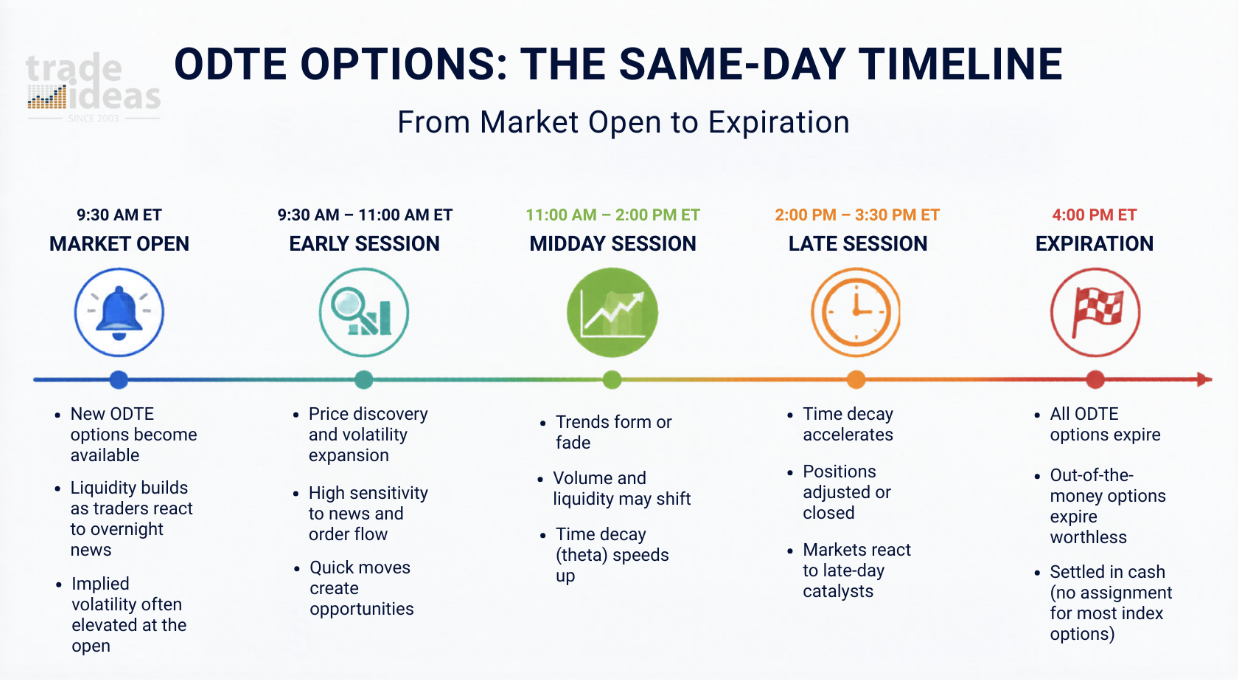
By May 2026, S&P 500 Index options remained one of the most active areas of the listed-options market. Earlier in 2026, SPX 0DTE options had reached a monthly average daily volume record of 3.0 million contracts in February, equal to 63% of SPX options trading that month. That February record is not the freshest monthly read, but it shows the size of the same-day options base going into mid-2026.
The practical takeaway is not “trade every fast move.” It is that intraday moves now need stronger filters. A stock moving today may be reacting to earnings, sector news, index pressure, options flow, or simple noise. Traders need a way to separate tradable movement from motion without confirmation.
Also Read: Understanding Stock Market Fluctuation and Opportunities
Why Stocks Moving Today Need a Different Filter
A stock that is up 5% before 10 a.m. can look attractive on a basic mover list. In a 0DTE-heavy market, that is not enough. The move still needs participation, liquidity, a catalyst, and intraday structure.
The filter should answer five questions:
- Is volume real? Relative volume above 2.0x by 10:30 a.m. ET shows participation beyond a normal open.
- Is the move liquid? Tight spreads matter because fast markets punish poor execution.
- Is there a catalyst? Earnings, guidance, macro sensitivity, sector rotation, or breaking company news helps explain why the stock is moving.
- Is the price respecting the structure? VWAP can help distinguish controlled trend behavior from a failed move.
- Is the broader tape supportive or unstable? The CBOE Volatility Index, measuring expected market volatility over the next 30 days, gives useful context when intraday movement accelerates.
This affects different trader types in different ways. News-driven traders need to know whether a headline is already priced into the first move. Opportunity hunters need to know whether a high-volume stock has enough follow-through potential to monitor. Long-term planners need to understand whether 0DTE activity is changing daily market behavior or simply adding intraday noise.
Common mistake: Treating a stock-mover list as a trade list. A mover list shows activity. It does not confirm liquidity, risk, or follow-through.
Historical Data & Precedents
The rise of 0DTE options is not one event. It is a series of market-structure changes that made same-day positioning more common, especially around index products and fast-moving catalysts.
Past performance does not guarantee future results. The point of the historical record is to understand how similar conditions behaved in the past and then to build a preparation framework.
| Date / Period | Trigger | Conditions | Market Reaction | Duration |
| 2022 | Daily SPX expirations became more common | Weekly SPX options expanded across every trading day | Same-day trading became easier to access across more sessions | Multi-month structure shift |
| March 10, 2023 | Bank stress and broad financial-sector pressure | 0DTE activity clustered around major index products, SPY, SPXW, QQQ, and high-liquidity names | Shock events showed how quickly intraday options interest can concentrate | 1 trading session, with follow-through risk |
| April 4, 2025 | Broad volatility event and record options activity | Total U.S. listed options volume moved above 100 million contracts | Short-dated positioning surged around a macro shock | 1 trading session |
| October 10, 2025 | Broad market stress event | More than 110 million contracts cleared | S&P 500 fell 2.7%, Nasdaq Composite fell 3.6%, and Dow fell 1.9% | 1 trading session |
| February 2026 | SPX 0DTE monthly average daily volume record | SPX 0DTE options averaged 3.0 million contracts per day, 63% of SPX trading | Same-day index options became a dominant intraday volume category | 1 calendar month |
Pro Tip: The stock-level lesson is not that 0DTE volume automatically creates direction. The cleaner lesson is that intraday traders should require confirmation. The strongest setups combine catalyst, volume, liquidity, and price structure.
Current conditions differ from earlier periods because daily-expiration behavior is now more familiar to both retail and institutional traders. That can make some moves cleaner, but it can also make crowded trades reverse faster when liquidity weakens.
Also Read: 7 Strategies for Navigating Market Volatility
Scenario Analysis
Scenarios are preparation tools, not predictions. Each setup below uses if/then logic so traders can respond to evidence instead of assuming one outcome.
| Scenario | IF condition | THEN historical precedent suggests | What to watch | Main risk |
| Momentum continuation | IF a stock gaps above 3%, relative volume is above 2.0x by 10:30 a.m. ET, and price holds VWAP after the first pullback | THEN the move has stronger participation and may remain tradable while liquidity holds | Higher lows above VWAP, clean spreads, high-of-day retests | Chasing after the cleanest entry has passed |
| Failed move | IF a stock gaps up, loses VWAP twice, and volume fades below opening pace | THEN historical intraday behavior suggests reversal risk is elevated | Failed reclaim attempts, expanding spreads, lower highs | Premium decay and fast stock reversals |
| Neutral or no-trade | IF index 0DTE activity is high but the individual stock lacks a catalyst, relative volume, or spread quality | THEN the better decision may be waiting for confirmation rather than forcing a trade | Volume acceleration, news confirmation, tighter spreads | Treating market-wide activity as stock-specific confirmation |
The contrarian scenario matters. Sometimes the broad market is active, but the individual stock does not meet trade-quality standards. That is not a missed opportunity. It is a filter doing its job.
Trading Approaches
The goal is not to turn every 0DTE headline into a trade. The goal is to build a process for finding stocks moving today, then to decide whether the setup fits the trader’s time frame and risk tolerance.
Day traders: start with structure
Day traders can begin with stocks above $5, daily volume above 1 million shares, relative volume above 2.0x, and an opening gap above 3%. From there, VWAP behavior matters.
A cleaner intraday setup often has three parts:
- The stock holds above VWAP after the first pullback.
- The spread remains tight enough for practical execution.
- The move has a clear catalyst, not just a chart spike.
If one of those pieces is missing, the setup needs more caution. Traders using a short-term continuation process can also compare this filter against broader momentum trading principles, especially volume confirmation and follow-through quality.
Swing traders: wait for the close
Swing traders do not need to react to the first hour. In a 0DTE-heavy session, early moves can reverse quickly. A stronger swing filter is whether the stock closes near the top of its range, holds above a key moving average, and keeps volume above average into the close.
This reduces the risk of mistaking intraday options-driven activity for a multi-day trend.
Position traders: track regime, not noise
Position traders should focus less on one-day movers and more on whether 0DTE activity is changing volatility patterns. Useful markers include VIX behavior, index breadth, sector dispersion, and whether high-volume days keep clustering around macro events.
Options-aware traders: separate signal from instrument
A stock can be worth monitoring because of unusual options activity without being a good 0DTE options trade. Same-day options can lose value quickly if the stock stalls, even when the original direction was right for a few minutes.
The no-trade approach
Doing nothing is valid when the signal stack is incomplete. Wide spreads, weak relative volume, no catalyst, and repeated VWAP failures are enough reasons to wait.
Common mistake: Entering because a stock is moving, then looking for confirmation after the trade. Confirmation should come first.
Also Read: 8 Risk Management Techniques for Active Traders
Tools & How Trade Ideas Can Help
Trade Ideas can be used to monitor the exact conditions in the signal dashboard rather than relying on manual watchlists.
A scan for stocks moving today can start with:
- Price above $5.
- Relative volume above 2.0x.
- Gap above 3%.
- Daily volume above 1 million shares.
- New high of the day or VWAP reclaim alert.
- Spread and liquidity filter where available.
Alerts can then track changes that matter after the open: high-of-day breaks, VWAP loss, volume acceleration, gap fade, and sector-wide momentum. This keeps the workflow focused on evidence rather than reacting to every fast-moving headline.
Paper trading can also help test the process before using real capital, especially around high-volatility event days when gap risk, whipsaw risk, and liquidity risk are higher.
Conclusion
0DTE options have changed the intraday environment, but the trading process still depends on evidence. Volume, liquidity, catalyst quality, VWAP behavior, and risk controls matter more than the headline alone. The best preparation is scenario-based, data-led, and patient enough to skip incomplete setups.
Explore how Trade Ideas can help monitor real-time stock movers, alerts, and scanner conditions through its stock scanner.
FAQs About 0DTE Options
What does 0DTE mean in options trading?
0DTE means zero days to expiration. The option expires the same trading day, so price movement, time decay, and volatility changes can affect the contract quickly. For this article, the focus is not on recommending 0DTE trades. The focus is how same-day options activity changes the way traders scan for stocks moving today.
Are 0DTE options only used on indexes?
0DTE activity is most closely associated with major index products and highly liquid ETFs, but same-day options activity can also influence how traders watch liquid stock movers. The key is liquidity. Thinly traded stocks or contracts can create wider spreads and weaker execution conditions.
How do 0DTE options affect stocks moving today?
0DTE options can increase attention around intraday catalysts, especially when traders are focused on fast price changes. That does not mean 0DTE activity directly explains every stock move. A stock still needs confirmation through volume, catalyst quality, liquidity, and price structure.
What signals help identify real stock movement?
Useful signals include relative volume above 2.0x, an opening gap above 3%, VWAP support after the first pullback, options volume above 2.0x its 20-day average, and tight spreads below 0.10% of the stock price [DATA AS OF: 2026-06-07]. These signals should be reviewed together, not in isolation.
What are the biggest risks around 0DTE-driven trading?
The main risks are elevated volatility, fast reversals, gap risk, wide spreads, liquidity problems, and rapid premium decay. Event-driven moves can look clean for several minutes, then fail quickly when volume fades or the broader tape shifts.
What if I miss the first move?
Missing the first move does not automatically mean the opportunity is gone. The cleaner question is whether the stock forms a second valid setup, such as a VWAP reclaim, opening-range break, or controlled pullback with volume still above average. If the second setup does not appear, doing nothing remains a valid decision.