
The Machine Economy: How AI Agents Are Creating a Brand New Type of Transaction
The Machine Economy: How AI Agents Are Creating a Brand New Type of Transaction
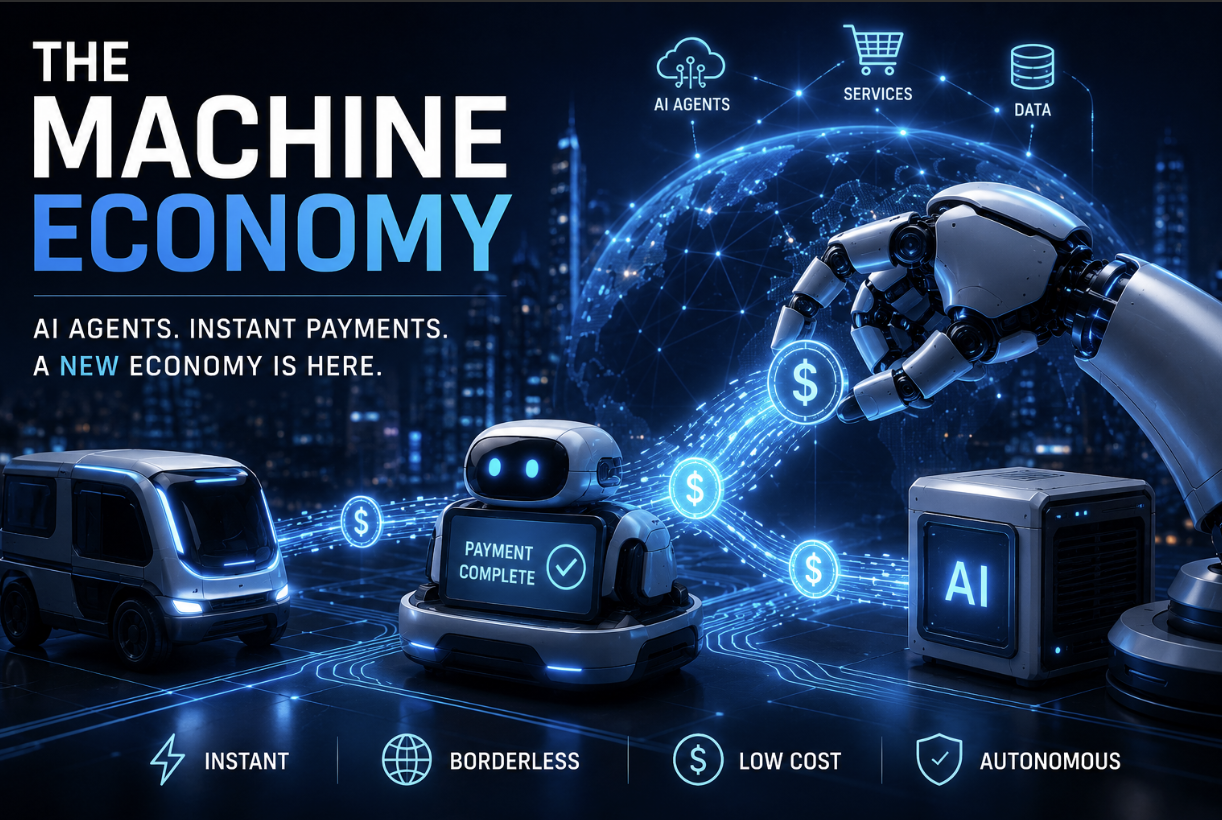
For decades, the financial system has revolved around three transaction types: person-to-person, business-to-business, and business-to-consumer. Every payment rail, bank, and fintech app has been built to serve these categories. Now, a fourth type is emerging that involves only machines. Machine-to-machine payments, powered by autonomous AI agents, are redefining transactions. These agents act as the hands of artificial intelligence: executing tasks, making decisions, signing up for services, and increasingly paying without human involvement. This isn’t theoretical—the infrastructure is being built, and the financial implications are huge. The next economy will run on AI agents paying other AI agents, and the payment rails are already being constructed.
The Four Transaction Types: Where We’ve Been and Where We’re Going
To appreciate the significance of machine-to-machine transactions, it’s useful to compare them with earlier transaction types. Person-to-person payments—Venmo, cash, wire transfers—involve two humans. Business-to-business transactions involve companies exchanging invoices, managing payment terms, and using enterprise banking infrastructure. Business-to-consumer payments power retail purchases, subscriptions, and online checkouts. All three models rely on a human to initiate or approve the transaction. Machine-to-machine payments overturn this rule. In the agentic economy, logic—not people—triggers payments. An AI agent detects a need, selects a service, pays, and moves on—all without human involvement. This is not merely a faster version of old models. It is a new economic category, emerging as AI agents become industry infrastructure.
What Are AI Agents and Why Do They Need to Make Payments
To understand why machine-to-machine payments are inevitable, you need to know what AI agents are and what they do. Unlike a chatbot that waits and answers questions, an AI agent independently executes multi-step tasks. These tasks include browsing, booking, managing workflows, and taking action without human approval at every step. Every major technology company is racing to deploy them. 2026 is widely seen as the year agentic AI moves from experiment to wide deployment. This is where finance gets interesting: AI enables a business model with zero employees—fully agent-operated. An AI agent can register a domain, build a storefront, manage inventory, and handle customer service entirely on its own.
To do that, it pays for things—API access, cloud compute, data feeds, and other agents’ services. These are micropayments: small, frequent, automated payments at speeds and volumes traditional banking can’t handle. When an AI agent must pay another AI agent in milliseconds for a task worth fractions of a cent, credit cards and bank transfers fall short. The agentic economy needs something architecturally different. This is where utility tokens and cryptocurrencies become valuable.
Why Utility Tokens Become the Currency of the Machine Economy
Traditional payment rails were built for humans. That becomes a fatal flaw in the agentic economy. Credit cards require a human authorization step. Bank transfers take days to settle. Transaction fees that seem small for a $500 purchase become absurd when millions of micropayments are involved. Each is worth fractions of a cent. The machine economy needs something different: programmable, borderless, near-instant transactions with almost no cost per payment. That description fits crypto utility tokens better than anything the traditional system offers. Utility tokens settle in milliseconds, operate without intermediaries, and allow logic to be embedded through smart contracts. No human approval is needed anywhere in the payment chain. Several blockchain projects are targeting machine-to-machine payments. There are no specific tokens traders must buy now. They should do their own research to determine which are best for their portfolios. HBAR, ALGO, XLM, and XRP are just a few examples. When assessing these projects, focus on transaction speed, per-transaction cost, smart contract features, and enterprise adoption.
What the Agentic Economy Actually Looks Like in Practice
Successful traders always try to stay one step ahead of the market. They not only look for the best trades now, but also for the best-momentum trades for the future. To show what the agentic economy looks like, imagine a single AI-operated business a few years from now. A “day in the life” of an AI agent running a content business might begin by identifying a trending topic. The agent then pays another AI agent a micropayment in utility tokens for SEO research. That agent pays a data provider for real-time keyword and traffic data. The content is written, optimized, and distributed by another agent that charges per-post micropayments for syndication.
Ad revenue comes back in, gets allocated to operating costs, and the cycle repeats. There are no invoices. No payment terms. No employees. Just logic executed thousands of times each day. Now imagine millions of agent-operated businesses, each generating streams of machine-to-machine micropayments. The scale is staggering. This is not a parallel economy running alongside the human one. It is a new economic layer built on top of the current infrastructure. The early builders setting payment rails are positioning themselves for one of the most significant financial shifts ever seen.
What This Means for Traders and Investors in 2026
The fourth transaction type is here — and the market hasn’t priced it in yet. The agentic payment economy is early enough that the opportunity landscape is still wide open, but mature enough that the infrastructure decisions being made right now will determine who wins when this shift hits mainstream awareness. For traders and investors, there are three areas worth building a research thesis around:
1.) AI agent platform companies providing the software layer
2. Blockchain infrastructure plays a role in building the settlement rail
3.) Utility token ecosystems specifically designed for high-frequency, low-cost machine transactions.
The companies and protocols laying this groundwork today are the picks-and-shovels play of the agentic era. Historically, picks-and-shovels plays are where the most durable wealth gets built during transformational shifts. Though the risks are real, making this a research-and-monitor situation, not a chase; risks include:
- Regulatory uncertainty around crypto payments
- Fierce competition between blockchain ecosystems
- Timeline uncertainty around agentic deployment.
Understanding this shift before the consensus is the edge. That edge belongs to those who pay attention early. Use Trade Ideas’ real-time scanning and alert tools to track stocks and tokens in this emerging economy. When the machine-to-machine payment narrative hits the mainstream, moves will be fast, significant, and rewarding for those already watching.