
How to Own SpaceX Before It Goes Public & Why DXYZ Is the Smartest Way In
How to Own SpaceX Before It Goes Public & Why DXYZ Is the Smartest Way In
by: Katie Gomez
By the time a top company finally goes public, most gains have been claimed by early backers at lower prices. Retail investors often end up buying at peak hype, while insiders exit. SpaceX’s expected $2 trillion IPO could be the most anticipated ever—yet jumping in at that stage might be too late. But there’s already a smarter entry point available on the public market.
The Problem With Waiting for IPOs
IPO investing has a key downside: by the time a company rings the opening bell, the best returns are usually claimed by venture capitalists and institutional investors who entered at much lower valuations. IPO pricing is designed to benefit early allocations, and retail traders typically buy at the top of the initial markup as early investors take profits. Historically, real fortunes in Uber, Airbnb, and Facebook came from private rounds, not IPO day. Applying this to SpaceX, a $2 trillion Day 1 valuation compresses potential upside compared to those holding private shares now. For generations, getting into that pre-IPO seat was exclusively reserved for venture capitalists, accredited investors, and institutional funds. The average retail trader simply had no seat at that table…until now.
What Is DXYZ?
DXYZ or The Destiny Tech100 Fund is one of the most genuinely novel investment vehicles to emerge in the retail trading space in years. It is a publicly traded closed-end fund with a singular mandate: acquire equity stakes in high-growth private technology companies before they go public, then give everyday investors access to that exposure through a regular brokerage account. No accredited investor status required, no minimum buy-in, no private placement paperwork: if you can buy a stock, you can buy DXYZ. Inside the fund sits a portfolio of some of the most closely watched private companies in technology and artificial intelligence, with SpaceX representing one of the largest single positions.
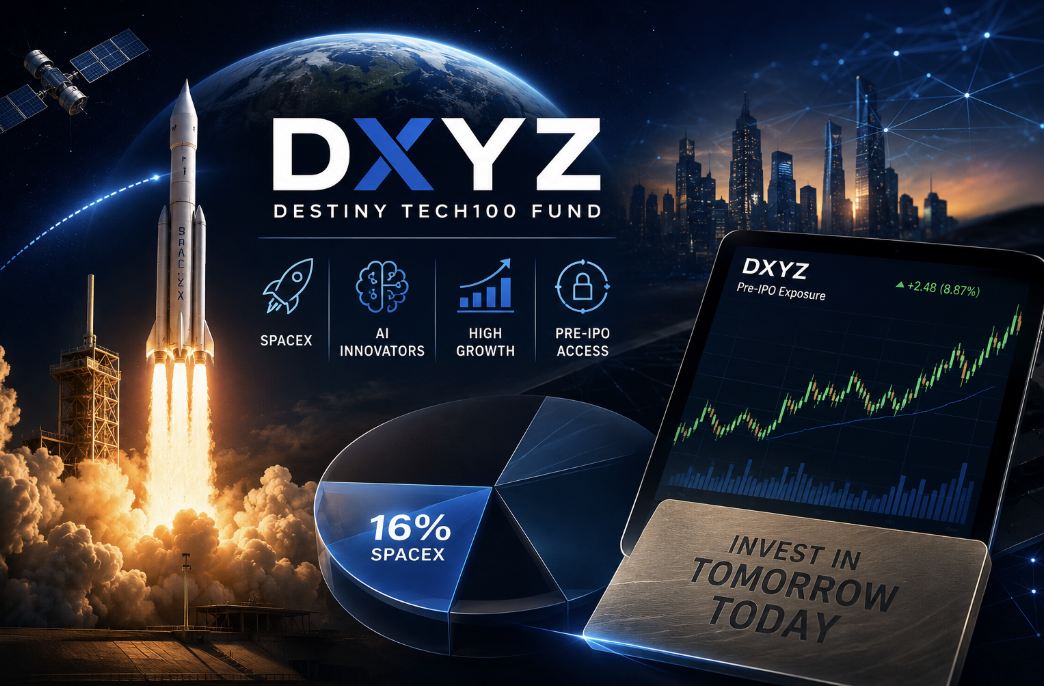
Though it is not disclosed how many shares DXYZ actually owns of SpaceX, according to Q1 reports, SpaceX occupies 16% of the fund’s total allocation. And analysts expect that percentage to rise even higher once the latest Q2 reports drop, which is extremely telling and suggests they must own quite a bit. Beyond SpaceX, the fund holds stakes in leading agentic AI companies and other high-profile private tech names that are themselves among the most anticipated liquidity events of the coming years. Each quarter, DXYZ files reports that reveal portfolio composition and management’s estimated valuations, giving investors a window into the private market that simply didn’t exist for retail traders before. In short, DXYZ is a venture capital fund you can buy and sell like a stock, and the SpaceX position alone has made it one of the most talked-about tickers of 2026.
The SpaceX Angle: Why It’s the Core of the DXYZ Trade
No single company defines the DXYZ trade more than SpaceX. The latest private market valuation estimates put the potential Day 1 public market cap at $2 trillion — a number that would make it the largest IPO in history by a margin that dwarfs anything that has come before. The growth narrative driving that valuation is genuinely multi-layered:
- Starlink’s global satellite internet business
- Starship’s commercial and defense launch contracts
- NASA relationships
An expanding footprint in sectors that didn’t exist as commercial markets a decade ago. Understanding DXYZ’s portfolio value starts here—with SpaceX and its multi-pronged growth.
Understanding NAV: The Most Important Number DXYZ Investors Need to Know
The key metric for any DXYZ investor is NAV—Net Asset Value—which reflects the estimated value of the fund’s holdings, divided by outstanding shares. Each quarter, the fund discloses its best estimate for this figure, offering a direct comparison to the trading price. As of January 2026, NAV was around $19 per share, while DXYZ traded near $29—placing the stock at a roughly 50% premium to its last audited value. That premium reflects what the market believes the portfolio will be worth, not what has been confirmed.
To put this premium in context, recent developments for SpaceX and private AI valuations since December point to a much higher forward NAV. With these factors included, Q2 (April 2026) NAV estimates range from $28 to $40 per share. At current trading levels of $29 to $30, the valuation picture looks notably different:
- The bear case says DXYZ is still modestly overvalued if SpaceX disappoints.
- The base case says it’s fairly valued.
- The bull case: a SpaceX IPO clearing $1.75 trillion or above actually makes it undervalued at current prices.
If SpaceX’s valuation triples to quadruples from current private market levels, DXYZ’s NAV could see a 60 to 120% uplift from that single position alone. Investors already holding DXYZ are effectively pre-positioned for the IPO event without scrambling for allocation or paying Day 1 retail prices. And SpaceX isn’t the only catalyst in the portfolio — reported exposure to Anthropic and other leading agentic AI names means the fund is sitting on multiple potential repricing events simultaneously. The core thesis is straightforward: DXYZ is SpaceX plus private AI, packaged into a ticker you can buy right now. Instead of betting on a single event, you’re getting a basket of high-profile pre-IPO opportunities—making DXYZ a unique approach in today’s market.
Is it worth the risk?
DXYZ is not a trade without risk, and anyone entering the position today needs to understand exactly what they are signing up for. The NAV premium collapses quickly if SpaceX delays its IPO, prices fall short of expectations, or private AI sentiment shifts, forcing portfolio markdowns. Closed-end fund dynamics mean the stock price can diverge significantly from NAV in either direction, and with the last official NAV update dating back to December 2025, investors are currently flying partially blind until Q2 information is released. Recognizing these risks is vital before considering potential next steps.
The concentration risk is real: SpaceX and a handful of AI names drive the overwhelming majority of fund value, which means this is a high-conviction, high-concentration bet on a specific set of outcomes, not a diversified holding. That said, the setup today is meaningfully different from the pure hype premium of earlier periods. The easy money has already been made, but the thesis remains intact for believers in the SpaceX story: at current prices, the fund sits somewhere between fairly valued in the base case and genuinely undervalued in the bull case. The next NAV filing and any SpaceX IPO timeline update are the two catalysts worth watching most closely. For traders who want pre-IPO SpaceX exposure without the chaos of fighting for scraps on IPO day, DXYZ remains the most accessible vehicle, as long as we size it as the speculative position it is.
Where do Traders go from here?
DXYZ represents something genuinely new in retail investing—a publicly traded backdoor into the most anticipated IPO in market history, packaged alongside a portfolio of private AI names that are themselves among the most valuable unlisted companies in the world. The NAV premium demands respect, the concentration risk is real, and the next quarterly filing will tell investors a great deal about where the true value sits today. If you believe in the SpaceX story and want a position before the IPO, the opportunity is here. To maximize your edge, use Trade Ideas’ real-time scanners and alert tools to track DXYZ price action, NAV announcement volume surges, and SpaceX IPO catalyst news as it breaks. When this story moves, it moves fast, and the advantage lies with those prepared and alert. Instead of waiting for the IPO, get ahead and learn how to trade like the 1% at Trade Ideas today.