
How Traders Use Stock Scanners for Day Trading in a Volatile Premarket
How Traders Use Stock Scanners for Day Trading in a Volatile Premarket
Premarket is where the day starts, not at the open.
By the time the bell rings, the best opportunities are already forming. The problem is not finding trades; it’s filtering the right ones fast enough.
That’s where Stock Scanners for Day Trading come in. They allow traders to narrow thousands of stocks down to a focused watchlist before the market opens.
This article breaks down how traders actually use scanners in volatile premarket conditions, without guesswork or unnecessary complexity.
Why Premarket Trading Is So Volatile
Premarket volatility isn’t random. It’s a direct result of how the market functions before regular hours.
Between 4:00 AM and 9:30 AM EST, liquidity is thinner. Fewer participants mean the price can move quickly with relatively small order flow. Add in earnings releases, analyst upgrades, or unexpected news, and you get sharp, fast moves that don’t behave like normal intraday price action.
The most important window is usually between 7:00 AM and 9:30 AM. That’s when volume starts to build, and institutions begin positioning. By 9:00 AM, key levels are often already forming, levels that will matter once the market opens.
Most traders miss this entirely because they’re either not watching early enough or relying on static watchlists. By the time they notice a stock, the move is already extended.
Why Traders Rely on Stock Scanners
Manually scanning the market doesn’t work in a fast environment. There are simply too many stocks and too many variables.
A stock scanner solves that by narrowing the field instantly. Instead of searching, you’re filtering. Instead of guessing, you’re reacting to specific conditions: gaps, volume, volatility.
The real advantage isn’t just speed. It’s clarity.
When your scanner is set correctly, it removes a huge amount of noise. You’re left with a small group of stocks that are actually in play. That alone improves decision-making more than most strategies do.
How Traders Actually Use Scanners in Premarket
In premarket, speed matters, but clarity matters more.
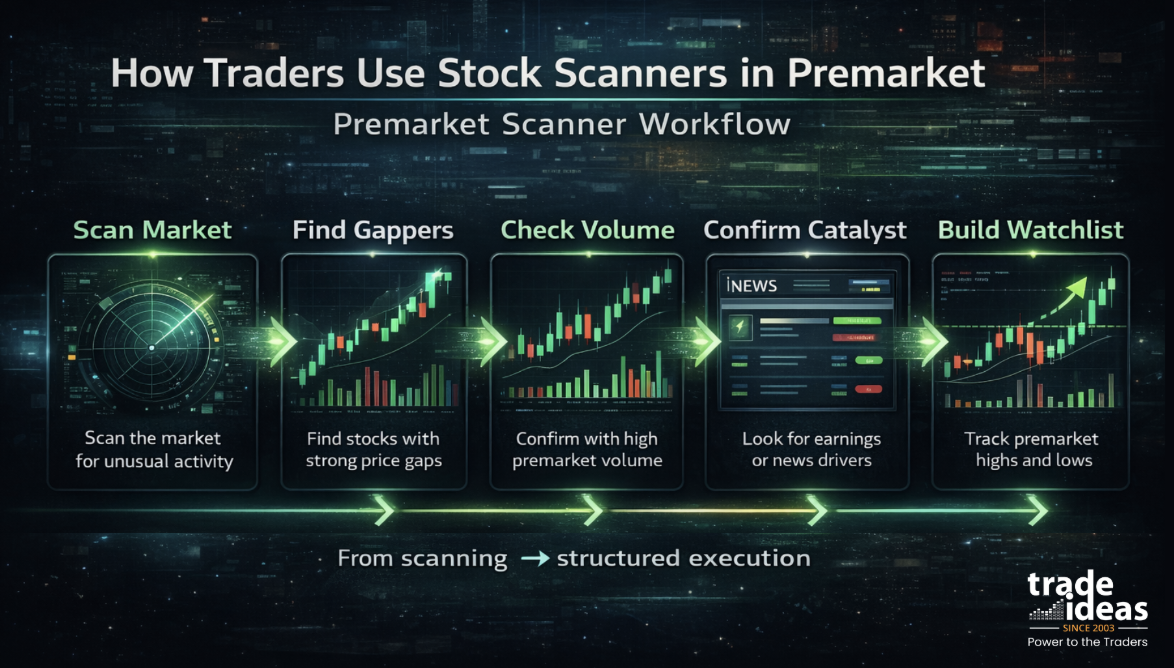
Traders are not trying to scan everything. They’re trying to quickly narrow the market down to a few stocks that actually deserve attention. That usually means looking for a mix of price movement, volume, and a clear catalyst.
Once those names show up, the focus shifts. It’s no longer about searching; it’s about understanding which setups are worth tracking into the open.
Identifying High-Volume Gappers
The first thing most traders look for is a stock that’s clearly gapping.
A gap tells you the market has already repriced the stock before the open. But what makes it actionable is volume. If a stock is up several percent and already trading meaningful shares premarket, it usually means there’s real interest behind the move.
Those are the stocks that tend to stay in play once the market opens.
Confirming Moves with Relative Volume
A stock can gap and still fail. That’s why traders don’t rely on price alone.
Relative volume gives context. It shows whether the current activity is actually unusual compared to recent sessions. When volume is clearly above normal, the move is more likely to hold attention.
Without that confirmation, many premarket moves lose momentum quickly.
Using Catalyst-Based Scanning
The strongest setups almost always have a reason behind them.
Earnings, guidance, analyst upgrades, these are what drive sustained movement. When traders see a stock moving with a clear catalyst, they’re more confident that the move won’t fade immediately.
It’s a simple filter: movement backed by news tends to behave better than movement without it.
Scanning for Low Float and High Volatility Stocks
Some traders deliberately look for stocks that can move fast.
Low float names have fewer shares available, which makes them more sensitive to buying pressure. That’s why they can spike quickly in premarket conditions.
At the same time, they require discipline. The same speed that creates opportunity can also lead to sharp reversals if momentum stalls.
Detecting Technical Breakouts in Premarket
Even before the open, price levels start to matter.
Traders pay attention to premarket highs, resistance areas, and how the price behaves around them. These levels often become decision points once regular trading begins.
The idea is not to predict the move, but to know where it becomes meaningful.
Common Premarket Scanner Settings Traders Use
There isn’t a single perfect scanner setup. But most traders rely on a similar set of filters to cut through noise.
The goal is simple: remove inactive stocks and focus only on those showing real activity.
1. Gap Percentage
Traders typically look for stocks that are clearly separated from the previous close.
A move of a few cents isn’t enough. A stronger gap, usually several percent, signals that something has changed and draws attention early.
2. Premarket Volume
Volume tells you whether the move is actually being traded.
A stock with solid premarket volume is more likely to stay relevant into the open. Thin volume, on the other hand, often leads to unreliable price action.
3. Relative Volume
Relative volume helps confirm whether the activity is unusual.
When a stock is trading well above its normal pace, it usually means more participants are involved. That’s what keeps momentum going.
4. Price Range
Different traders focus on different types of stocks.
Some prefer lower-priced names for faster moves, while others stick to higher-priced stocks for cleaner structure. Better stick to a range that matches your strategy.
5. Average Daily Volume
This adds another layer of consistency.
Stocks with stronger average daily volume tend to behave more predictably once the market opens. It also helps avoid names that look active early but fade quickly due to a lack of liquidity.
Execution: Where Most Traders Get It Wrong
Scanning is the easy part. Execution is where trades are won or lost.
Premarket action sets the stage, but it’s not a signal on its own. Many of the worst trades come from entering too early, before the market confirms direction.
Experienced traders wait. They watch how the price reacts after the open, especially around premarket levels. If a stock holds above its premarket high and volume continues, that’s a very different setup than a stock that immediately fades.
Market conditions matter as well. On strong days, momentum tends to continue. On weaker days, gaps often fail. The same scanner results can lead to completely different trades depending on the broader environment.
Risk management is non-negotiable here. Premarket leaders can reverse quickly, and when they do, they move fast. Position sizing and defined exits matter more than the setup itself.
Common Mistakes When Using Stock Scanners
A stock scanner can improve speed and focus, but only if it is used with context. A few mistakes tend to come up repeatedly, especially in volatile premarket conditions.
- Over-filtering the scanner
Some traders make their filters so tight that they remove valid setups before they even appear.
How to avoid it: Start with a solid base setup, then adjust only where needed. The goal is to narrow the list, not eliminate everything.
- Chasing every alert
Not every alert deserves a trade. A scanner shows activity, but it does not confirm quality.
How to avoid it: Use alerts as a starting point. Check volume, catalyst, price structure, and market conditions before acting.
- Ignoring the broader market context
A strong-looking stock can still fail if the overall market is weak or momentum is fading.
How to avoid it: Read the market first. Let the broader tone shape whether you focus on continuation, pullbacks, or fade setups.
- Buying extended moves
A stock that is already stretched far from support often offers poor entry and higher downside risk.
How to avoid it: Wait for confirmation or a cleaner setup. A missed trade is usually better than forcing a bad entry.
- Treating the scanner like a signal generator
The scanner highlights opportunities, but it does not make trading decisions for you.
How to avoid it: Use the scanner to build a watchlist, then apply your own process for entries, exits, and risk.
What to Look for in a Scanner
A scanner for premarket trading has one job: help traders find the right stocks fast, without adding noise. The features that matter most are the ones that support speed, clarity, and consistency.
Real-Time Data
In premarket, delayed data is a problem.
Stocks can move quickly before the open, so a scanner needs to reflect what is happening now. If the data lags, the setup may already be gone by the time it appears.
Flexible Filters
A scanner should let traders narrow the market based on the factors that actually matter.
That includes gap percentage, volume, relative volume, price range, float, and technical levels. The more control traders have over these filters, the easier it is to build a clean watchlist.
Useful Alerts
Alerts should help traders focus, not distract them.
The value is not in getting more alerts. It is in getting alerts that highlight developing setups early enough to matter.
Workflow Support
Scanning is only one part of the process.
A good platform should also make it easier to track stocks, mark levels, and stay organized once the market opens. The tool should support the trade plan, not just the scan.
Advanced Features That Add Value
For traders who want more depth, features like backtesting, pattern recognition, and AI-generated trade ideas can be useful.
They do not replace judgment, but they can help traders spot repeatable setups and improve decision-making over time.
The best scanner is not the one with the most features. It is the one that helps traders find relevant setups quickly, filter out weak names, and stay focused when the market starts moving. This is where platforms like Trade Ideas stand out, combining real-time scanning, customizable filters, and AI-driven alerts to help traders stay ahead of fast-moving premarket conditions.
Final Thoughts
Premarket isn’t chaotic; it’s just compressed.
Everything happens faster, which makes preparation more important. Traders who come in with a plan have a clear advantage over those who react in real time.
Using Stock Scanners for Day Trading isn’t about finding more trades. It’s about focusing on the right ones early, when the opportunity is still developing.
That’s the difference between chasing moves and being ready for them.
Frequently Asked Questions
1. What time should I start scanning for premarket opportunities?
Most traders begin scanning around 7:00 AM EST when volume starts increasing, but earlier scans (4:00–6:30 AM) can reveal early movers. The key is consistency, tracking how stocks develop over time rather than relying on a single snapshot just before the open.
2. How many stocks should I keep on my premarket watchlist?
A focused watchlist of 3 to 8 stocks is typically ideal. Too many stocks dilute attention and lead to missed entries, while too few limit opportunity. This helps to track only the most active and clean setups that show both volume and structure.
3. Can stock scanners help identify short-selling opportunities in premarket?
Yes, scanners can highlight stocks gapping down or showing weak price action with volume. These often become candidates for short setups, especially if they fail to hold key levels. However, confirmation after the open is critical before entering any short position.
4. Should I change my scanner settings every day?
Not constantly. Most traders use a consistent base setup and make small adjustments depending on market conditions. For example, during high volatility, you might tighten filters, while slower markets may require broader criteria to capture enough tradable setups.
5. Do stock scanners work in all market conditions?
Scanners work in any market, but the type of setups they surface will vary. In strong markets, they highlight continuation plays, while in weak or choppy markets, they may surface fading opportunities. The tool stays the same, the trader adapts the strategy.