
The Psychology of a Losing Streak: How to Reset, Recover, and Come Back Stronger
The Psychology of a Losing Streak: How to Reset, Recover, and Come Back Stronger

It started with one bad trade. Then another. Then a third that looked perfect on paper and failed anyway. Now you’re sitting at your desk staring at a red P&L, questioning your strategy, your instincts, and quietly wondering if you were ever as good at this as you thought you were. The losing streak is the most psychologically destructive experience in trading — not because of the money lost but because of what it does to everything else. Your confidence erodes. Your decision-making gets cloudy—your sense of identity as a trader starts to crack. And the harder you try to trade your way out of it, the deeper in you go. Here’s the truth nobody talks about enough: losing streaks don’t just happen to bad traders. They happen to every trader — including the professionals. What separates the ones who come back stronger from the ones who never fully recover isn’t talent or capital. It’s how they respond in the middle of the storm. This is the guide for the middle of the storm.
Why Losing Streaks Happen — And Why They’re Inevitable
The market is not obligated to reward good process in the short term. Even the best setups fail in stretches, and even the most disciplined traders go through periods where nothing clicks. This is especially true in August — thin liquidity, unexpected volatility, and choppy conditions create an environment where normal strategies stop working through no fault of the trader. What worked in May genuinely fails in August, and the trader who doesn’t understand that context starts blaming themselves for a market problem.
The first loss is just a loss. The second makes you question your entry. The third makes you question your strategy. By the fourth, you’re questioning yourself — and emotional damage is contaminating every decision going forward. You abandon strategies that were working. You chase setups you’d normally pass on. You size up to recover losses faster — exactly the wrong move at exactly the wrong moment. The losing streak becomes self-fulfilling. Here’s the insight that changes everything: a losing streak is not evidence that you are a bad trader. It is evidence that you are a trader — and every person who has ever built lasting success in this market has sat exactly where you are sitting right now.
The Warning Signs — When a Bad Stretch Becomes a Real Problem
There’s a critical difference between a normal losing streak and one spiraling into something more damaging. Watch for these five warning signs.
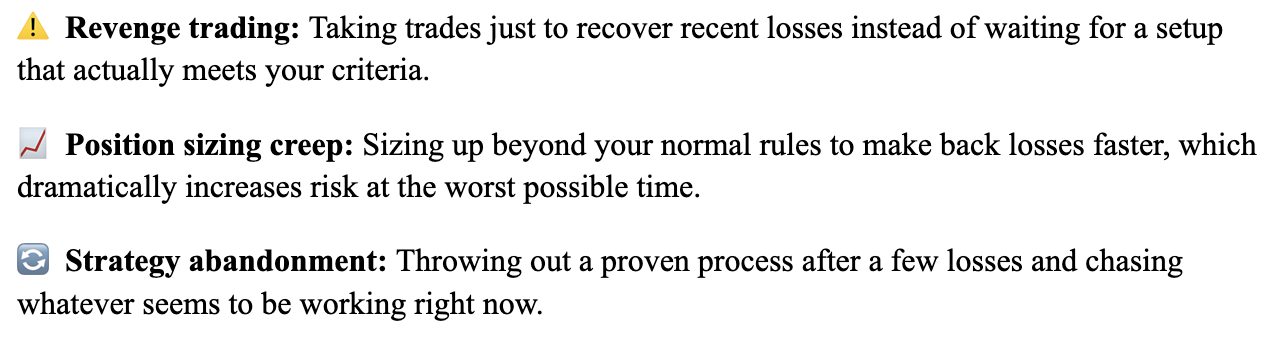
Emotional decision-making: letting yesterday’s P&L contaminate today’s mindset before the market even opens. And the absence of a stop — staying in losing positions far longer than your rules allow because you can’t bring yourself to realize the loss. If you recognize more than two of these in your current trading, the streak has moved beyond normal and into territory that requires an intentional reset.
Step 1: Stop. Immediately
The single most important and most overlooked response to a losing streak is the one that feels most counterintuitive: stop trading. Not forever. Not because you’ve failed. But because continuing to trade while emotionally compromised is the fastest way to turn a manageable drawdown into an account-damaging one. Take one to three days completely away from the market — no charts, no scanning, no paper trading, no watching tickers. A genuine, complete break. This isn’t weakness. It’s the most professional decision you can make. The break interrupts the emotional feedback loop losing streaks create, gives your nervous system time to reset, and creates the psychological distance you need to assess your trading objectively. Elite athletes don’t practice through injuries — they rest and return when they can perform at their level. Trading through emotional damage is the exact equivalent of playing through a torn muscle. The market will be there when you get back. Your account will be in better shape if you take the break.
Step 2: Diagnose Before You Trade Again
Coming back without understanding what happened is how traders walk straight into the next losing streak. Before you place another trade, run an honest diagnostic on every loss. For each one, ask three questions: Did I follow my rules or deviate from them? Was the setup genuinely valid or did I force it? Was the loss a result of bad process or bad luck on a good process? That last distinction is the most important one in trading psychology.
A loss from following your rules perfectly is completely different from a loss that came from breaking them — one requires patience, the other requires correction. Also run a market conditions audit — was the streak happening in choppy low-volume conditions that reflect a mismatch between your strategy and the environment rather than a flaw in your approach? If so, the strategy doesn’t need fixing — the market conditions needed waiting out. Use Trade Ideas to review your setups objectively. The data almost always tells a cleaner and more honest story than your memory does.
Step 3: Rebuild Small
Coming back from a losing streak is not the time to return to full size and try to recover everything at once — that is the exact thinking that turns a manageable drawdown into an account-destroying event. Come back at significantly reduced position size — half your normal or less — and focus entirely on process rather than P&L for the first week back. Smaller size removes the emotional weight from each trade, allowing you to execute without fear of compromising every decision.
Define your return criteria before you place your first trade back, not a dollar amount to recover, but a specific number of trades executed according to your rules regardless of outcome. One good trade won’t fix a losing streak psychologically. But five consecutive trades executed with discipline — win or lose — will begin to restore the process confidence the streak destroyed. Prove to yourself you can follow your rules again before you worry about what the P&L says.
The Mindset Reset
Reframe the losing streak entirely. It is not evidence of failure — it is the tuition payment every successful trader makes on the way to becoming consistently profitable. The best traders in the world have losing streaks. The difference is they don’t let losing streaks have them. A trader who followed their rules on every losing trade did their job — the market didn’t cooperate, but the process was sound, and that trader will be fine. The traders who recover fastest are almost always the ones who write it down — not to punish themselves, but to create objective distance between the emotional experience and the analytical one. And when you’re ready to return, let Trade Ideas pull you back into process. The scanners, the alerts, the systematic approach to finding setups — returning to tools that support disciplined, unemotional trading is one of the most effective ways to break the emotional pattern a losing streak creates.
A losing streak is not the end of your trading story — it is one of the chapters every successful trader’s story contains. The market will give you another opportunity. Make sure you’re in the right mental and financial shape to take it. Log into Trade Ideas, rebuild your watchlist, run your scans, and let the platform pull you back into systematic, process-driven trading — because the fastest way out of a losing streak is returning to the discipline that got you here in the first place.