
$7.30 a Gallon: California’s Gas Crisis and What Comes Next
$7.30 a Gallon: California’s Gas Crisis and What Comes Next
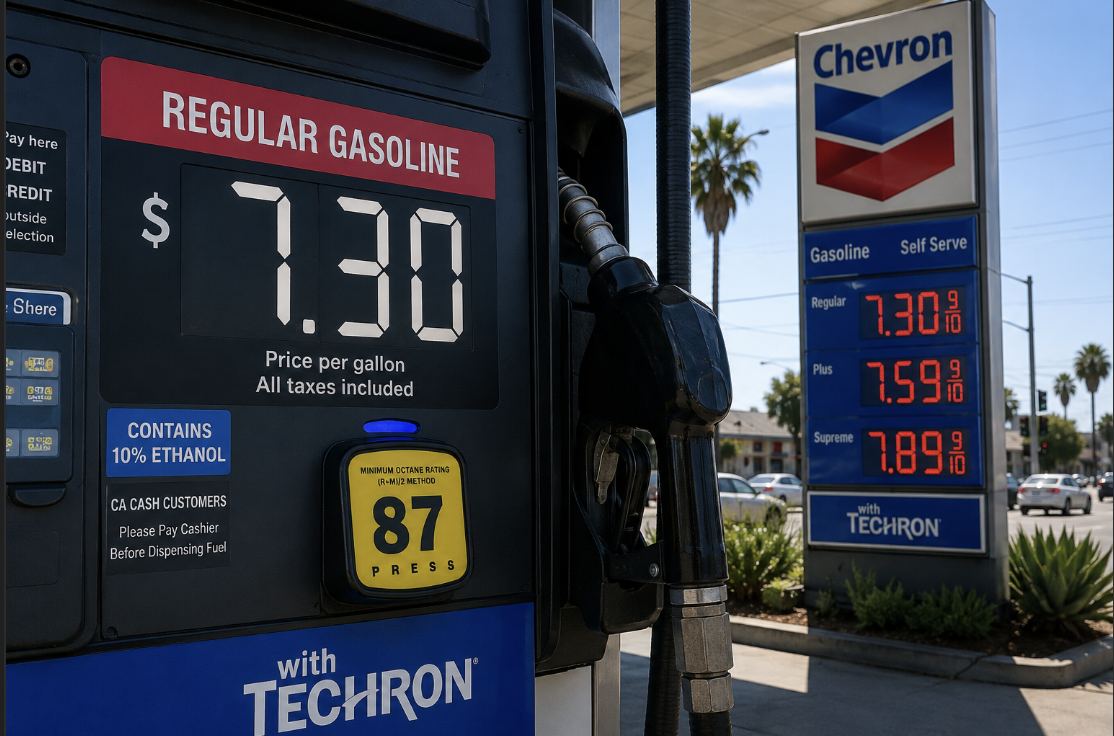
Pulling up to a California gas station now offers a real-time snapshot of the American economy. With prices at $7.30 a gallon in some areas, California again leads the nation, this time with a hardship no one seeks. While higher pump prices are typical in California due to state taxes, cap-and-trade, and boutique fuel blends, today’s spike is more than inconvenient—it signals genuine economic disruption. This issue goes beyond state borders. Soaring prices at the pump are a clear warning of broader economic stress across the country, and anyone not paying attention is missing a key market signal.
Why Is Gas So Expensive Right Now?
California’s sky-high gas prices aren’t an accident — they’re the result of several compounding factors hitting at once. Gas prices don’t exist in a vacuum, and when they spike this hard, the ripple effects move fast. As we examine what’s driving costs up, it becomes clear how quickly these pressures touch everyday life:
- Household budgets tighten
- Discretionary spending drops
- Retirement contributions get quietly shelved.
- Consumer confidence starts to crack.
California relies on a unique boutique fuel blend that can’t be imported from other states in emergencies, so any disruption in local refinery output quickly drives up prices. High fuel taxes and the cap-and-trade program further raise costs throughout the supply chain, creating a structurally higher price floor, even before global issues come into play. Currently, OPEC+ is keeping supply tight, Western US refinery capacity is limited, and aging infrastructure adds to the system’s fragility. The result: $7.30 a gallon is the predictable outcome of policy, location, and global market conditions converging.
The Household Budget Hit
Let’s put $7.30 a gallon into real numbers. A commuter driving 1,000 miles a month in a 25 mpg vehicle uses about 40 gallons, costing nearly $300 monthly just for commuting. In a state where median rent exceeds $2,500, groceries are rising, and child care rivals a second mortgage, that $300 comes directly out of savings or discretionary spending. This is a regressive shock, hitting hardest those who can’t work from home or switch to an EV. When gas prices remain high for extended periods, it becomes a persistent drain on financial stability—a reality in California today.
The 401k Effect — People Are Investing Less
A less-discussed result of a prolonged gas price spike is the impact on long-term wealth-building. When budgets are squeezed, retirement contributions are among the first to be cut, as they feel optional during financial stress. Yet even a short pause can have high long-term costs due to compound interest—a six-month gap in your 30s or 40s can mean tens of thousands of dollars lost by the time you retire. This hits lower- and middle-income workers hardest, widening the wealth gap as those with financial cushions continue contributing while others fall behind. High gas prices don’t just hurt now—they create lasting effects into retirement.
The Cost of Living Cascade
Gas prices are painful at the pump, but their real economic damage happens in the hours and days after you drive away. Fuel costs are embedded in virtually every layer of the modern economy: trucking, food distribution, last-mile delivery, manufacturing, and agriculture. Therefore, when they spike this hard and this fast, businesses don’t absorb the hit; they pass it on. For California households already navigating some of the highest rents in the nation, this creates what can only be described as a triple squeeze — energy costs up, grocery bills up, and housing costs showing no sign of meaningful relief. What makes this moment particularly precarious is the speed at which it’s compounding. Inflation driven by energy tends to spread faster than other types because fuel touches every part of the supply chain at once. The Federal Reserve can raise rates to cool demand-driven inflation, but it has very limited tools to fix a refinery capacity problem or an OPEC production decision. This means households are largely on their own to absorb the pressure, and right now it’s building fast.
What This Means for the Market
When gas prices stay elevated long enough to visibly change consumer behavior, the market eventually has to reprice that reality, and we may be approaching that inflection point right now. The first place to watch is consumer confidence data, which historically drops in sustained correlation with gas price spikes. When confidence falls, discretionary spending follows, and that pain shows up fastest in retail, restaurants, travel, and entertainment stocks — the names that depend on Americans feeling flush enough to spend beyond the basics. On the flip side, the energy sector remains the clearest winner in this environment, with ExxonMobil (XOM) and broader energy ETFs like XLE serving as natural hedges against the inflationary pressures hitting markets everywhere else. The more nuanced market dynamic, however, is what this means for the Federal Reserve.
Energy-driven inflation puts the Fed in an uncomfortable position; it’s the kind of price pressure that doesn’t respond well to rate hikes, since you can’t cool an OPEC production cut with tighter monetary policy. That ambiguity tends to create volatility in rate-sensitive sectors like real estate, utilities, and growth stocks, as markets try to read whether the Fed will hold, cut, or be forced to act despite the limits of its own tools. The bottom line for investors is this: a sustained gas price shock is not just a consumer story; it’s a macro story, and the portfolios best positioned to weather it are those that account for energy exposure on both sides of the trade.
What Can You Actually Do About It?
The worst response to an economic squeeze like this is paralysis, and the second worst is panic. High gas prices are a real headwind, but they also create a clear roadmap for adjustment. On the personal finance side, protect your 401k contribution before anything else; the long-term compounding cost of pausing it far outweighs the short-term relief. Cut discretionary spending first: subscriptions, dining, impulse purchases. On the investment side, energy stocks and ETFs like XOM and XLE act as natural inflation hedges, rising alongside fuel prices that are squeezing everything else. And for investors with a longer horizon, this environment is accelerating the shift toward EVs and clean energy; names like NEE and ENPH stand to benefit as fossil fuel dependency becomes impossible to ignore.
What’s happening at the California pump is not only about high fuel bills— it’s an immediate reflection of economic pressure that reaches from households to markets. As fuel costs rise and household budgets adapt, ripple effects travel through personal finances and investment decisions. The clearest lesson is that understanding these signals early is crucial for protecting yourself from broader market turbulence and seizing opportunities as the economic picture shifts.
Ready to protect your portfolio and find the opportunities inside this market? Join Trade Ideas now and get the tools you need before the next market open.