
GameStop Wants to Buy eBay for $56 Billion — The Wildest Trade Story of 2026
GameStop Wants to Buy eBay for $56 Billion — The Wildest Trade Story of 2026
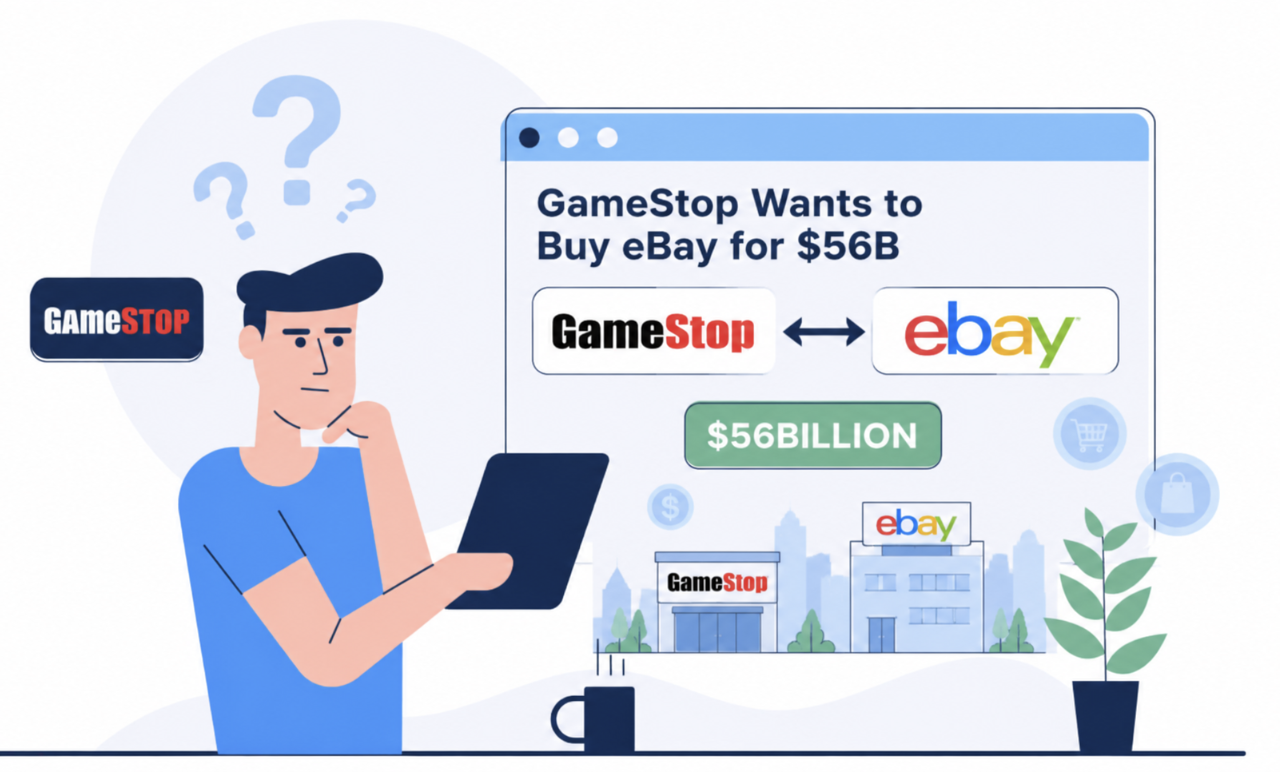
Just when you thought the GameStop story had run out of ways to surprise you, Ryan Cohen has gone and bid $56 billion for eBay. Let that sink in for a moment. A company with a market cap of roughly $11 billion is making an unsolicited offer to acquire one worth $45 billion. It financed the gap with its own cash reserves, billions in debt, and a hefty stake in GameStop. The deal (if it closes) would transform GME from a fading video game retailer into a major e-commerce and collectibles powerhouse with a direct mandate to challenge Amazon. If it doesn’t close, the fallout will be its own kind of market event. Either way, this is the most audacious corporate move of 2026, and it is creating real, tradeable volatility across both stocks right now. The meme stock that was supposed to die is now trying to buy one of the internet’s oldest e-commerce giants. Here’s everything traders need to know.
The Backstory: How Did We Get Here?
To understand how we arrived at this moment, you need to know both sides of the story. GameStop’s journey from near-bankruptcy to meme stock legend in 2021 is well documented. But what happened after the chaos is less understood. Ryan Cohen quietly took control of the board and shifted the company’s strategic vision away from dying physical retail. Most importantly, he allowed GameStop to accumulate $9.4 billion in cash reserves while keeping the balance sheet lean. That war chest was building in plain sight for anyone paying attention. Now we know what it was for. On the other side sits an eBay that is not, by any measure, a distressed company in need of rescue. Shares have risen significantly heading into 2026. The platform maintains a strong foothold in collectibles, trading cards, and secondhand commerce. While it faces long-term pressure from Amazon and newer platforms, eBay is a profitable, functioning business. That makes Cohen’s unsolicited approach even more audacious. This isn’t a vulture bid on a struggling asset but an aggressive play by a cash-rich company with a big vision.
How a $11 Billion Company Bids $56 Billion
The deal structure is where this story gets truly extraordinary. GameStop has a market cap of roughly $11 to $12 billion. It is bidding $56 billion ($125 per share) for eBay, which is itself valued at over $45 billion. The gap between buyer and target is one of the most dramatic in recent M&A history. The financing architecture needed to bridge this gap is equally bold. Cohen’s plan starts with GameStop’s $9.4 billion cash reserve. Then, it adds up to $20 billion in debt financing backed by a “highly-confident letter” from TD Securities. Finally, it covers the remaining consideration with newly issued GameStop stock. The offer is split 50% cash and 50% GME shares, so eBay shareholders would become part-owners of the combined entity. The immediate problem with this structure is dilution. Issuing the volume of new GameStop shares needed to fund this deal dilutes existing GME holders. The market responded by sending GME stock lower following the announcement. Beyond dilution, the leverage burden would put the combined company’s debt-to-earnings ratio among the highest in the e-commerce sector. This raises serious questions about financial flexibility and resilience if integration does not go as planned.
Building an Amazon Competitor
If we strip away the shock value of the deal size, Cohen’s strategic logic is ambitious but actually coherent. The main goal is to build a legitimate e-commerce competitor to Amazon by combining eBay’s marketplace infrastructure with GameStop’s physical retail footprint. Alone, neither company can achieve this in today’s market. The 1,600 U.S. GameStop stores, once seen as liabilities in the streaming era, are reimagined as a national network for authentication, intake, fulfillment, and live commerce. Physical presence would become a real differentiator in an increasingly delivery-focused landscape.
The collectibles angle is where the two businesses overlap most. Both companies already have significant exposure to trading cards, memorabilia, and limited-edition items. Combining them would create the world’s largest dedicated collectibles marketplace. GameStop’s store network provides authentication infrastructure that competitors like Amazon and Etsy cannot replicate. On costs, Cohen is targeting $2 billion in annualized reductions within 12 months of closing. This includes a dramatic 50% cut to eBay’s marketing budget. That last point is where critics get loudest. eBay’s marketplace depends on sustained buyer traffic, and slashing the marketing engine is risky. It could undermine the very revenue base the deal is meant to build.
The Hostile Takeover Wildcard
eBay’s board didn’t invite this offer, and their initial response has been carefully noncommittal. They acknowledged the proposal and committed to reviewing it with shareholder value in mind, but that silence may not last long. Cohen has already signaled that if the board fails to engage, he is prepared to take the offer directly to eBay shareholders. This classic activist escalation move would transform this from a negotiated deal into a full hostile takeover battle. That’s Cohen’s natural habitat, and institutional eBay holders would suddenly find themselves at the center of a proxy fight with significant implications for the stock in either direction. The eBay board response timeline is the first major catalyst to watch: acceptance opens a negotiation and rejection opens a war (both create volatility).
The Risks Every Trader Needs to Understand
The risks on both sides of this trade deserve serious attention before taking any position. GME holders face:
- Significant dilution from the share issuance required to fund the deal
- A heavy post-close leverage burden
- Enormous execution risk on $2 billion in promised cost cuts (i.e., 50% marketing reduction that analysts warn could actively damage eBay’s core business).
If the deal collapses entirely, GME loses its primary narrative catalyst and is likely to reprice sharply lower. EBAY holders face a different set of concerns:
Although the $125-per-share offer is attractive, half is paid in GME stock. Accepting means eBay shareholders must take on the risk and volatility associated with GameStop shares, instead of holding a stable e-commerce stock.
Many analysts question whether eBay benefits from this deal, given its recent performance. Uncertainty from a takeover battle could hurt both stocks. Macroeconomic factors, such as high interest rates, make the leverage burden harder to manage. In addition, regulatory scrutiny for such a large merger might delay, reshape, or stop the deal, adding more risk for EBAY holders.
How to Trade the GME-eBay Story
Whether you think this deal closes or fails, the GME-eBay story brings real, tradeable volatility to both stocks right now. For traders, the opportunity lies in having a plan before each catalyst rather than reacting. On the long side, EBAY trades at a discount to the offer price, with the spread reflecting real deal uncertainty. For some, this is a classic merger arbitrage setup. GME options are trading with significant movement in both directions, so volatility plays can offer exposure without committing to a directional bet on the deal outcome.
On the short side, a deal collapse would remove GME’s primary narrative catalyst and likely trigger a sharp repricing. Traders must watch for catalysts, including:
- eBay board response
- Any hostile takeover escalation from Cohen
- Financing confirmation from TD Securities
- Regulatory filing signals
GME stock price stability is worth monitoring, since the deal’s stock offer depends on it. This is a multi-week, multi-catalyst story that rewards preparation over reaction.
Use Trade Ideas‘ real-time scanners and alert tools to track price action, volume surges, and breaking news across both GME and EBAY as this story develops. In these volatile M&A situations, traders with their alerts already set are always the first to act.