
The Great Deception: How Index Gains Hide the 40% Carnage in Individual Stocks
The Great Deception: How Index Gains Hide the 40% Carnage in Individual Stocks
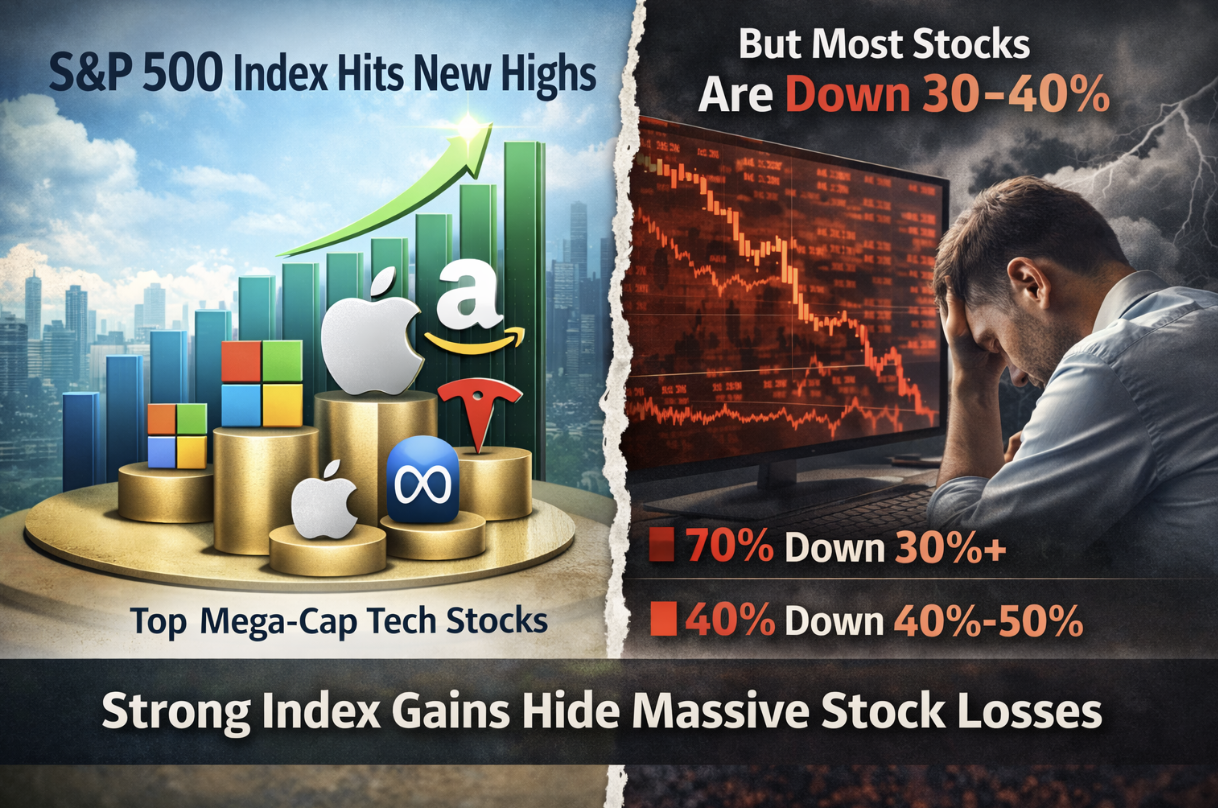
Financial headlines announce new “market gains” as the S&P 500 nears record highs, but most portfolios are not feeling these gains. The core issue is that a small group of mega-cap technology stocks dominates market-cap weighted indexes, creating an illusion of overall market strength. Meanwhile, most individual stocks are suffering steep declines, with many down 30-40% or more from their highs. This sharp concentration means that the performance of just seven companies sets the tone for the entire “market,” masking losses in the majority of stocks. As a result, index gains do not reflect investors’ true experience, leaving many feeling they are failing while headlines suggest success.
The Numbers Don’t Lie: Market Concentration Exposed
The data shows that market leadership is more concentrated than at any point since the ’99 tech bubble. The top seven stocks now account for over 30% of the S&P 500’s total value. Their performance alone can make the overall market appear healthy, even when over 60% of stocks are experiencing 30-40% declines from their peaks. This creates a misleading picture in which index gains mask widespread losses and the broader market’s real struggles. Advance/decline lines are falling, new lows routinely outpace new highs, and the equal-weighted S&P 500 is often flat or negative even as cap-weighted indexes rise. Historical parallels to previous periods of extreme concentration highlight the risks, and remind us that index performance may have little to do with most investors’ actual results.
The Hidden Carnage: What’s Really Happening
Beneath the surface of index gains, small- and mid-cap stocks are experiencing severe declines. While the S&P 500 posts gains, the Russell 2000 is down significantly, revealing how a handful of mega-cap stocks can mask widespread losses. Over 70% of individual stocks have dropped 30% or more from their peaks, and almost half are down 40-50%. This hidden weakness is missed by those who focus only on index numbers, further supporting the main argument that index performance no longer reflects the true market.
- Advance/decline lines consistently diverge from index levels.
- New lows outnumber new highs on most trading days.
- Fewer than 20% of stocks are participating in supposed “rallies” that are actually just mega-cap stock movements.
This disconnect explains why many stock pickers and fund managers are underperforming despite solid strategies. Diversified portfolios are hurt by broad declines, while indexes benefit from a few mega-cap winners. Even high-quality and previously favored stocks, including many growth and biotech names, have suffered major losses. The main point: traditional diversification is no longer providing the risk protection it once did, as index gains are disconnected from most investors’ actual experiences.
Why This Deception Matters for Traders
This market concentration traps traders in a cycle of disappointment, as even sound strategies can’t compete with the index, which is driven by a few mega-cap stocks. Diversification, the cornerstone of traditional investing, fails when most gains come from a single sector. This highlights why benchmark-relative thinking can be misleading in today’s concentrated markets.
- Individual stock analysis rather than market timing
- Developing sector rotation strategies that identify actual leadership versus index manipulation
- Reconsidering what “market exposure” actually means in this era (where owning the market essentially means owning seven technology companies trading at unsustainable valuations, while hundreds of quality businesses trade at discount prices).
How to Protect Yourself and Profit
Protect your portfolio by using equal-weighted indexes that don’t overemphasize the top seven stocks. Diversify across sectors—avoid tech overconcentration—and add international exposure to reduce U.S. risks. Monitor warning signs: falling advance/decline lines, concentration ratios near historical danger, and patterns seen before reversals in 1972 and 2000. Others way to protect your profit include:
- Navigate concentrated markets by using Trade Ideas to scan for:
- Actual strength beyond mega-caps
- Identifying true breakouts versus index-driven moves that lack fundamental support
- Conducting relative strength analysis against sector peers rather than the manipulated S&P 500 to find genuine leadership.
What Smart Money Is Doing and How to Follow it
While retail investors chase index headlines, smart money is quietly repositioning away from the concentration trap:
- Hedge funds are reducing their exposure to mega-cap tech.
- Increasing international and small-cap allocations
- Preparing for the inevitable rotation that history guarantees.
Professional investors are repositioning to avoid the concentration trap. They see contrarian opportunities in oversold, high-quality companies and small-caps that could outperform when the market shifts. The crucial truth is that your performance depends on what you own—not on the headline index—and the gap between them is now larger than ever. Index gains driven by concentration are misleading; individual stock selection is critical in this environment.
Start your action plan now: use Trade Ideas to find strength beyond mega-caps, screening for quality, value, and momentum—not just index members. Don’t let headlines distract you from opportunities among hundreds of undervalued, profitable companies. Remember, as attention focuses on a few stocks, the best opportunities often lie elsewhere—hidden by the illusion of index gains amid individual stock declines.