
The Trader’s Morning Ritual: 5 Pre-Market Routines That Separate Winners from Losers
The Trader’s Morning Ritual: 5 Pre-Market Routines That Separate Winners from Losers
By Katie Gomez

The market opens at 9:30 AM. But the real game? It starts at least 30 minutes before the bell rings. Most retail traders roll out of bed, open their brokerage app, and start clicking — reacting to whatever flashes on the screen. Professional traders, meanwhile, have already worked through a deliberate routine: they know what they’re watching, why they’re watching it, and exactly what will trigger a trade. That gap in preparation is one of the most underappreciated reasons why the majority of retail traders consistently lose money in the first hour of the session. If you want to trade like a professional, you have to prepare like one. This article will provide five pre-market routines that will transform your trading day.
The Hidden Cost of Skipping Your Prep
Before we get into the routines, let’s be honest about what happens without them.
When you skip pre-market preparation, you don’t just miss information — you walk into one of the most psychologically demanding environments in the world with zero armor. The result? Emotional decision-making. FOMO trades in the first 15 minutes because a stock is flying and you didn’t have a plan. Revenge trades after an early loss because you never set a hard stop for yourself. Chasing momentum because you confused noise for signal. Trading psychology studies consistently show that impulsive, reactive traders underperform disciplined, process-driven traders — not because of intelligence, but because of preparation. Professional traders average 45 to 90 minutes of pre-market work. Most retail traders? Less than ten. That difference shows up directly in the P&L.
Routine #1: News and Market Context Review (8:30–8:40 AM)
Start your morning by answering one question: What does the market care about today?
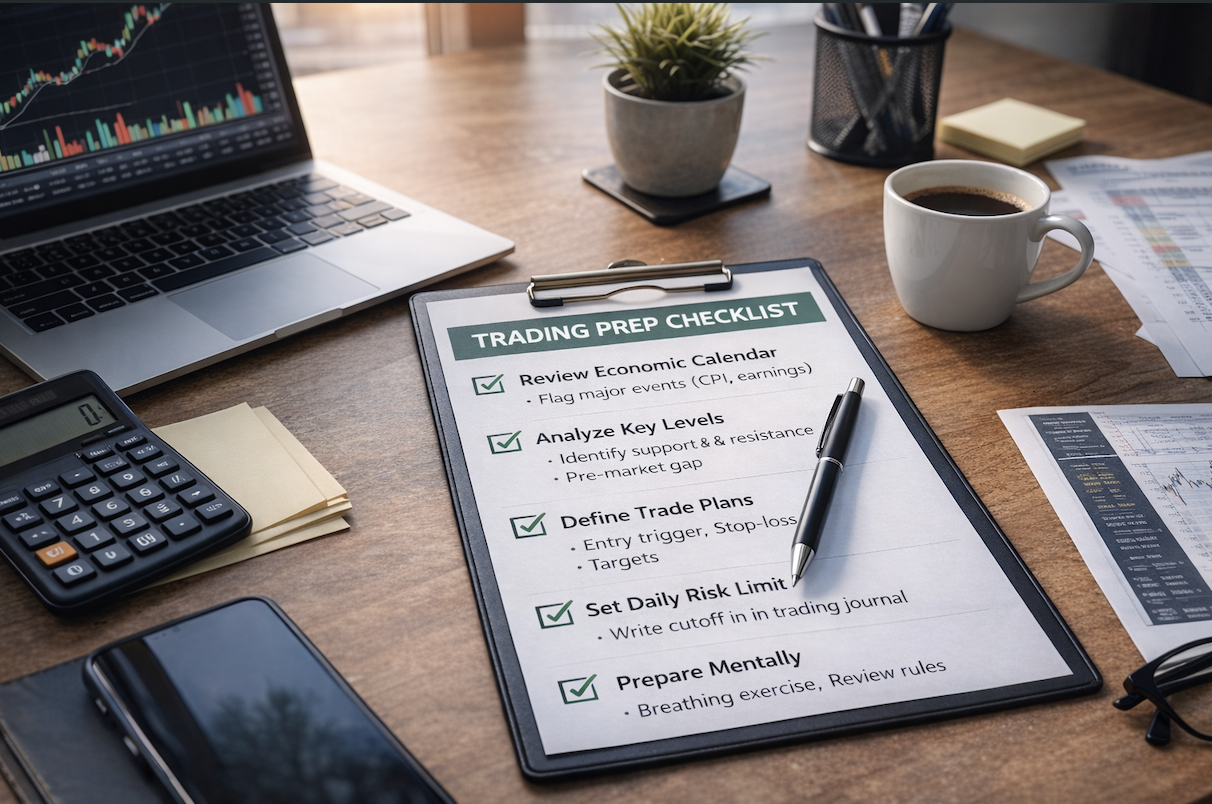
Pull up your economic calendar and flag any major data releases — CPI, jobs reports, Fed speeches, earnings. These are the events that can shift the entire tape in minutes. Next, scan overnight news: how did Asia close? What’s happening in Europe? Are there geopolitical developments that could pressure specific sectors? The key skill here is filtering. Financial news is designed to generate engagement, not to help you trade. Your job is to separate market-moving catalysts from background noise. A Fed official making an offhand comment on inflation is different from a scheduled policy statement. An earnings beat from a major bank matters. A Twitter thread about a meme stock usually doesn’t. Build a simple priority hierarchy: scheduled macro events first, major sector news second, individual stock catalysts third. Work top-down, not bottom-up, and you’ll avoid the trap of getting lost in the weeds before the market even opens.
Routine #2: Technical Analysis and Chart Review (8:40–8:50 AM)
With context established, move to your charts — but with a specific purpose. You’re not browsing; you’re building a map.
For every stock on your watchlist, identify the key levels: support, resistance, the overnight gap (if any), and pre-market volume. A stock gapping up on strong volume with a clear catalyst is a very different setup than one drifting higher on no news and thin volume. Know the difference before the open.
Then zoom out. Check the major index futures — S&P, Nasdaq, Dow. Is the market set up for a gap-and-go, or is it a fade? Check the VIX for overall sentiment. Run a quick sector ETF scan to spot rotation — which sectors are showing relative strength, and which are lagging? These macro signals give your individual trade setups context, which dramatically improves your odds of being on the right side of the trade. Finish by locking in your game plan for each position: entry trigger, stop-loss placement, and profit target. If you can’t articulate all three, the trade isn’t ready.
Routine #3: Risk Management and Position Planning (8:50–9:00 AM)
This is the routine most traders skip — and the one that keeps professionals alive during bad streaks. Before the open, calculate your total portfolio exposure and set a hard daily loss limit. Write it down. If you hit that number, the trading day is over. No exceptions. This one rule will save you from the death spiral of revenge trading more than any strategy ever will.
Size your positions before the open using your risk parameters, not your emotions. Decide how much of your available buying power you’re willing to deploy today, and hold some in reserve — the best opportunities often come mid-session, not at the open. Check for correlation across your positions; if three of your four trades move with the same sector, you’re not diversified, you’re concentrated.
Write your trade plans down. There is something powerful about committing to a plan in writing before the chaos of the open. It makes you accountable to a rational, prepared version of yourself — not the emotional version who sees red and starts clicking.
Routine #4: Mental and Emotional Preparation
Trading is a performance discipline. No serious athlete walks onto the field without warming up, and no serious trader should either. Take 5 to 10 minutes for mental preparation. That might mean a short meditation, a breathing exercise, or simply sitting quietly and running through your trading rules. Visualize how you’ll respond to different scenarios — a big winner, a quick stop-out, a slow morning with no setups. The goal is to reach the open in a calm, focused state rather than an anxious or overexcited one.
Assess your emotional baseline honestly. Tired? Stressed from something outside the market? These states impair judgment, and impaired judgment costs money. If you’re not in the right headspace, consider reducing your position sizes or sitting out entirely. Preservation of capital is always the priority.
Routine #5: Platform and Technology Setup
The final routine is the least glamorous and among the most important: make sure your tools actually work. Check that your trading platform is loading correctly. Test your alerts. Confirm your charts are set up the way you need them: indicators, time frames, watchlists. If you use multiple monitors, make sure your layout is organized and distraction-free. Have your checklist accessible. A frozen platform, a missed alert, a wrong chart setup — cause real trading mistakes. Two minutes of verification saves you from expensive surprises.
The 30-Minute Framework in Practice
The full routine fits neatly into 30 minutes starting at 8:30 AM: ten minutes on news and context, ten minutes on charts, and ten minutes on risk planning and mental prep, with platform checks woven throughout. Day traders may want to start earlier for deeper analysis; swing traders can compress the technical portion.
What matters isn’t perfection — it’s consistency. Run this routine every single trading day, regardless of how confident you feel or how busy the morning is. Champions prepare while others react. The compound effect of 30 disciplined minutes, every day, is one of the most powerful edges available to any trader.
Start Tomorrow
Pick one of these five routines and implement it this week. Track your results over 30 trading days. Then add another. Build gradually, but build deliberately.
The best tool to accelerate your pre-market routine is Trade Ideas. Its AI-powered scanners, real-time alerts, and integrated economic calendar are built specifically for the kind of systematic, data-driven preparation described above. From gap scanners to news alerts to watchlist automation, Trade Ideas gives you the infrastructure to execute a professional pre-market routine without spending hours on manual research.Serious traders don’t guess. They prepare. Start tomorrow — intentionally.
Want to level up your pre-market process? Explore Trade Ideas today and see how the platform’s tools can sharpen your daily routine.