
The Zen Trader: How 10 Minutes of Meditation Creates Unshakeable Trading Discipline
The Zen Trader: How 10 Minutes of Meditation Creates Unshakeable Trading Discipline
By Katie Gomez

As a yoga teacher, I have spent years helping people find balance, manage stress, and stay present during challenging moments. When I began trading, I found myself facing new psychological pressures. Recognizing the intense demands of trading, I decided to bridge my experience in yoga and trading to better manage my own stress and that of others. I quickly realized the challenge: trading requires fast decisions and laser focus, yet the emotional reactions most harmful to traders are those meditation teaches us to observe and release. After seeing how FOMO, revenge trading, and panic could derail trades, I found that the practices I taught in yoga, such as meditation and breathwork, could transform emotional, reactive traders into disciplined professionals. Mindfulness, along with systematic trade preparation, offers a framework for trading success that goes beyond technical analysis. The most successful traders I observed were not the fastest or cleverest, but those who were most emotionally regulated—a skill that can be trained through consistent practice.
The Emotional Trading Epidemic
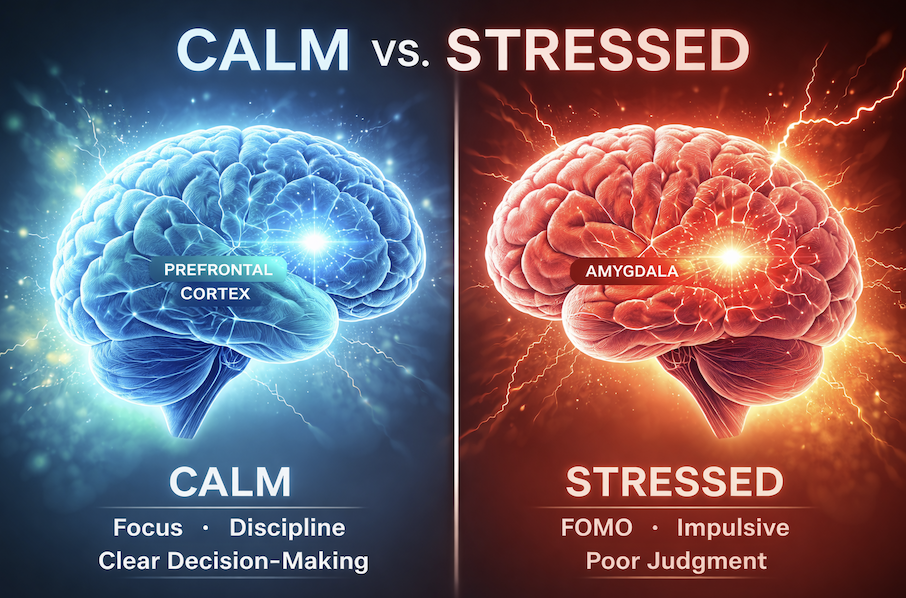
The statistics are brutal: over 90% of day traders lose money within their first year, not because they lack intelligence or market knowledge, but because emotional reactions systematically destroy their accounts through FOMO entries at market tops, panic exits at bottoms, and revenge trading that turns small losses into account-killing disasters. Neuroscience research confirms what I’ve observed while teaching yoga for years: meditation literally rewires the brain through neuroplasticity, strengthening the prefrontal cortex, which is responsible for executive function and emotional regulation. It also reduces amygdala reactivity to stress triggers such as sudden market volatility or large drawdowns. Traditional trading education completely ignores this physiological reality, focusing on charts and strategies while leaving traders defenseless against their own nervous systems. From yoga, I’ve seen how breath directly influences the nervous system. Shallow, rapid breathing during market stress activates the sympathetic nervous system, which promotes poor decision-making, whereas controlled breathing engages the parasympathetic system, enabling clear thinking. The connection between breath, nervous system regulation, and decision-making quality isn’t mystical – it’s measurable neuroscience that every trader needs to understand and practice.
The 10-Minute Pre-Market Meditation Protocol
Your trading day begins before the market opens with this systematic three-phase practice that transforms reactive impulses into disciplined execution.
- Minutes 1-3: focus on centering and breath awareness using the 4-7-8 breathing technique (inhale for 4 counts, hold for 7, exhale for 8)
- Minutes 4-6: First, close your eyes and visualize the market. Next, mentally rehearse responding calmly to volatility. Finally, imagine yourself strictly following your trading plan, no matter how the market moves.
- Minutes 7-10: Set an intention for disciplined trading and review your trading rules and risk limits. Set profit targets using clear, logical criteria and plan your Trade Ideas alerts thoughtfully. Mentally create ‘if-then’ scenarios so you know how you will react to different market conditions before they occur.
This protocol adapts to any schedule – use a 5-minute version when time is tight, extend to 15 minutes during high-stress periods, or incorporate longer weekend sessions for deeper preparation. The key is consistency: this daily practice creates the neural pathways that enable calm decision-making when money is on the line.
Mindful Alert Setup: Your Trading GPS
The meditation-to-action bridge transforms how you approach Trade Ideas alert configuration, moving from reactive market scanning to an intentional setup in which alerts serve as your trading GPS, guiding decisions with clarity rather than emotion. Setting price alerts with detailed reasoning attached while your mind is calm and clear creates a powerful decision-making framework. Instead of relying on in-the-moment judgment clouded by fear or greed, you’re following instructions from your best trading self, who analyzed the setup objectively. This “future self” preparation involves writing alerts as specific messages to your trading mind, anticipating the emotional states you’ll experience when alerts trigger, and pre-committing to responses that remove the pressure to make real-time decisions. Effective mindful alert notes include specific reasoning, such as “Strong support bounce setup – wait for volume confirmation before entry,” “Breakout above resistance – only take if followed by volume surge,” or “Risk management: Stop at $X regardless of whatever story I tell myself in the moment.” These detailed notes serve as your trading compass when emotions run high, ensuring that disciplined analysis guides your actions rather than the fear, excitement, or desperation that destroys most traders’ accounts during volatile market conditions.
The Compound Effect of Daily Practice and Overcoming Obstacles
- Just 10 minutes of daily meditation creates profound compound benefits:
- The gradual development of unshakeable emotional resilience that improves trading consistency
- Better entry and exit timing through patience
- Reduced overtrading from FOMO elimination
- Improved risk management through clear thinking
- Higher win rates from quality-over-quantity approaches that extend beyond trading into better sleep, relationships, and overall life satisfaction.
The most common obstacles are easily overcome with realistic expectations: the “I don’t have time” excuse ignores that 10 minutes of preparation prevents hours lost to emotional trading mistakes, and you can start with just 3-5 minutes and build up gradually. If your mind feels “too busy” for meditation, that’s exactly why you need it most – accept thoughts without fighting them and focus on consistency rather than perfection. Resistance and skepticism are normal; start with simple breathing techniques, track the correlation between practice days and trading performance, and let results speak for themselves. The key is making this practice as non-negotiable as checking your account balance or setting stop-losses, because the trader who controls their mind controls their results.
Getting Started: Your 30-Day Trading Meditation Challenge
Week 1: Foundation Building
- Focus on the basic 4-7-8 breathing technique for 5-10 minutes.
- Practice centering and present moment awareness.
- Establish a consistent pre-market timing routine.
Week 2: Mental Preparation
- Add market visualization and calm response rehearsal.
- Begin intention setting for disciplined trading.
- Extend practice to a full 10 minutes daily.
Week 3: Systematic Integration
- Integrate the mindful Trade Ideas alert setup.
- Write detailed reasoning notes for each alert.
- Practice “future self” preparation techniques.
Week 4: Complete Protocol
- Implement a full 10-minute meditation sequence.
- Track performance correlation with practice consistency.
- Refine and personalize your routine.
Measuring Your Success:
- Emotional Control: Count FOMO trades, revenge trades, panic exits before/after.
- Decision Quality: Rate your trade execution on a 1-10 scale daily.
- Physical Wellbeing: Monitor stress levels, sleep quality, and energy throughout the trading day.
- Performance Metrics: Document win rate, average gain/loss, and drawdown periods.
- Consistency: Track days practicing vs. days following the trading plan.
By week 4, you should notice calmer responses to volatility, fewer impulsive trades, and improved ability to follow your predetermined trading rules regardless of market conditions.
The Zen Trader’s Edge
My unique journey from yoga teacher to trading mentor has revealed what Wall Street doesn’t want you to know: the competitive advantage in markets isn’t superior analysis or faster technology – it’s emotional regulation that allows you to execute your best strategies when money is on the line. Ancient meditation wisdom meets modern markets through this simple truth: 10 minutes of daily practice can transform trading careers by creating the patience that markets reward and the calm clarity that separates profitable traders from emotional casualties. Markets test your psychology every day, but meditation trains you to witness volatility without being controlled by it, creating the space where your best trading decisions emerge. Bring this mindfulness to your money management, and discover that the path to trading success runs through the same present-moment awareness that transforms everything else in life. To learn more about emotional regulation and mindful training, join our team of experts at Trade Ideas today.