
Elon’s xAI Empire: How Tesla, SpaceX, and X Create an AI Monopoly
Elon’s xAI Empire: How Tesla, SpaceX, and X Create an AI Monopoly
Elon Musk’s recent xAI “all hands” meeting wasn’t just another tech presentation – it revealed the blueprint for an integrated AI strategy that positions xAI not as just another AI company competing with OpenAI and Google, but as the central nervous system of Musk’s entire business empire. While competitors fight over market share in isolated AI applications, Musk is orchestrating something unprecedented: Tesla’s vehicle data feeding xAI’s training, SpaceX’s orbital infrastructure powering space-based AI operations, and X platform’s social media conversations creating the world’s most comprehensive real-time human behavior dataset. The physical manifestation of this dominance lies in Memphis, where xAI’s “Macrohard” supercluster represents more than just computing power – it’s the engine driving an AI monopoly spanning transportation, space exploration, and social communication. This integration fundamentally reshapes Tesla’s investment thesis from that of an electric-vehicle manufacturer to an AI holding company, creating a vertically integrated empire in which each Musk venture strengthens the others through shared AI capabilities that no single competitor can replicate.
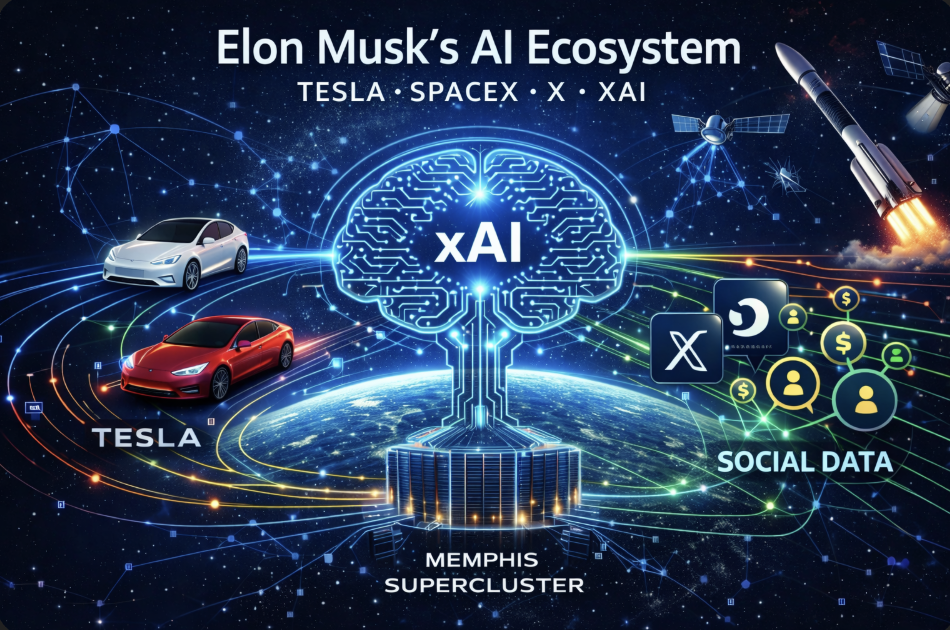
The xAI Foundation: Memphis Supercluster Advantage
The Memphis “Macrohard” training facility represents more than just impressive computing power – it’s xAI’s declaration of infrastructure dominance. It was designed to outclass OpenAI’s partnerships, Google’s data centers, and Meta’s AI research facilities through sheer scale, speed, and strategic positioning. This supercluster delivers training speed and model performance improvements, enabling technical superiority through the integration of custom hardware and software. It also provides exclusive access to data streams from Tesla’s global vehicle fleet, SpaceX’s orbital operations, and X platform’s real-time social conversations that competitors simply cannot replicate. The geographic advantages are equally compelling:
- Memphis offers lower energy costs.
- Central location for data transmission
- Favorable regulatory environment compared to Silicon Valley alternatives.
The speed of deployment demonstrates Musk’s ability to move from concept to operational infrastructure faster than traditional tech giants constrained by corporate bureaucracy. From an investment perspective, this represents massive capital expenditure and commitment, creating formidable barriers to entry for competitors. At the same time, establishing potential licensing revenue opportunities as other companies seek access to xAI’s superior infrastructure capabilities, positioning the Memphis facility as both a competitive moat and future profit center.
Tesla: From EV Company to AI Holding Company
- Tesla’s transformation into an AI holding company centers on its unparalleled data goldmine:
- Millions of vehicles continuously feed real-world driving data into xAI models.
- Full Self-Driving (FSD) systems provide edge-case scenarios that competitors can’t access
- The emerging robotaxi network serves as the ultimate AI training ground for autonomous decision-making at scale.
This data advantage enables a complete transformation of the revenue model from traditional automotive sales to software-as-a-service revenue through AI-powered features. The stock valuation impact is profound: AI capabilities justify Tesla trading at tech company multiples rather than traditional automaker ratios, with FSD and robotaxi potential representing trillion-dollar revenue streams that dwarf vehicle manufacturing margins. For investors, Tesla becomes the primary public market proxy for Musk’s entire AI empire, offering access to xAI’s growth without waiting for a separate IPO. Though this creates both opportunity and risk as Tesla’s stock performance increasingly correlates with AI hype cycles rather than automotive fundamentals, making it essentially a leveraged bet on Musk’s ability to transform multiple industries through artificial intelligence integration.

SpaceX: Space-Based AI Infrastructure
SpaceX provides the orbital backbone for Musk’s “space beats Earth for AI” prediction through Starlink’s constellation, serving as a global AI network infrastructure that enables satellite-based computing and data processing, reducing latency for worldwide AI services while bypassing terrestrial internet limitations. SpaceX-xAI creates unique competitive advantages:
- Launch capabilities for deploying AI satellite constellations at cost (structures competitors cannot match)
- Space manufacturing data feeding AI optimization models for rocket production and mission planning
- Mars exploration AI development that prepares for interplanetary operations
- “Moonbase Alpha” integration where xAI capabilities power lunar infrastructure development.
This positions SpaceX with a first-mover advantage in space-based AI, opening massive government and military contract opportunities, from national security satellite networks to defense AI applications. It also provides global reach that extends far beyond terrestrial competitors constrained by geography, regulations, and infrastructure limitations.
X Platform: The Social Media Data Monopoly
X Platform provides xAI with an unparalleled training dataset through real-time human conversations, multilingual communication patterns, and behavioral data that reveal how people actually think and make decisions. The integration of X Money adds financial transaction data for fraud detection and economic behavior prediction, while X Chat enables direct competition with ChatGPT through social media AI assistant capabilities and advertising optimization. This combination of social conversations, financial transactions, and behavioral patterns creates an AI training advantage that competitors cannot replicate without similar platform ownership. However, this data monopolization raises significant privacy concerns about user consent and potential antitrust scrutiny from EU and US regulators over the concentration of such vast personal information within Musk’s AI empire.
The Monopoly Strategy: Vertical Integration
Musk’s vertical integration creates an unprecedented data ecosystem where Tesla vehicles feed driving behavior to xAI, the X platform provides social data for AI personality development, and SpaceX contributes space operations data. Revenue synergies compound across businesses:
- X-AI improvements boost Tesla FSD margins
- X platform AI features increase engagement.
- SpaceX AI optimization reduces launch costs.
- Licensing generates new revenue streams.
This delivers monopoly characteristics through control of essential AI training data that competitors cannot access, infrastructure dominance via Memphis, platform control through X ownership, and government positioning through SpaceX. No competitor has simultaneous access to automotive, social media, and space data, while scale economies create network effects that strengthen each business unit.
The Investment Verdict: Bull vs. Bear Case
The bear case centers on execution risks, including: Musk’s mixed track record of predicting timelines, technical challenges of AI integration across platforms, competitive responses, and the likelihood of regulatory intervention (as governments scrutinize AI monopolization). Market reality checks reveal potential gaps between AI hype and actual revenue generation, consumer resistance to integrated surveillance, privacy backlash, and economic downturn’s impact on speculative investments. Alternative scenarios include competitors developing superior AI without data advantages, open-source models reducing proprietary value, and regulation limiting data collection.
Conversely, the bull case emphasizes network effect acceleration, where data advantages compound over time, ecosystem lock-in strengthens, and first-mover advantages create insurmountable moats. Revenue multiplication occurs as AI improves margins across all Musk businesses, generates new licensing streams, enables global market expansion, and creates subscription/SaaS potential. If this is the case, the technological breakthrough possibilities are endless, including:
- AGI development through integrated data approaches
- Quantum computing integration, Neuralink brain-computer interfaces
- AI requirements for Mars colonization that position the empire for multi-planetary dominance that no competitor can match.
Betting on Musk’s AI Vision
The unprecedented competitive advantages from vertical integration across the automotive, social media, and space industries create a unique investment opportunity, with 2026 as the critical period for validating whether execution matches the vision. Your investment decision ultimately boils down to believing in Musk’s ability to integrate and execute across multiple complex industries versus the substantial execution risks, regulatory challenges, and competitive responses. Smart positioning requires sizing appropriate to your risk tolerance while monitoring quarterly progress across Tesla performance, X platform engagement, and SpaceX contract wins. Remember, this isn’t just a stock pick – it’s a bet on whether one individual can orchestrate the most ambitious technological integration in business history. The stakes are clear: decide if you’re betting on the AI monopoly or against it, because in winner-takes-all artificial intelligence, the victor may indeed take everything. Learn more about how to strategically position your portfolio to benefit from all of X’s creations in 2026 by joining Trade Ideas today.