
Spring Sector Rotation: Where Money Flows From Winter to Summer
Spring Sector Rotation: Where Money Flows From Winter to Summer
Spring sector rotation represents one of the most predictable and statistically reliable patterns in equity markets, offering traders a systematic edge based on decades of consistent historical data rather than hopeful speculation. As winter’s defensive positioning gives way to spring’s growth-oriented optimism, institutional money flows create identifiable trends that careful observers can capitalize on before they become obvious to the mainstream. This seasonal shift isn’t subtle; certain sectors consistently outperform while others lag with remarkable regularity during the February-to-May window. In this guide, you’ll discover exactly which sectors to exit as winter fades, which to enter as spring emerges. and the precise timing strategies that separate profitable seasonal traders from those who recognize the pattern too late.
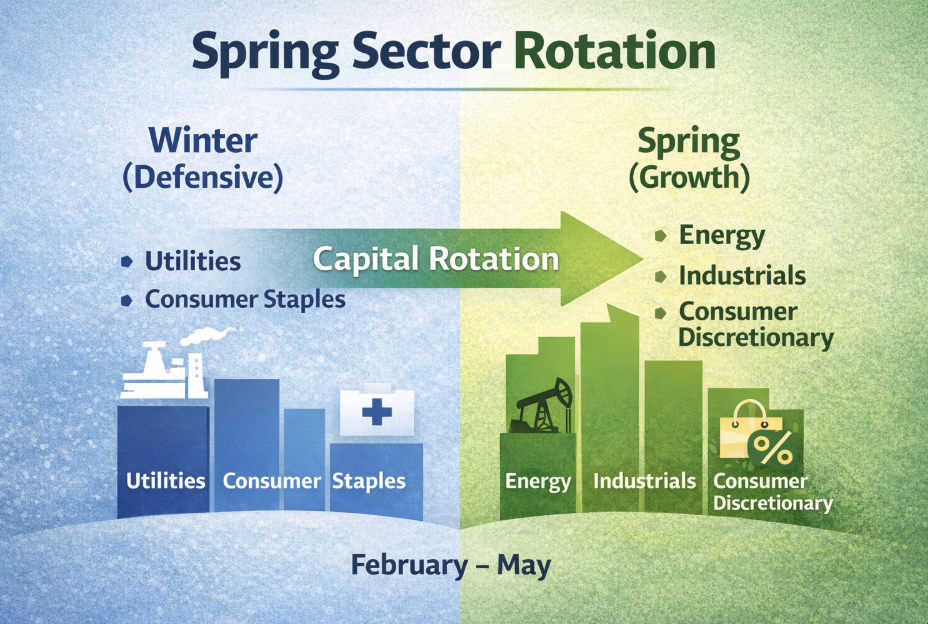
Why Spring Rotation Happens
Spring sector rotation isn’t market folklore – it’s driven by concrete catalysts that repeat with statistical reliability year after year. Institutional portfolio managers conduct Q1-to-Q2 rebalancing, shifting allocations from defensive winter positions toward growth-oriented sectors as performance targets and risk parameters adjust for the new quarter. At the same time, weather-dependent business cycles improve dramatically as construction resumes, manufacturing accelerates, and transportation volumes increase with better conditions. These underlying forces set the stage for the market’s next move.
Tax refund spending hits peak velocity from February through April, injecting billions into consumer accounts that flow directly into retail, automotive, home improvement, and travel sectors. Meanwhile, market psychology shifts from winter’s cautious “risk-off” sentiment to spring’s optimistic “risk-on” positioning as seasonal fears about year-end results and January volatility fade. The data conclusively validate this pattern: historical sector performance analysis from January through May shows statistically significant outperformance in energy, industrials, and consumer discretionary over 20+ years (while utilities and staples consistently lag). This isn’t a coincidence but a predictable rotation that smart traders exploit, even as “Sell in May and go away” positioning begins affecting flows by late April.
Sectors to EXIT (Winter Laggards)
As spring approaches, the defensive sectors that provided winter safety become dead weight in portfolios seeking growth. Utilities, the classic winter safe haven prized for stable dividends and low volatility, lose their appeal. Institutional money unwinds defensive positioning amid rising interest rates, making high-yielding utility stocks less attractive relative to other sectors. Exit timing is critical, with late February to early March offering optimal windows before the decline accelerates. Consumer staples face similar headwinds as the defensive premium disappears and money rotates from stability to growth. Expensive valuations that seemed reasonable during winter uncertainty become impossible to justify when better opportunities emerge elsewhere.
Healthcare presents mixed signals, losing its defensive premium as risk appetite returns, though the biotech subsector can buck the broader trend if innovation catalysts align, making a selective approach more appropriate. Even bonds and fixed income feel the spring rotation pressure as returning risk appetite drives money from the safety of treasuries and investment-grade debt into equities that offer growth potential the fixed income can’t match.
Sectors to ENTER (Spring Winners)
Energy experiences a powerful spring awakening as driving-season demand builds toward Memorial Day, refinery maintenance periods end, and supply tightens. Historical data demonstrates consistent March-through-May outperformance that justifies a mid-February entry to capture the full move.

Industrials surge as:
- Weather improvements spike construction activity nationwide.
- Infrastructure spending budgeted over the winter finally breaks ground.
- Transportation stocks (trucking, railroads) benefit from accelerating volumes.
Consumer discretionary stocks gain rocket fuel from IRS tax refunds hitting accounts February-April:
- Home improvement retailers like Home Depot and Lowe’s rally
- Auto sales increase as buyers use refunds for down payments.
- Travel bookings accelerate for summer planning.
Technology benefits from the broader growth rotation:
- Institutional money leaves defensive sectors for innovation plays.
- Q1 earnings momentum carries into spring guidance.
- Enterprise software and cloud infrastructure capture business spending, ramping after winter budget approvals.
Materials rally on multiple fronts:
- Construction demand drives commodity prices higher.
- The agricultural planting season creates fertilizer and chemical demand.
- Seasonal patterns in metals (copper and steel) and lumber are driven by synchronized industrial and construction activity.
The Timeline: When to Act
Successful spring rotation depends on precise timing across three distinct phases. Early February represents the positioning phase when smart money begins building positions in energy, industrials, and consumer discretionary, while methodically trimming utilities and staples before the crowd recognizes the shift. Mid-February — end of March marks the acceleration phase, historically the heaviest rotation period, as tax refunds hit consumer accounts, sector-specific earnings catalysts drive momentum, and institutional rebalancing reaches peak intensity. This period creates the strongest directional moves and best risk-reward opportunities. April through May marks the peak phase where “Sell in May and go away” positioning begins to affect flows. Missing the positioning phase means chasing expensive entries, while overstaying the peak phase transforms winning trades into disappointing exits as summer doldrums approach and the cycle prepares to reverse.
Key Indicators to Monitor
Track retail sales reports from February through April as critical confirmation of consumer discretionary strength.
Match IRS tax refund timing data to anticipate spending spikes.
Monitor ISM Manufacturing Index improvements that signal industrial-sector momentum.
These indicators work together as a real-time dashboard confirming whether seasonal rotation is playing out as expected or if macro factors are overriding normal patterns. That way, traders can adjust positions accordingly rather than blindly following historical trends that may not hold in unusual conditions.
Trade Ideas for Sector Rotation
Trade Ideas’ sector screening tools offer advantages for capturing spring rotation. Relative strength scanners track early momentum while volume surge alerts highlight institutional buying before retail. Money flow analysis shows exits and entries into spring winners, confirming the rotation. Alerts for SPY sector weights and ETF flows signal shifts, backtesting validates timing, and pairs trades let advanced traders long spring winners and short winter laggards to capture the spread in any market. These tools help identify the strongest opportunities within winning sectors while maintaining disciplined risk management.”
Specific Plays and Risk Management
Within winning sectors, focus on:
Energy: Refiners like Marathon Petroleum (MPC) and Phillips 66 (PSX)
Industrials: Caterpillar (CAT), Deere (DE), and United Rentals (URI), capturing construction activity
Consumer Discretionary: Home Depot (HD), Lowe’s (LOW), and Amazon (AMZN)
Materials: Steel makers Nucor (NUE) and Steel Dynamics (STLD)
Chemicals: DuPont (DD) and Dow (DOW)
Risk Management Essentials
Maintain disciplined risk management, recognizing that macro events like recessions can override seasonal patterns entirely. Extreme weather can also unpredictably delay or amplify rotations, and policy shocks like tariffs can reshape sector dynamics overnight. Never abandon core diversification for seasonal trades – allocate only 10-25% of your portfolio to rotation plays and size positions appropriately based on conviction and volatility. Remember that short-term capital gains tax implications can significantly reduce net returns if you don’t hold positions long enough for favorable treatment.
Capitalize on Spring’s Predictable Flows
Spring sector rotation offers one of the most statistically reliable edges in markets: systematically rotate OUT of utilities and consumer staples, INTO energy, industrials, and consumer discretionary during the February through April sweet spot. This isn’t speculation – it’s pattern recognition backed by decades of data. Combine these seasonal flows with fundamental analysis, use Trade Ideas to identify the strongest individual stocks within winning sectors, and start positioning now before the rotation becomes obvious. Track your performance against this seasonal framework to refine your approach each year. The money is already beginning to flow from winter’s defensive plays to spring’s growth opportunities – the only question is whether you’ll capitalize on these predictable patterns or watch from the sidelines while others bank the gains.