
GameStop Earnings Date: What Traders Watch Before, During, and After the Report
GameStop Earnings Date: What Traders Watch Before, During, and After the Report

Earnings season is one of the most emotionally charged periods in the market, and few stocks attract as much attention as GameStop. With GME’s next earnings estimated between March 24 and March 31, 2026, traders expect sharp price swings, high volatility, and intense market reactions.
For traders, the real opportunity and risk are not just in the financial results, but in how the market interprets and reacts to them. Expectations, positioning, and momentum often matter more than the actual earnings numbers.
This guide breaks down what traders watch before, during, and after the GameStop earnings report, helping you understand key signals, manage risk, and trade earnings with a disciplined mindset.
What GameStop’s Earnings Mean for Traders
GameStop is no longer just a traditional retail stock. Over the years, it has become a symbol of retail participation, market psychology, and extreme sentiment shifts. This makes every game stop earning a high-attention event, even when fundamentals remain unchanged.
Traders care about GameStop earnings because:
- Volatility tends to increase sharply around the report
- Liquidity often improves temporarily
- Market reactions can be exaggerated relative to results
- Expectations often matter more than actual performance
For momentum traders, earnings act as a catalyst, not a prediction tool. The goal is not to guess the outcome but to prepare for how the price may respond once new information enters the market.
What Traders Watch Before the GameStop Earnings Date
Before the earnings release, disciplined traders focus on positioning, expectations, and volatility rather than predictions. The goal is to understand how the market is set up and where price pressure is most likely to emerge once new information hits.
Key pre-earnings factors traders monitor include:
- Revenue & EPS Estimates: Analysts track projected revenue and earnings per share to assess whether GameStop is showing meaningful operational improvement or continued sales pressure.
- Cost Management: Traders evaluate management’s ability to control expenses and sustain positive operating income, a major shift from GameStop’s previous high-spending model.
- Cash Pile Strategy: With roughly $8.8 billion in cash reserves (as of Dec 2025), investors closely watch for updates on capital allocation, including acquisitions, buybacks, or potential Bitcoin exposure.
- Options Market Positioning & Implied Volatility: Elevated implied volatility, often exceeding 10% on earnings days, signals expectations for sharp price movement and helps traders assess risk, pricing, and potential post-earnings volatility collapse.
By analyzing these factors, traders gain insight into expectations, sentiment, and risk levels, allowing them to plan entries, exits, and hedging strategies with greater precision before the report drops.
Key Factors Traders Monitor Ahead of Earnings
Ahead of earnings, traders focus on expectations, positioning, and price behavior rather than predictions. The goal is to understand how the market is positioned and where pressure may build once new information is released.
Key signals traders track include:
- Market Sentiment: Measures whether optimism or pessimism is already priced in. Extreme bullish sentiment raises “sell-the-news” risk, while excessive pessimism increases upside surprise potential.
- Recent Price Behavior: Tight consolidation, repeated resistance tests, or slow trend moves suggest positioning and anticipation, while sharp pre-earnings rallies often reflect speculative activity.
- Options Positioning: Call and put activity reveals expectations around volatility and direction, helping traders identify where post-earnings pressure may emerge.
- Short Interest & Volume Trends: Changes in short interest and volume reveal shifts in conviction, risk appetite, and downside or upside pressure.
Price often begins to signal market expectations days or weeks before the earnings release, offering valuable context without requiring directional guesses.
Price Action Leading Into Earnings
Traders study whether GameStop is trending, consolidating, or becoming overextended into earnings. Rising momentum often reflects positioning rather than certainty and increases the risk of profit-taking after the announcement. As a result, many traders avoid aggressive directional bets and instead focus on volatility-based strategies with clearly defined risk.
Expectations vs Reality
Earnings reactions are driven by expectations, not just results. GameStop can beat estimates and still fall, or miss and still rally, depending on how outcomes compare to what the market already priced in. Traders monitor analyst forecasts, consensus estimates, management guidance, and earnings-call tone, since forward outlook often influences price more than raw numbers..
Options Activity and Implied Volatility
One of the most important pre-earnings indicators is implied volatility (IV) in the options market. IV reflects how much movement the market expects around the earnings release.
Before GameStop earnings:
- Implied volatility typically rises
- Option premiums become more expensive
- The market prices are in a large potential move
This tells traders that uncertainty is high and that a significant reaction is expected. However, elevated implied volatility also creates a challenge. The stock must move enough to justify the cost of options; traders may lose money even if the price moves in the correct direction.
Because of this, many professional traders use IV information to:
- Avoid overpaying for options when volatility is already elevated
- Structure defined-risk trades that account for volatility collapse
- Prepare for the typical drop in implied volatility after earnings are released
Volatility contraction after earnings is common and can impact option prices regardless of direction. Traders who ignore this often misunderstand why a “correct” trade still results in a loss.
Why This Preparation Matters
Preparing properly before the GameStop earnings date allows traders to:
- Reduce emotional decision-making
- Avoid chasing pre-earnings speculation
- Enter the event with realistic expectations
Rather than reacting impulsively, disciplined traders let the market reveal its intentions. This approach creates clarity, not certainty, and clarity is what allows for consistent decision-making.
In earnings trading, preparation does not guarantee profits. It simply prevents avoidable mistakes. And over time, avoiding mistakes matters far more than catching every move.
What Traders Watch During the Earnings Release
During the earnings moment, traders focus on hard data, guidance, and real-time price response, not headlines or emotional reactions.
Key factors traders monitor include:
- EPS & Revenue Beat/Miss: Whether GameStop beats or misses analyst expectations, which often drives the initial price reaction.
- Guidance & Management Commentary: Forward-looking statements on growth strategy, profitability, and capital deployment often influence price more than the raw numbers.
- Balance Sheet Strength: Traders assess cash levels, liquidity, and financial stability, especially given GameStop’s large cash position and long-term transformation efforts.
Beyond fundamentals, traders closely track price behavior, volume, and momentum:
- Initial Reaction vs Follow-Through: The first price spike is often misleading. Traders watch whether the move holds, volume confirms direction, and price respects key levels.
- Volume & Speed: Rising volume with continuation signals conviction, while sharp spikes without follow-through suggest emotional, short-term reactions.
Experienced traders wait for confirmation and momentum alignment before acting, using real-time price and volume behavior to manage risk rather than chase headlines.
Guidance and Forward Commentary
For GameStop, forward guidance often matters more than past earnings because it shapes expectations for future performance.
Traders focus on:
- Management tone: Confidence, caution, or hesitation during the earnings call often influences short-term price direction.
- Strategic direction: Updates on business focus, transformation efforts, and long-term vision help determine whether the company is positioning for stability or growth.
- Cost control and expansion plans: Signals how management balances risk, spending discipline, and future investment.
These forward-looking insights frequently outweigh headline earnings numbers, as market reactions are driven more by expectations and narrative than by a single result.
What Traders Watch After the Earnings Report
Once the initial reaction settles, traders focus on trend confirmation, technical structure, and momentum sustainability to identify higher-probability setups.
Key post-earnings signals include:
- Initial Price Reaction: Traders assess whether the market is rewarding or punishing the results and if the move holds after volatility fades.
- Trend Alignment: They watch whether price action confirms a sustainable trend or shows signs of a temporary, sentiment-driven spike.
- Technical Level Reset: Earnings often create new support and resistance zones, with traders closely tracking key levels, gaps, and prior breakout or breakdown points.
- Post-Earnings Trend Behavior: Higher highs and higher lows suggest bullish continuation, while lower highs and breakdowns signal bearish control. Tight consolidation after a large move often precedes the next breakout.
- Momentum vs Exhaustion: Slowing price speed, fading volume, and failed continuation attempts warn of exhaustion, prompting disciplined exits.
This phase often provides cleaner risk-to-reward opportunities than the initial spike, as structure, volume, and trend direction become clearer.
Common Mistakes Traders Make Around GameStop Earnings
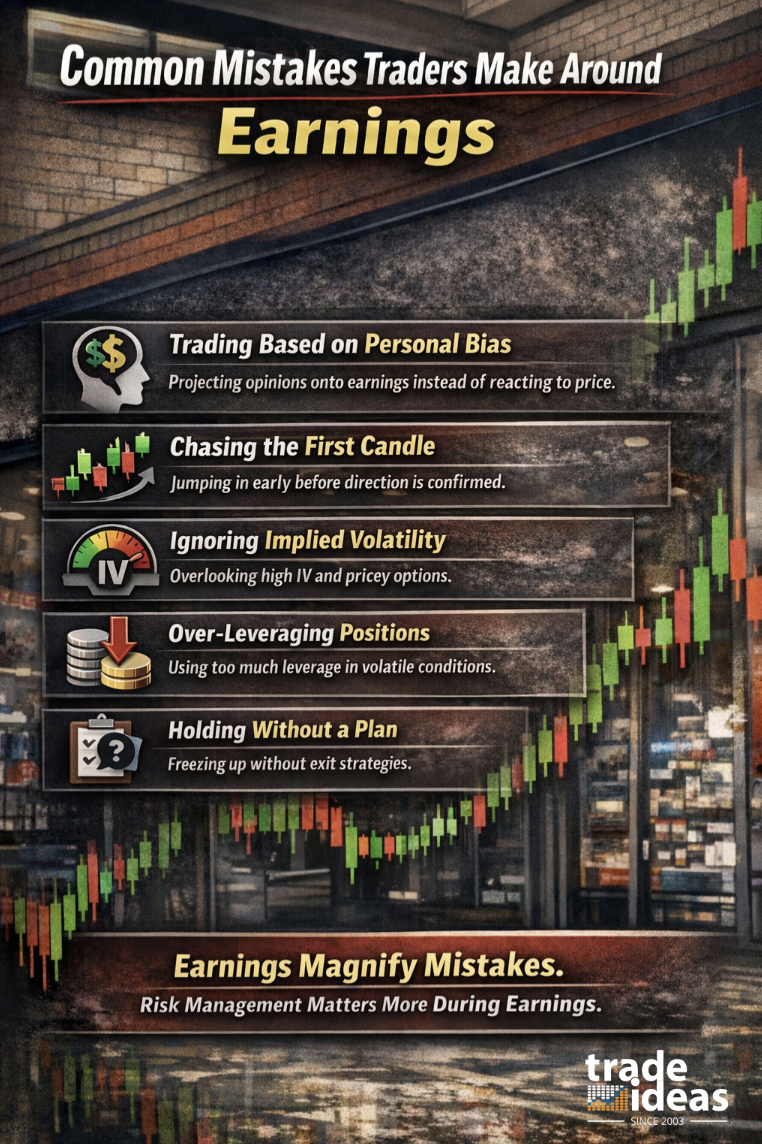
Even experienced traders can fall into traps during high-profile earnings events.
Earnings amplify mistakes. This is why risk management matters more during games that stop earning than during normal sessions.
Risk Management Around Earnings
Earnings trading is optional, not mandatory.
Smart risk practices include:
- Reducing position size
- Using defined-risk setups
- Accepting that no trade is also a decision
Many professionals prefer to trade after earnings, when uncertainty is reduced, and structure is clearer.
Momentum offers opportunity, but risk management creates longevity.
How Momentum Fits Into Earnings Trading
Momentum does not predict earnings outcomes. It reacts to participation.
For earnings:
- Momentum confirms whether traders agree with the reaction
- Strong momentum suggests follow-through
- Weak momentum suggests noise
Using momentum filters allows traders to focus on reaction quality rather than emotional headlines.
This approach aligns with institutional logic and reduces screen fatigue.
Final Thoughts: Trading GameStop Earnings With Clarity
The GameStop earnings date is not about excitement or speculation. It’s about preparation, reaction, and discipline. Traders who approach Gamestop earnings events with structure, realistic expectations, and controlled risk place themselves in a stronger position than those chasing headlines.
Earnings do not create opportunity by themselves. The market’s response does. By focusing on momentum, volume, and post-earnings structure rather than emotional prediction, traders can navigate GameStop earnings with clarity and professionalism.
Frequently Asked Questions
1. Do stocks usually go up or down after an earnings report?
Positive earnings can increase optimism, while disappointing earnings can make investors more cautious and risk-averse. The impact of an earnings report on the price of a stock depends greatly on what investors expected.
2. Is GameStop a buy, sell, or hold?
GME AI-Powered Stock Analysis. GameStop (GME) has an AI Score of 4/10 (Hold) because, according to an overall analysis, it has a probability advantage of -2.25% of beating the market (S&P500) in the next 3 months.
3. Is it better to buy before or after an earnings call?
It makes sense to buy stock options before an earnings announcement only if you expect a sharp change in the asset price. This strategy is ineffective when the stock price volatility is low.
4. What are analysts’ predictions for GameStop?
GameStop (GME) has been analyzed by 1 analyst, with a consensus rating of Sell. 0% of analysts recommend a Strong Buy, 0% recommend Buy, 0% suggest Holding, 100% advise Selling, and 0% predict a Strong Sell.
5. What is the 3-5-7 rule in the stock market?
No more than 3% of your total trading capital is at risk in a single trade. No more than 5% of your capital is at risk across all open positions. No more than 7% of your entire portfolio is exposed to market risk at any given time.
6. What to expect from GameStop earnings?
For comparison, GameStop reported EPS of $0.06 in the same quarter last year. The company is expected to announce its next earnings report on 03/24/2026, with analysts projecting an EPS of -$0.08.