
Momentum Trading Strategy: Monitor Momentum Without Charts
Momentum Trading Strategy: Monitor Momentum Without Charts

Watching charts all day is one of the fastest ways to burn out as a trader. Candles form, patterns appear, price moves quickly, and by the time you react, the opportunity is already gone. This is where a momentum trading strategy built around real-time monitoring instead of constant chart watching becomes powerful.
In this guide, you’ll learn how a momentum trading strategy works, why momentum matters more than patterns alone, and how tools like a Momentum Monitoring (Running Up) filter help you spot strong price moves in real time. We’ll also connect this approach with classic price-action concepts, such as bullish reversals signalled by hammer candles, to show how momentum and structure work together.
What Is a Momentum Trading Strategy?
A momentum trading strategy focuses on entering trades when the price is moving strongly in one direction and exiting when that strength begins to fade. Instead of buying low and waiting, momentum traders look for speed, urgency, and follow-through.
In simple terms:
- If the price is moving up fast and buyers are clearly in control, momentum traders look for long entries.
- If the price is falling quickly with strong selling pressure, momentum traders look for short opportunities.
Momentum exists because markets are driven by human behaviour. Fear, greed, urgency, and institutional activity cause prices to move in bursts rather than smooth lines. A solid momentum trading strategy is designed to capture those bursts without guessing tops or bottoms.
Why Momentum Matters More Than Patterns Alone
Many traders rely on chart patterns without asking an important question: Is there real strength behind this move?
A hammer candlestick, for example, can signal a bullish reversal. But as discussed in the earlier hammer candlestick analysis, the pattern alone is not enough. It needs:
- A prior downtrend
- Strong rejection of lower prices
- Confirmation and follow-through
Momentum provides that missing confirmation.
When momentum aligns with structure, reversals become more reliable. When momentum is absent, even the cleanest pattern can fail. This is why professional traders prioritize momentum first, patterns second.
The Problem With Watching Charts All Day
Chart watching creates three major problems:
- Delayed Reactions: By the time you notice momentum visually, the move may already be extended.
- Emotional Overtrading: Constant chart exposure increases impulsive entries, fear-based exits, and revenge trading.
- Information Overload: Multiple timeframes, indicators, and patterns often conflict, leading to hesitation and missed trades.
A smarter momentum trading strategy removes unnecessary visual noise and focuses on real-time signals that matter.
Monitoring Momentum Without Charts: The Core Idea
Monitoring momentum without charts does not mean ignoring price action. It means allowing technology to:
- Track price, speed, and strength
- Compare current movement to historical behavior
- Alert you only when momentum becomes meaningful
Instead of staring at charts waiting for something to happen, you let the system tell you when something important is already happening.
This is where Trade-Ideas’ Momentum Monitoring filter, specifically the Running Up (RU) alert, becomes valuable.
Understanding the Trade-Ideas Running Up (RU) Momentum Filter
The Running Up (RU) alert in Trade-Ideas is a real-time momentum monitoring tool. It detects when a stock is moving upward faster than it normally does, based on its own historical volatility.
In plain terms:
- The system constantly watches price movement
- It measures how quickly the price is rising
- It compares that speed to what is “normal” for that stock
- When the price accelerates unusually fast, the alert triggers
This allows traders to identify true momentum, not random price fluctuations.
How the Momentum Filter Works
Not every price movement deserves your attention. One of the biggest strengths of this momentum trading strategy is the built-in momentum filter, which helps separate meaningful moves from random market fluctuations.
The filter controls how strong the momentum must be before an alert is triggered. In simple terms, it decides when a move is significant enough to interrupt you:
- Lower filter values show more alerts, including weaker moves
When the filter is set low, the system becomes more sensitive. You’ll see frequent alerts, even for minor bursts of momentum. This can be useful for very active traders or those exploring early-stage moves, but it also increases exposure to false signals and short-lived price action.
- Higher filter values show only the strongest momentum events
Raising the filter tightens the criteria. Alerts only appear when price movement reaches a higher level of intensity, typically backed by strong volume or rapid price expansion. This reduces noise and helps traders concentrate on moves with real follow-through potential.
By applying this filter, traders can:
- Focus on high-quality opportunities
Instead of reacting to every small fluctuation, you’re guided toward trades where momentum is clearly established. This improves decision-making and aligns your attention with market moves that matter.
- Avoid choppy, low-energy price action
Sideways or indecisive markets often generate misleading signals. The momentum filter helps you sidestep these conditions by ignoring weak or unstable moves that lack conviction.
- Reduce screen fatigue
Constant chart-watching can be mentally draining. With filtered alerts, you don’t need to monitor dozens of charts throughout the day; the system does the heavy lifting for you.
Rather than being glued to multiple screens, you receive alerts only when momentum reaches a level truly worth your attention. This allows for a calmer, more focused approach to executing a momentum trading strategy without sacrificing opportunity.
Momentum vs Chart Patterns: How They Work Together
Momentum does not replace chart patterns; it enhances them. Chart patterns provide structure and key price levels, while momentum confirms whether real participation is entering the market. Used together, they reduce false signals and improve timing.
This is especially effective with hammer candlestick logic. A hammer shows rejection of lower prices, but it does not guarantee follow-through. Momentum helps confirm whether buyers are stepping in with strength.
Example:
- Price declines into a support zone, creating a logical area for a reaction.
- A hammer forms, signalling that selling pressure is fading.
- A Running Up alert triggers shortly after, showing momentum is building.
In this setup, the hammer defines structure and location, while momentum confirms strength and timing. This combination filters out weak reversals and improves entry precision.
Building a Momentum Trading Strategy Without Charts
Step 1: Let the System Watch Price
Instead of manually monitoring multiple markets, use momentum monitoring tools to scan price activity continuously. These systems identify sudden increases in speed or strength that signal momentum and keep you informed without staring at charts all day. This ensures you only engage when something meaningful is happening.
Step 2: Filter for Strength
Filtering helps eliminate weak or short-lived price moves. By adjusting the filter settings, you control how strong the momentum must be before an alert appears. Higher filters reduce noise and false signals, keeping your focus on moves that show clear intent and better follow-through.
Step 3: Check Context
When an alert triggers, do a quick reality check. Confirm the trend direction to ensure momentum isn’t fighting the market, note any nearby support or resistance that could stall the move, and review recent price behavior to see if the move is clean or erratic. This quick check replaces deep chart analysis while maintaining trade quality.
Step 4: Execute With Discipline
Once confirmed, execute with predefined risk, clear stop placement, and realistic targets. Having rules in place removes emotion from the process and keeps execution consistent. This structured approach minimizes impulsive decisions and maximizes efficiency.
8 Common Mistakes Traders Make With Momentum
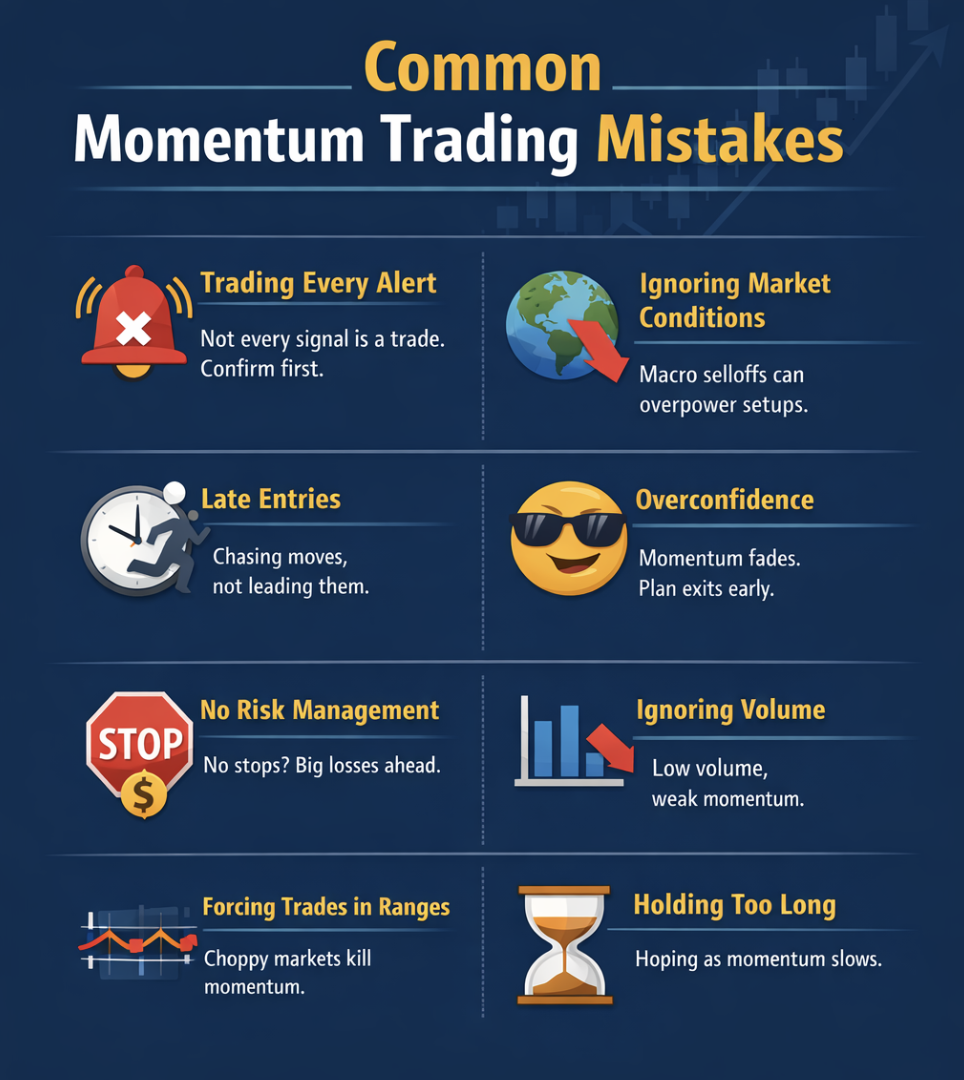
Avoiding these mistakes is part of mastering a professional momentum trading strategy.
Why Monitoring Beats Constant Chart Watching
Monitoring momentum without charts:
- Saves time
- Reduces emotional stress
- Improves reaction speed
- Encourages rule-based trading
This approach aligns with how institutions and algorithmic systems operate, by reacting to data, not staring at candles.
Final Thoughts: Momentum Trading With Clarity
A momentum trading strategy is not about predicting what the market might do next. It’s about recognising strength when it appears and responding with discipline. By using momentum monitoring tools like the Trade-Ideas Running Up filter, traders can spot opportunities faster, reduce chart fatigue, and focus only on high-quality moves that show real intent.
When momentum is combined with solid structure, such as hammer candlestick reversals and clear risk management, it becomes one of the most reliable forces in trading. You don’t need to watch every chart or react to every price change; you simply need to know when momentum truly matters.
Frequently Asked Questions
1. How to trade without looking at charts?
Trading without technical analysis involves making decisions based on fundamental factors such as economic data, company performance, and market trends, without relying on chart patterns or indicators. Traders focus on broader economic conditions and company fundamentals for investment decisions.
2. What is the basic momentum trading strategy?
A basic momentum trading strategy is to buy a stock or asset that’s clearly trending up, then sell when the upward move starts weakening. Traders usually pick liquid, fast-moving securities and use stop-losses to manage risk.
3. Which is the safest trading strategy?
The trend trading strategy is often considered one of the most accurate. It involves using technical analysis to identify and follow a prevailing trend, entering trades only in the direction of the predetermined trend. Following the trend is seen as a reliable approach in the markets.
4. What is the 90% rule in trading?
The Rule of 90 is a grim statistic that serves as a sobering reminder of the difficulty of trading. According to this rule, 90% of novice traders will experience significant losses within their first 90 days of trading, ultimately wiping out 90% of their initial capital.
5 What is the 70/30 trading strategy?
Typically, any reading above 70 is considered overbought and ripe for a reversal, while readings below 30 are considered oversold and also ripe for a reversal. Some traders use the 80 and 20 levels as their signal points.
6. What is not allowed in trading?
Hedging across multiple accounts is prohibited. Trading behavior like taking a risk of full or close to the daily loss limit in one trade will be suspected as a multi-platform hedge with FundedNext. Doing so is not considered a genuine trading strategy and can result in account termination.
7. Why does Momentum Trading work across different markets?
Momentum trading works across markets because it’s driven by human behavior, not asset type. When participation increases during news, macro events, or sentiment shifts, price accelerates, and momentum helps traders spot and act on these moves early.