
MLK Day and the Stock Market: What Traders Need to Know
MLK Day and the Stock Market: What Traders Need to Know
Every third Monday in January, U.S. financial markets close to observe Martin Luther King Jr. Day. For traders and investors, this isn’t just another day off—it’s a strategic inflection point that demands careful planning and risk management.
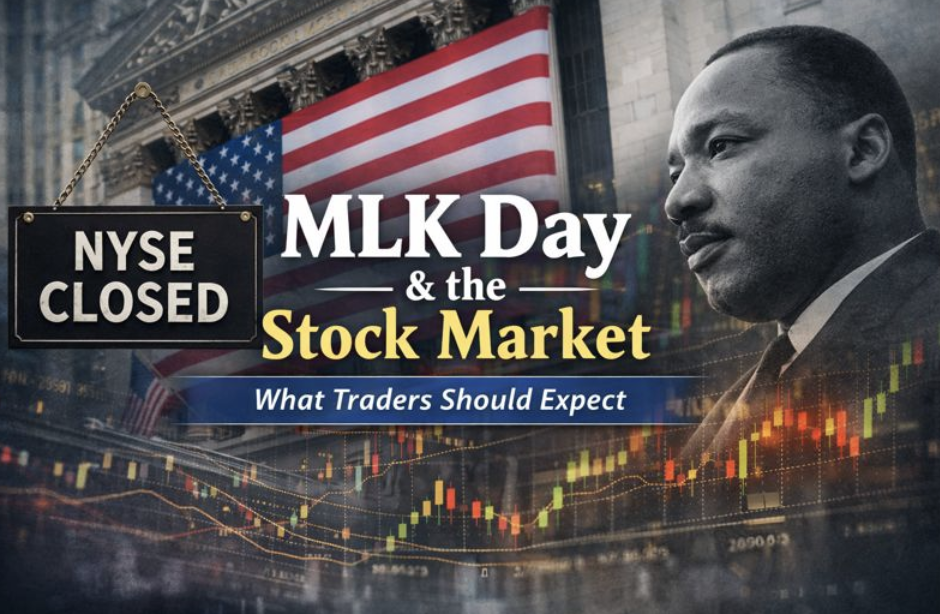
MLK Day became a federal holiday in 1986, but the NYSE and NASDAQ didn’t begin observing it until 1998. This market closure creates a three-day weekend that significantly impacts trading dynamics, particularly during the critical first month of the year, when new patterns emerge, and fresh capital flows into markets. The holiday’s timing matters. It falls during January when tax-loss harvesting reverses, institutions deploy new capital, and traders establish positions that often set the tone for Q1. Combined with the reduced trading days, MLK weekend creates unique opportunities and risks that prepared traders can navigate profitably.
Market Dynamics Around the Holiday
The Friday before MLK Day typically sees lighter volume as institutional investors reduce positions to minimize weekend exposure. Trading becomes muted, particularly in afternoon sessions, as portfolio managers close their books early. This creates a compressed four-day trading week, requiring adjustments to normal weekly strategies. When markets reopen on Tuesday, volume surges as traders react to developments during the closure. This often creates gap openings—stocks opening significantly higher or lower than Friday’s close. While U.S. markets sleep, European and Asian markets continue trading, and global events unfold without American participation in price discovery. Currency markets trade 24/7, and international news can move markets substantially while U.S. traders watch from the sidelines.
Strategic Considerations by Trading Style
Day traders face a complete break from the action. This forced pause offers valuable time to review recent performance and recalibrate strategies without the pressure of live markets demanding immediate decisions.
Swing traders confront critical decisions about holding positions through the extended weekend. The three-day closure increases gap risk—the possibility that news could cause significant price changes between Friday’s close and Tuesday’s open. Some traders close all positions before the holiday, preferring certainty over gap risk. Others maintain positions based on their original thesis, depending on risk tolerance and position size.
Options traders face an additional challenge: time decay continues even when markets are closed. Three days of theta decay occur with zero opportunity to adjust positions, potentially painful for those holding short-dated options if markets move adversely.
Long-term investors have a different opportunity—uninterrupted time for strategic thinking. The three-day weekend offers rare quiet time for portfolio reviews, rebalancing, and deep research, free from the noise of daily market fluctuations. It’s an ideal checkpoint for reviewing Q1 goals and refining strategies for the months ahead.
Risk Management Essentials
Position management decisions before MLK weekend rank among January’s most important risk choices. Position size matters critically—a 2% gap on an oversized position can devastate an account, while the same gap on a properly sized position remains manageable. Sector-specific risks require attention. Energy positions face geopolitical risk that could impact oil prices. Financial holdings might be vulnerable to regulatory announcements. Technology stocks could gap on product news. Understanding each sector’s specific risk factors informs smarter position management. Many traders adopt systematic rules: “reduce all positions to 50% before three-day weekends” or “close positions in stocks reporting earnings within three days of reopening.” These rules remove emotion and ensure consistent risk management
Smart traders approach the holiday with a structured checklist:

Before the Holiday:
- Review all open positions for comfort holding through closure.
- Reduce or close oversized or volatile positions.
- Set price and news alerts for all holdings
- Verify earnings schedules and options expiration dates.
- Check broker holiday schedules and margin requirements.
- Update watchlists for Tuesday reopening opportunities.
During the Holiday:
- Monitor international markets and futures to gauge sentiment.
- Stay informed on global developments affecting holdings.
- Use downtime for professional development, strategy review, or simply stepping away from screens.
Tuesday Preparation:
- Plan for heightened opening volatility
- Identify gap-and-go or gap-fill trading opportunities.
- Be ready for above-average volume in the opening hour.
Historical Patterns
While not perfectly predictable, certain tendencies emerge around MLK Day. Friday before the holiday averages 15-20% below normal volume. Tuesday typically features 25-30% higher opening volume than usual, with gap openings historically ranging from 0.3% to 0.8%.
The broader January effect—small caps’ tendency to outperform in January—intersects with MLK timing. Some research suggests the pre-holiday and post-holiday periods capture seasonal strength, though separating MLK effects from general January seasonality proves challenging. Past MLK weekends have occasionally seen geopolitical tensions escalate, corporate M&A announcements, or international market crises develop while U.S. markets remained closed. These events consistently demonstrate that extended closures create uncertainty, and uncertainty creates risk.
Beyond the Numbers
While tactical considerations dominate trader thinking, MLK Day offers something deeper: space for reflection and perspective. The three-day weekend naturally creates opportunities for professional development—such as taking courses, reading market history, or attending workshops. Many successful traders find these breaks more valuable than any single trade they might have made.
There’s significant value in simply stepping away from screens. The forced closure provides guilt-free permission to focus on family, health, and life beyond markets. This prevents burnout and maintains the mental clarity required for good trading.
Most importantly, the holiday commemorates Dr. King’s work for civil rights, equality, and justice. Taking time to reflect on these principles and how they apply to our lives—both in and out of markets—honors the holiday’s true purpose.
Looking Ahead
MLK Day represents both a tactical challenge and a strategic opportunity. The market closure creates real effects that demand attention: gap risk, volume shifts, and the potential for international developments to move markets while U.S. exchanges sleep. Traders who prepare for these effects position themselves advantageously. Yet the holiday also offers increasingly rare forced downtime for reflection, learning, and balance. The most successful traders understand that sustainable careers require both financial success and meaningful lives. MLK Day, with its combination of market closure and social significance, serves as an annual reminder of this broader perspective—one that honors both our trading aspirations and our collective well-being.