
Trump’s Tariff Timeline: The 7 Stocks That Will Explode (or Implode) in January 2026
Trump’s Tariff Timeline: The 7 Stocks That Will Explode (or Implode) in January 2026
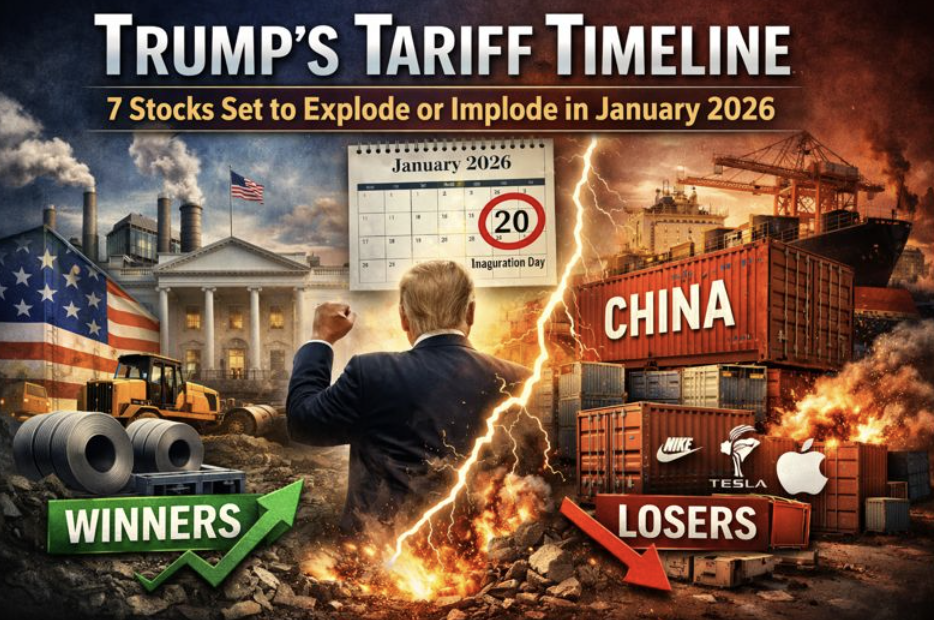
Donald Trump’s return to the White House on January 20, 2026, isn’t just a political event—it’s a market catalyst with trillions of dollars at stake. The tariff announcements are already rolling in: 100% levies on pharmaceutical imports, threatened 60% rates on Chinese goods, and 25% tariffs on automotive and semiconductor imports. While mainstream investors wait for “clarity,” the smart money is positioning now, before inauguration day chaos sends stocks flying in both directions.
History proves this Playbook works: when Trump took office in 2017, steel stocks surged 40% within weeks of his first tariff executive orders, while retailers dependent on Chinese imports cratered 30%. This time, the moves will be even bigger because companies can’t claim surprise—they’ve had months to prepare, and the implementation timeline is compressed. The seven stocks below are positioned for the most explosive moves—three set to soar on domestic manufacturing tailwinds, four poised to implode under Chinese supply chain exposure. The opportunity is clear: position before January 20 and capture the move, or wait for confirmation and chase.
The Tariff Landscape: What’s Already Announced
The current state of play as of December 2025 reveals a tariff framework already taking shape. Trump announced a 100% tariff on branded drugs unless companies are actively building U.S. manufacturing plants—a policy technically effective since October 1, but with enforcement ramping up dramatically post-inauguration. China faces threatened baseline tariffs of 60% or higher on imports, while the automotive sector braces for 25% levies on vehicles not manufactured in the USA. Steel and aluminum producers anticipate a revival of Section 232 tariffs mirroring Trump’s first-term protections.
The Timeline That Matters:
- January 20: Executive orders signed, pharmaceutical tariff enforcement intensifies, China tariff investigation launches
- January 21-31: Agency guidance and implementation details released
- February-March: Company earnings calls reveal real impact
- April 15: Tax day coinciding with Q1 earnings—reality hits hard
The Winners: 3 Stocks That Will Explode
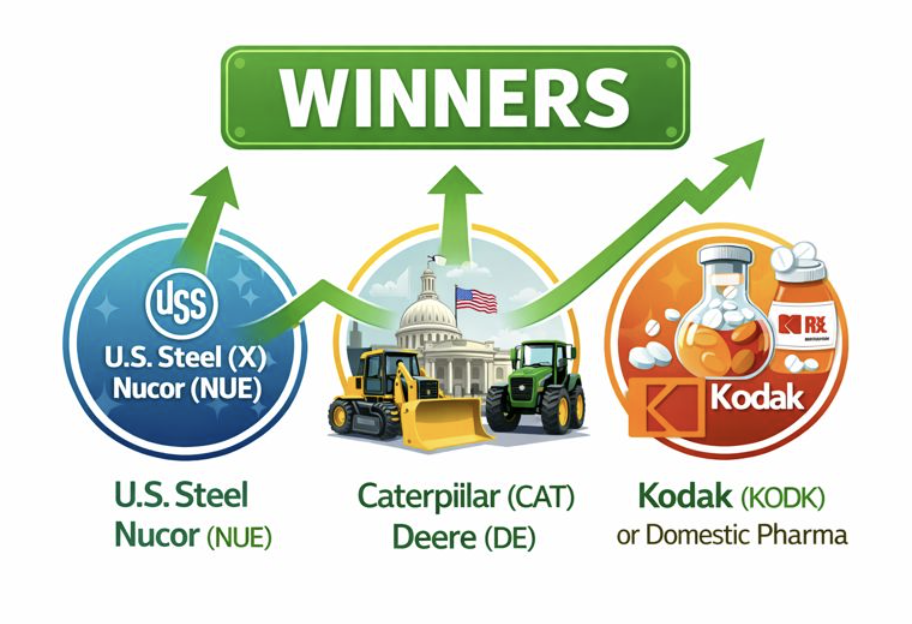
U.S. Steel (X) or Nucor (NUE)
Steel producers represent the most direct beneficiaries of Trump’s tariff agenda, with 25% levies on steel imports expected within days of inauguration. Steel stocks surged by more than 40% following the 2018 Section 232 tariffs, as domestic producers gained pricing power after foreign competition was eliminated. Domestic steel capacity cannot meet current demand, creating sustained pricing power, while Trump’s promised $1 trillion infrastructure spending ensures multi-year demand visibility. Upside targets of 30-50% in Q1 2026 are conservative based on 2018 precedent.
Caterpillar (CAT) or Deere (DE)
Heavy equipment manufacturers with domestic production footprints stand to dominate as Trump’s $1 trillion+ infrastructure plan materializes and foreign competitors face prohibitive tariff barriers. Companies like Caterpillar and Deere operate manufacturing plants across the United States, qualifying them for “Buy American” federal contract preferences. At the same time, tariffs price out foreign equipment rivals such as Komatsu and Hitachi. Current stock prices reflect some optimism but haven’t fully reflected the dual catalysts of the infrastructure bill details (expected in February 2026) and the competitive advantage gained as Chinese and Japanese manufacturers face 25-60% tariff headwinds. Upside targets of 25-40% over six months are achievable, with the critical nuance that these remain quality industrial companies regardless of tariff impact.
Kodak (KODK) or Small-Cap Pharma Manufacturers
The 100% pharmaceutical tariff creates a captive domestic market for US-based drug ingredient manufacturers, positioning Kodak’s pharmaceutical pivot as a generational opportunity. The setup carries a higher risk but potentially explosive reward—3x to 5x returns are possible if Kodak’s pharmaceutical segment scales successfully, with upside targets exceeding 100% if quarterly earnings demonstrate accelerating pharma revenue.
The Losers: 4 Stocks That Will Implode
Nike (NKE) or Other Apparel Retailers
Nike exemplifies the problem: over 60% of production is concentrated in China and Vietnam, meaning 25-60% tariff rates translate directly into unsustainable cost increases that cannot be passed on to price-sensitive consumers. No quick pivot to domestic manufacturing exists (reshoring takes 2-3 years minimum), leaving these companies trapped between margin compression and demand destruction. Nike is already down year-to-date, with more pain inevitable as tariff implementation combines with Q1 guidance cuts to drive another 30-40% decline from current levels.
Dollar Tree (DLTR) or Dollar General (DG)
Dollar stores represent the purest short opportunity because their entire business model—selling cheap Chinese imports to price-sensitive consumers—becomes economically impossible under Trump’s tariff regime. With 70-80% of inventory sourced from China, these retailers cannot raise prices without destroying their value proposition, and they cannot source products elsewhere at comparable costs. Already struggling with margin pressure, tariffs trigger inventory write-downs and catastrophic margin compression. Downside targets of 40-50% are not hyperbole but mathematical inevitability once tariffs take effect.
Tesla (TSLA)
Tesla presents the most controversial short on this list, with Elon Musk’s close relationship to Trump creating uncertainty around potential exemptions—but the fundamental exposure remains severe. Tesla produces significant volume in China for the U.S. market, incorporates Chinese parts into U.S.-Assembled vehicles, and faces 25% auto tariffs that would devastate the profitability margins of the Model 3 and Model Y. Musk may negotiate special exemptions (though precedent suggests this is unlikely), but even partial exemptions hurt Tesla as domestic competitors receive complete tariff protection.
Apple (AAPL)
Most iPhones are assembled in China, meaning a 60% tariff would add over $600 to iPhone costs—an increase that would either destroy margins or kill demand. Chinese retaliation would likely target Apple’s 18% revenue exposure in the Chinese market through consumer boycotts or regulatory obstacles. While Apple has begun scaling India manufacturing operations, the timeline spans years, not quarters, leaving the company exposed throughout 2026. The setup suggests a best-case scenario of flat performance for the year, with a worst-case downside of 20%.
How to Position Your Portfolio NOW
Bulls: Allocate 30-40% to domestic manufacturers, infrastructure plays, and steel producers. Scale in over the next three weeks. Position sizing should favor obvious plays, such as steel stocks, with larger allocations, while speculative pharma pivots warrant smaller exposure. Set stop losses at 15% below entry points.
Bears: Allocate 20-30% of portfolio value to short positions, entering now and adding after any relief rallies. Take profits on 50% of short positions after the initial 20% decline, then let the remainder run. Use put options instead of direct short positions to limit unlimited downside risk.
Hedged Traders: Pair long positions in domestic winners with short positions in import-dependent losers—for example, going long Nucor (NUE) while shorting Dollar Tree (DLTR) creates pure tariff exposure without market beta.
Scanner Strategies: Finding Hidden Tariff Plays
Domestic Manufacturing Beneficiaries: Filter for companies headquartered in the USA that generate over 70% of revenue from North America, have positive cash flow, and have share prices under $50—then scan for recent volume upticks signaling institutional positioning.
China Exposure Risks: Filter for companies with greater than 30% revenue from China or over 50% supply chain dependence, combined with negative cash flow and high P/E ratios—watch particularly for insider selling.
Tariff Volatility Plays: Target stocks mentioned in tariff-related news over the last 30 days, filtering for options volume exceeding twice the average and implied volatility above 50%. Set up real-time Trade Ideas alerts for any mentions of “Trump,” “tariff,” or “China”—breaking news triggers immediate stock movements, and traders who act within minutes capture the most profitable initial reactions.

Your 32-Day Playbook
January 20, 2026, is the most critical trading day of Q1. The ultimate strategy requires immediate action: start positioning this week to secure better entry prices, finalize positions during the first week of January, manage extreme volatility between January 20-31 by taking profits on outsized moves, and from February onward hold winners while ruthlessly cutting losers.
However, the contrarian risk looms large—Trump may announce aggressive tariffs only to negotiate them down later, mirroring the 2019 China trade deal. If this scenario unfolds, tariff winners will surrender 50% of their gains while losers rally hard on relief. Hedge this risk by avoiding all-in positions, taking profits quickly on initial 20-30% moves, and maintaining 40% cash reserves. Tariffs represent the most telegraphed market catalyst of 2026, traders positioning now will capture the move; those waiting for confirmation will chase. Use Trade Ideas to scan for tariff winners and losers in real-time, with AI-powered alerts catching breaking tariff news and immediate stock reactions—giving you the edge to act before the crowd and profit from the chaos.