







 GTTOP
▼ Bearish
Streaming Alert (Scanner)
Triangle Top Alert (GTTOP)
By Daniel Mirkin, CEO, Trade Ideas. Updated October 2026.
Find stocks forming a triangle top pattern in real time with Trade Ideas Streaming Alerts (Scanner). A triangle top pattern is when a stock has formed a triangle (lower highs and higher lows) whose first move was down. Trade Ideas reports it after at least 5 turning points.
Know when the pattern finishes.
Free account, just an email. No card. Live access for a limited time.
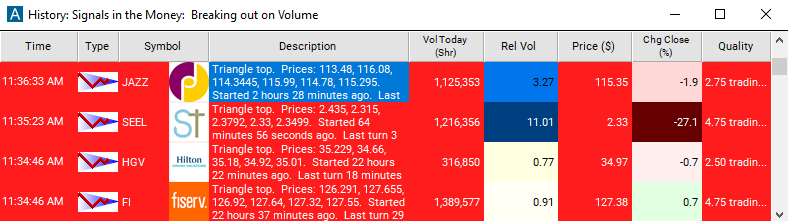
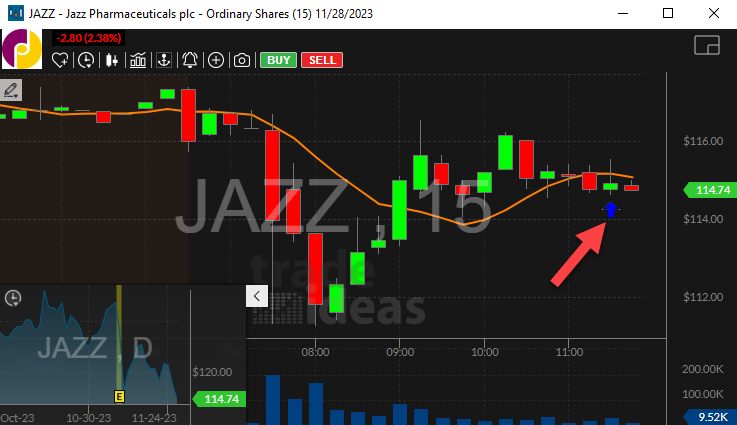
Streaming Alerts show a triangle top the moment it completes, not on the next refresh.
How Trade Ideas finds it: by default, the 'Triangle Top' alert will appear when there is a series of at least 5 consecutive higher lows and lower highs. See Trade Ideas plans and pricing to run it live.
What is a triangle top?
A triangle is a stock trading in a tighter and tighter range. Each high is lower than the one before, and each low is higher. Draw lines across the highs and lows and they come together like a triangle on its side.
Key point
Trade Ideas calls it a triangle top when the pattern starts at a high and the first leg goes down. The name is about how it started, not which way it will break. A triangle can break either way.
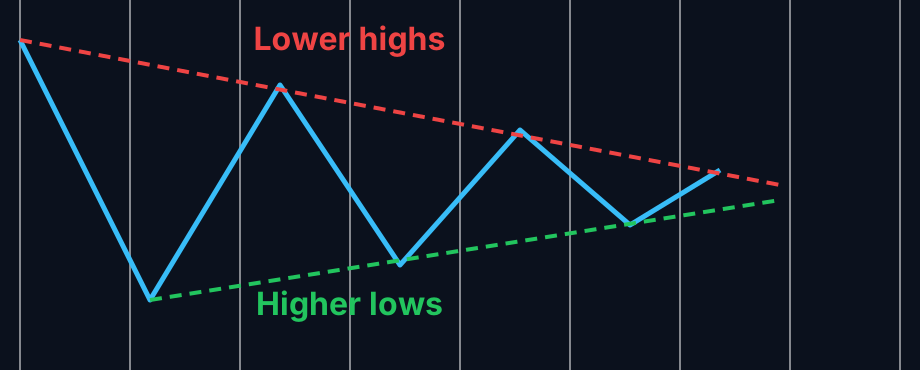
Parts of a triangle top
Lower highs
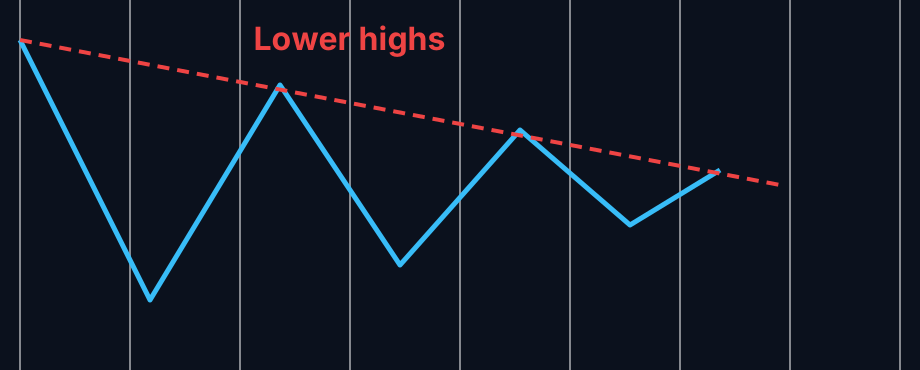
Each rally stops a little lower than the last. Sellers are showing up sooner.
Higher lows
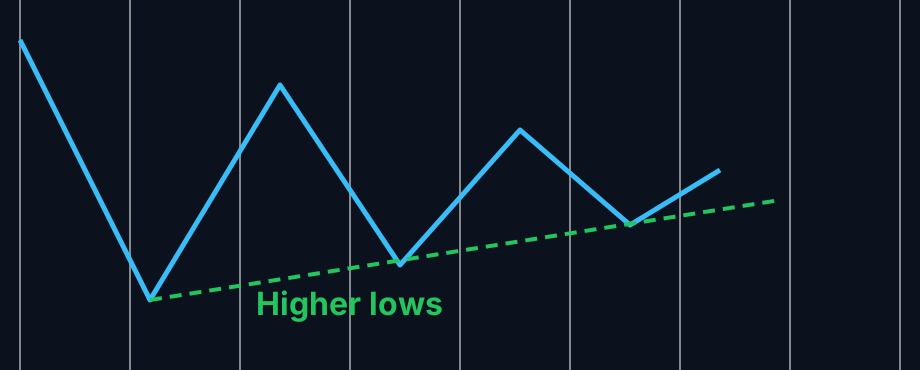
Each dip ends a little higher. Buyers are stepping in sooner too.
Squeeze toward the point
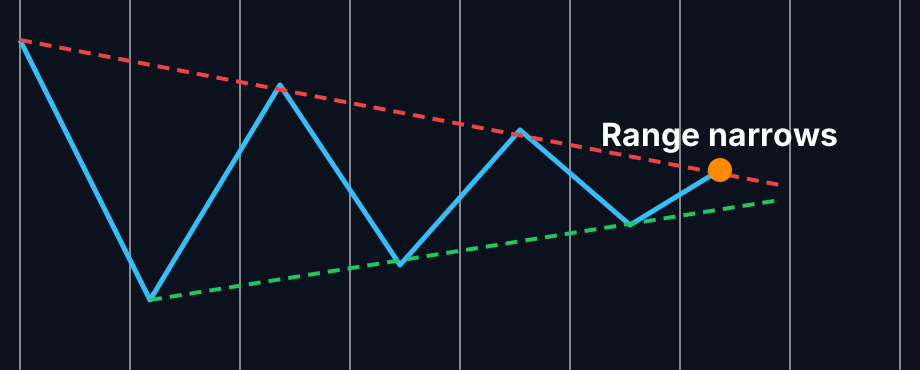
The range keeps shrinking. Trade Ideas needs at least five turning points in this pattern before it reports it.
How traders use it
Step 1: Let the Trade Ideas alert find it
Key point
Turn on the Triangle Top alert (GTTOP), and the Triangle Bottom alert (GTBOT) if you want both starts. Trade Ideas counts the highs and lows for you and sends the stock once five line up. See it live in the Web Dashboard.
Step 2: Wait for the trigger
Since a triangle can break either way, most traders wait for price to close outside one of the two lines.
Step 3: Entry
Traders usually go with the break: long above the upper line, short below the lower line.
Step 4: Exit
Trader tip
A common stop sits just inside the triangle on the other side of the break. Some use the height of the widest part of the triangle as a rough target. This is how traders often think about it, not advice.
Tips
- Volume tends to dry up inside a triangle. A pickup on the break helps.
- Breaks near the very tip of the triangle are often weaker.
- Do not guess the direction from the name. Top and bottom only describe the first swing.
- Pair it with a filter on average volume to skip thin stocks.
Key point
Past results, including backtests, are not indicative of future results.
How the Triangle Top alert works
Key point
This alert reports standard triangle patterns, which are common in technical analysis. A triangle pattern describes a stock price which keeps moving but covers smaller and smaller price ranges over time. A triangle is defined as a series of lower highs and higher lows. It takes at least 5 consecutive highs and lows in this pattern before we report it.
We use the term "triangle top" because it is so common in the literature. While triangles are important patterns, it is hard to say for certain if the price will go up or down after a triangle. We call a triangle a "top" and color it red if the first point is at the top, and the first line is going down. For the most common case, when the pattern contains exactly 5 turning points, a triangle top will end by going down.
Key point
After seeing a triangle pattern with 5 turning points, we might see more lower highs and higher lows. These points make the triangle pattern stronger and more distinct. Each one of these points means that the stock price changed direction. In these cases, we continue to use the first point, not the last point, to choose a name and icon for the pattern. We use the initial because point because the initial trend is the largest and the strongest trend in the triangle. The last point shows the smallest and the weakest trend.
Default settings
By default, the 'Triangle Top' alert will appear when there is a series of at least 5 consecutive higher lows and lower highs. It is determined a triangle top when the initial move is downward with the final move going down. The pattern is complete when the price breaks through its support level.
Custom settings
Settings
For 'Triangle Top' alerts, you have the option to use an alert specific filter. This filter is located immediately to the right of the corresponding alert and is always optional. You can decide to leave it blank if you want to receive more alerts, or you can fill it in to restrict the number of alerts you receive. This filter allows you to specify the quality of the alert. When you set a higher number for this filter, you are telling the alerts server to display only alerts that meet a higher quality standard, resulting in fewer alerts being shown.
When setting an alert for 'Triangle Top', the user can filter the alert by hours traded.
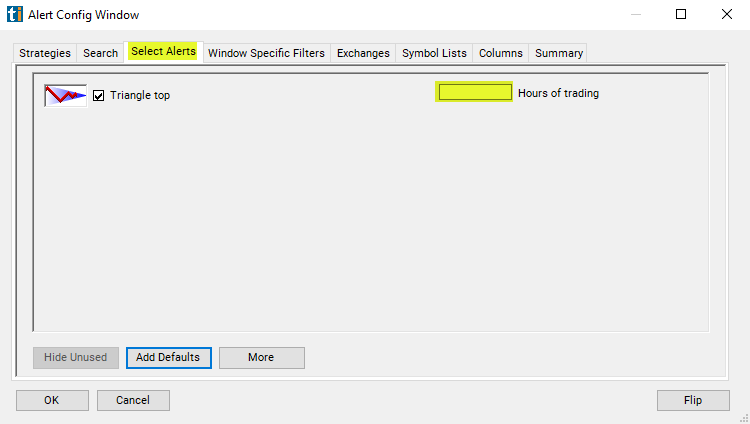
Normally there are 6.5 hours between the open and the close. But, what about premarket and post market?
Key point
If I see a pattern that lasted from noon yesterday to noon today, is that any better than a pattern that lasted from the open this morning to the close this afternoon? How much better? We weight the pre and post market according to volume. On an average day an average NASDAQ 100 stock will trade roughly 1 hour's worth of volume between the close and the following open. If you want to see stock patterns that lasted for a whole day, a good estimate is 7.5 hours, 6.5 for normal hours plus 1 for the pre and post market.
The same rules apply during the day. If a chart pattern lasts for one hour starting from the open, it will almost always be considered a stronger pattern than if it lasted one hour starting from the beginning of lunch. Hours are just an estimate. Volume is the major factor in this filter. Stocks trading on higher than average volume will satisfy this filter faster than stocks trading on lower than average volume.
What the alert shows you
Key point
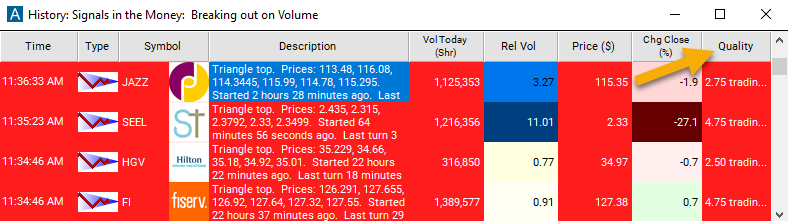
The description of each alert lists the prices that formed the pattern. It also includes the times of when the pattern started and ended.
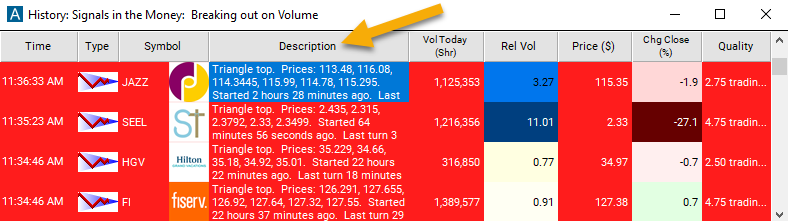
The quality value on a scan using the 'Triangle Top' alert defines the number of hours since the measured pattern has been established.
Related alerts
Filters to pair with the Triangle Top alert
Categories
FAQ
Which stocks are forming a triangle top pattern right now?
Turn on the Triangle Top alert (GTTOP) in Trade Ideas Streaming Alerts. By default, the 'Triangle Top' alert will appear when there is a series of at least 5 consecutive higher lows and lower highs.
What is the Triangle Top alert?
A triangle top pattern is when a stock has formed a triangle (lower highs and higher lows) whose first move was down. Trade Ideas reports it after at least 5 turning points.
How do I see fewer, higher-quality Triangle Top alerts?
Use the optional alert-specific filter immediately to the right of the alert. A higher number tells the alerts server to show only higher-quality alerts, so fewer appear. Leave it blank to see more.
What is the opposite of the Triangle Top alert?
Is a triangle top bearish?
Not by itself. Trade Ideas names it a top because the first point was at the top. Traders wait for the break to know the direction.
How many touches does a triangle need?
Trade Ideas requires at least five consecutive highs and lows in the pattern before it reports it.
What is the difference between a triangle and a rectangle?
In a triangle the highs keep falling and the lows keep rising. In a rectangle the highs and lows stay at about the same prices.
What is a symmetrical triangle?
It is the kind of triangle this alert finds: lower highs and higher lows coming together.