







 GRBOT
▲ Bullish
Streaming Alert (Scanner)
Rectangle Bottom Alert (GRBOT)
By Daniel Mirkin, CEO, Trade Ideas. Updated October 2026.
Find stocks forming a rectangle bottom pattern in real time with Trade Ideas Streaming Alerts (Scanner). A rectangle bottom pattern is when a stock has formed a rectangle of roughly equal highs and equal lows, with the last turning point a low. Trade Ideas reports it after at least 5 turning points.
Know when the pattern finishes.
Free account, just an email. No card. Live access for a limited time.
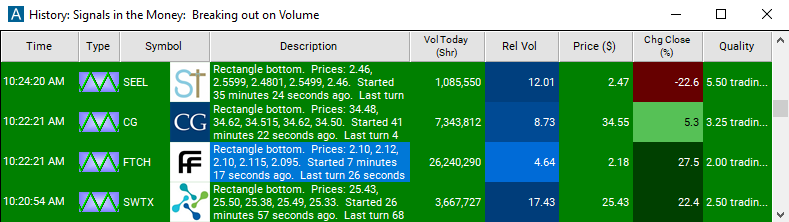
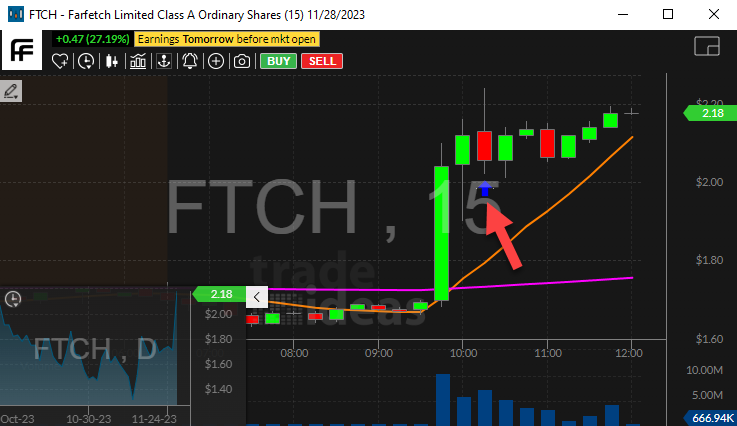
Streaming Alerts show a rectangle bottom the moment it completes, not on the next refresh.
How Trade Ideas finds it: by default, the 'Rectangle Bottom' alert will appear when there is a series of at least 5 consecutive highs and lows that are ending at approximately the same price as the other highs and lows. See Trade Ideas plans and pricing to run it live.
What is a rectangle bottom?
A rectangle bottom is a sideways range where the stock just bounced off the floor. Highs sit at one price, lows sit at another, and the most recent turn was a low.
Trade Ideas shows it in green because the latest swing is pointing up, toward the top of the box.
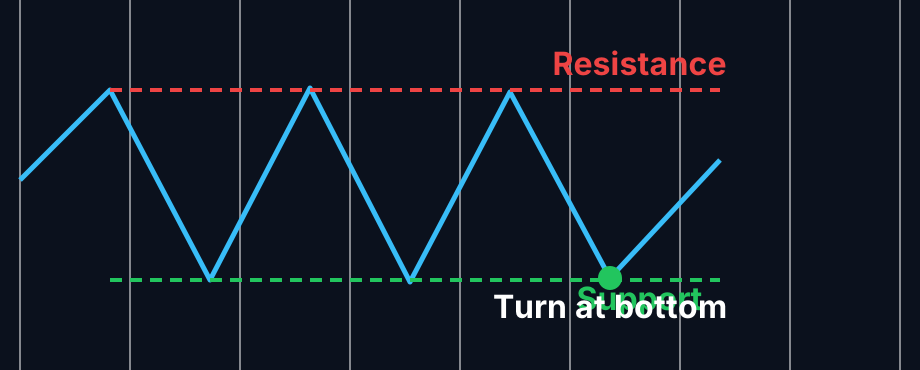
Parts of a rectangle bottom
Floor of the range
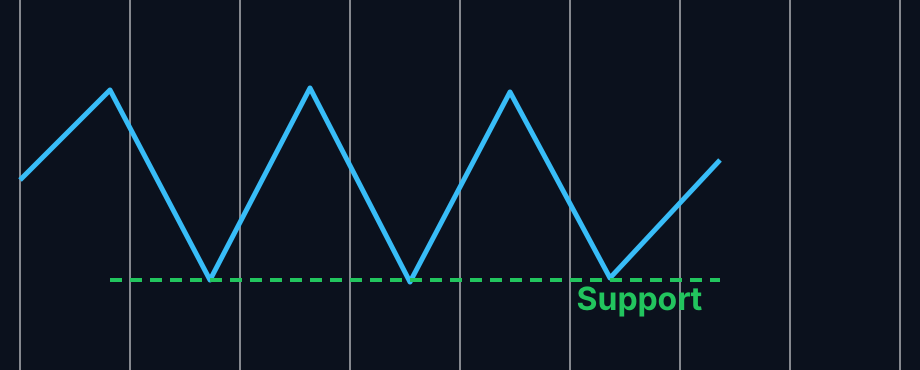
Buyers keep stepping in at about the same price.
Top of the range
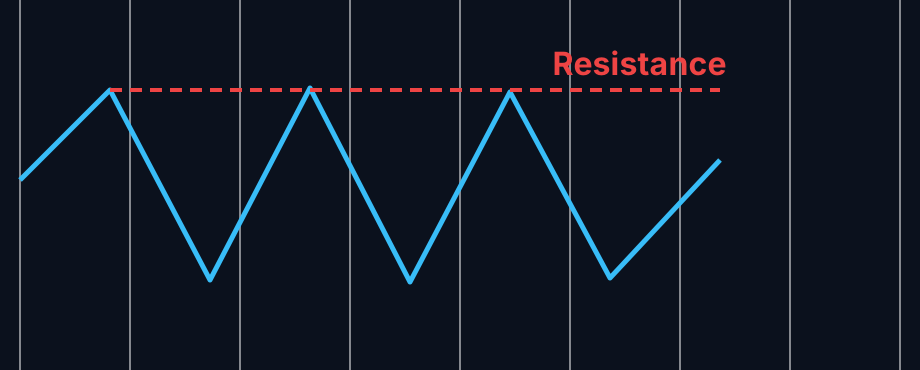
Sellers keep showing up at about the same price on the way up.
Bounce off the floor
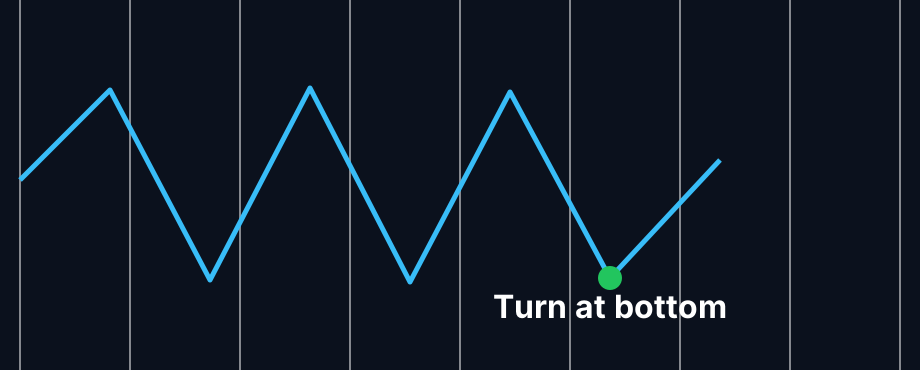
After five or more highs and lows, price turns up from support and the alert fires.
How traders use it
Step 1: Let the Trade Ideas alert find it
Turn on the Rectangle Bottom alert (GRBOT) to get stocks bouncing off the bottom of a flat range. See it live in the Web Dashboard.
Step 2: Wait for the trigger
Trader tip
Decide your style first. A range trader acts on the bounce. A breakout trader waits for price to clear the top of the box.
Step 3: Entry
Range traders often buy near the floor and look to the ceiling as the exit. Breakout traders buy a close above resistance.
Step 4: Exit
A stop just under the floor is common for a range trade. After a breakout, many put it back inside the range. These are typical habits, not advice.
Tips
- Count how many times the floor has held. Many traders trust a level more after several tests.
- Watch for a quick drop through support. That turns a bounce idea into a breakdown.
- Ranges in low-volume stocks can be choppy. Use a volume filter.
- Pair it with Rectangle Top (GRTOP) to see both ends of the range.
Past results, including backtests, are not indicative of future results.
How the Rectangle Bottom alert works
Key point
A rectangle is another standard technical analysis pattern. A rectangle is defined by a series of highs and lows where each high is at approximately the same price as the other highs, and each low is at approximately the same price as the other lows. We report a rectangle pattern after seeing at least 5 consecutive highs and lows.
Key point
If the last turning point was a low, we call the pattern a rectangle bottom, and we draw a green icon to show that the price is going up. Each time we add another point to the rectangle, the direction changes.
Rectangles are similar to consolidation patterns, because they both show a stock trading in a channel. However, we use completely different algorithms to build the two types of channels. The consolidation algorithm depends heavily on the volatility of the stock, comparing the amount that the stock price moved recently to the amount that we would expect it to move.
Key point
A consolidation pattern can become stronger if the price just stays inside the channel. A rectangle pattern depends more on the specific prices near the edges of the pattern. The only way to confirm a rectangle pattern is for the price to move up and down through the entire range of the rectangle. A rectangle might not be a consolidation pattern if the rectangle is too tall.
A consolidation might not be a rectangle if the top and bottom edges are not precise enough.
We use the channels from our consolidation algorithm to create channel breakout alerts. This algorithm is good at finding a specific interesting price level. Our rectangle algorithm is best at exactly the opposite. The rectangle alert tells you that the channel has been confirmed, and the price is moving back inside the channel.
Default settings
Settings
By default, the 'Rectangle Bottom' alert will appear when there is a series of at least 5 consecutive highs and lows that are ending at approximately the same price as the other highs and lows. It is reported as a 'Rectangle Bottom' if the last turning point is a low.
Custom settings
Settings
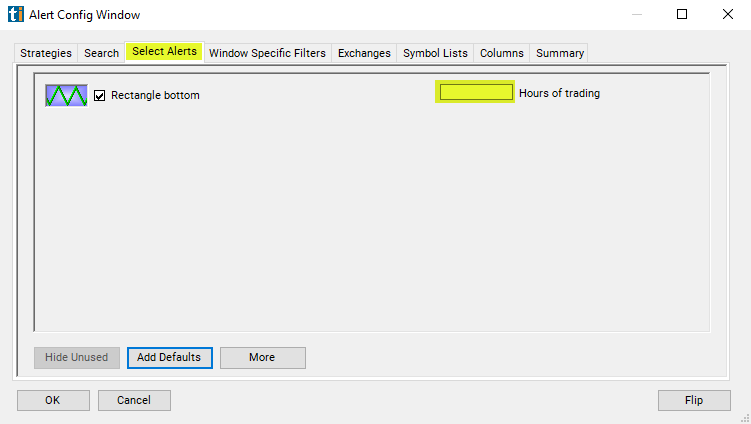
For 'Rectangle Bottom' alerts, you have the option to use an alert specific filter. This filter is located immediately to the right of the corresponding alert and is always optional. You can decide to leave it blank if you want to receive more alerts, or you can fill it in to restrict the number of alerts you receive. This filter allows you to specify the quality of the alert. When you set a higher number for this filter, you are telling the alerts server to display only alerts that meet a higher quality standard, resulting in fewer alerts being shown.
When setting an alert for 'Rectangle Bottom', the user can filter the alert by hours traded.
Key point
If I see a pattern that lasted from noon yesterday to noon today, is that any better than a pattern that lasted from the open this morning to the close this afternoon? How much better? We weight the pre and post market according to volume. On an average day an average NASDAQ 100 stock will trade roughly 1 hour's worth of volume between the close and the following open. If you want to see stock patterns that lasted for a whole day, a good estimate is 7.5 hours, 6.5 for normal hours plus 1 for the pre and post market.
The same rules apply during the day. If a chart pattern lasts for one hour starting from the open, it will almost always be considered a stronger pattern than if it lasted one hour starting from the beginning of lunch. Hours are just an estimate. Volume is the major factor in this filter. Stocks trading on higher than average volume will satisfy this filter faster than stocks trading on lower than average volume.
What the alert shows you
Key point
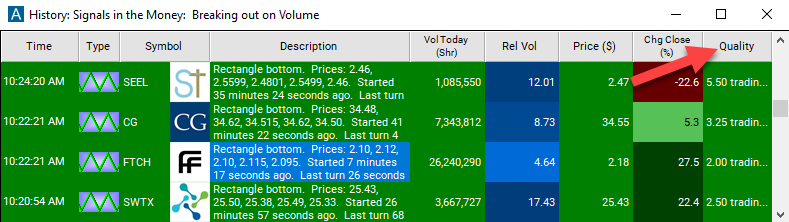
The description of each alert lists the prices that formed the pattern. It also includes the times of when the pattern started and ended.
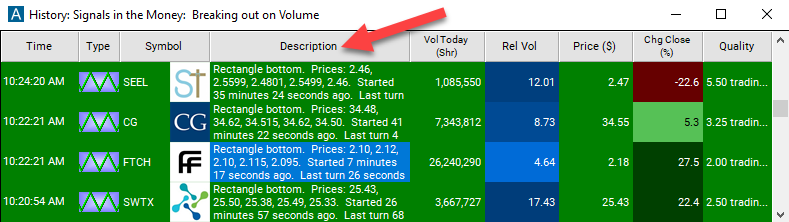
The quality value on a scan using the 'Rectangle Bottom' alert defines the number of hours since the measured pattern has been established.
Related alerts
Filters to pair with the Rectangle Bottom alert
Categories
FAQ
Which stocks are forming a rectangle bottom pattern right now?
Turn on the Rectangle Bottom alert (GRBOT) in Trade Ideas Streaming Alerts. By default, the 'Rectangle Bottom' alert will appear when there is a series of at least 5 consecutive highs and lows that are ending at approximately the same price as the other highs and lows.
What is the Rectangle Bottom alert?
A rectangle bottom pattern is when a stock has formed a rectangle of roughly equal highs and equal lows, with the last turning point a low. Trade Ideas reports it after at least 5 turning points.
How do I see fewer, higher-quality Rectangle Bottom alerts?
Use the optional alert-specific filter immediately to the right of the alert. A higher number tells the alerts server to show only higher-quality alerts, so fewer appear. Leave it blank to see more.
What is the opposite of the Rectangle Bottom alert?
What is a rectangle bottom pattern?
It is a flat trading range where the stock just turned up off the bottom.
Is a rectangle bottom bullish?
The latest swing is up, so it leans that way inside the range. A break below the floor would change that.
Why does the alert switch between top and bottom?
Each new turn in the range flips the direction, so the same box can trigger both alerts over time.
Can I use rectangle alerts for range trading?
Yes. They tell you when price turns at the edge of a range, which is what range traders watch for.